What an idiot I am! Today while mowing the lawn, I saw a clump of weeds along the chain link fence that I just had to trim. So I ran the mower over them; and in the process, chewed up the feedlines to both my G5RV and the Butternut vertical! Talk about wanting to kick yourself in the behind!
Fortunately, all was not lost. I took the coax to my 2 Meter antenna, which I never use and hooked it up to the feedline leading to the Butternut. I cut the Butternut feedline above the mower damage and installed a PL-259. Then I used a barrel connector to attach it to the 2 Meter line. Done! I switched the coax from the VHF radio to the HF radio and it worked just fine.
For the G5RV, I used the piece of coax that was feeding the Butternut last year. I was having trouble with that coax and found the problem area. I cut away the bad part and the balance was just sitting, coiled up and tied to the fence. I put a PL-259 on that and pressed it into service. Voila! It works! It's mini RG-8X and will serve until I can afford some RG9913 or LM283 or something like that.
For safety, I took the coax and tie-wrapped it along the top of the chain link fence. Now it's no longer at ground level and this unfortunate incident should never happen again! I knew I was going to have a busy day with mowing the lawn and repairing the grill. The day got much busier than I had intended!
73 de Larry W2LJ

Saturday, April 29, 2006


Friday, April 28, 2006
Makes a body feel good!
I had an excellent QSO last night with Dave KK4PQ from down in Albany, GA. 20 Meters was open nicely last night; and Dave answered a CQ that I put out. Dave was using a Yaesu FT-817ND at 5 Watts to a Vee beam. He had a killer signal into New Jersey; of course, until the band changed and killed us both. But it gets better than that! This was Dave's first CW QSO in about 10 years; and I was to have the honor of being the lucky op to work him!
He apologized for his fist, complaining that he was rusty. There was nothing to apologize for! And if Dave was rusty last night, I'd hate to have to work him when he's at top form. I'd probably get blown away! His fist was truly excellent and a joy to copy. If you ever hear KK4PQ calling CQ on the bands- rush right on over to work him. You're in for a treat!
73 de Larry W2LJ
He apologized for his fist, complaining that he was rusty. There was nothing to apologize for! And if Dave was rusty last night, I'd hate to have to work him when he's at top form. I'd probably get blown away! His fist was truly excellent and a joy to copy. If you ever hear KK4PQ calling CQ on the bands- rush right on over to work him. You're in for a treat!
73 de Larry W2LJ
Thursday, April 27, 2006
It Don't Get Any Better
Sunny and 72 degrees during lunchtime. Set up the K1 and the 20 Meter Hamstick on the Explorer. Had a really nice QSO with Jim W9KRH down in Weeki Wachee, FL while munching on a ham & cheese sandwich. What a way to spend lunch .... warm weather, sunny skies, good food and a good conversation.
I remember being in Weeki Wachee about 37 or so years ago, on vacation with my family. I remember going to see the mermaid show at the Spring. Jim says it's still going on, although he hasn't gone in years. He lives about three miles from the Spring. A quick Google search showed that the attraction is bigger than when I was a kid!
http://www.weekiwachee.com/
Jim was a solid 589 and he gave me a 579. Not bad considering there was an M Class solar flare earlier this morning. The effects must have passed; as I heard a decent number of signals on 20 Meters.
73 de Larry W2LJ
I remember being in Weeki Wachee about 37 or so years ago, on vacation with my family. I remember going to see the mermaid show at the Spring. Jim says it's still going on, although he hasn't gone in years. He lives about three miles from the Spring. A quick Google search showed that the attraction is bigger than when I was a kid!
http://www.weekiwachee.com/
Jim was a solid 589 and he gave me a 579. Not bad considering there was an M Class solar flare earlier this morning. The effects must have passed; as I heard a decent number of signals on 20 Meters.
73 de Larry W2LJ
Jumping bands!
I was able to get on the air for just a lil' bit last night. The Mets game went into extra innings and I had to see the end. Yes, my number one outside-of-Ham-radio preoccupation is baseball in general; and the New York Mets in particular. In fact, this summer marks the 39th anniversary since I went to my first ball game at Shea Stadium. I remember it like it was yesterday! My dad took me on his day off and we saw a weekday double header against the Houston Astros. Rookie phenom, Tom Seaver, pitched one of the two games. I was hooked for life!
Anyway, I digress. When I finally did get the K2 fired up, I was treated to the sounds of many European and other DX stations on 30 and 40 Meters. With much difficulty, I worked IK2DOT on 30 Meters. I was pretty tough to hear with my 5 Watts signal. Originally, Carlo gave me a 119 report and was ready to QRT with me. That's when I realized I was on the G5RV. For whatever reason that is beyond my puny amount of antenna knowledge, the G5RV just does not play well on 30 Meters. I quickly switched on over to the Butternut HF9V vertical; and my signal must have literally jumped up! Carlo related to me that he had a good copy on me after that. We exchanged the standard pleasantries and then we signed.
As nice as it was to get that one in the log; I wish that DX stations would ragchew more. When my QRP signal makes it overseas with some decent strength; it would be nice to learn a little bit more about the op I'm working other than "UR 599 TNX QSO DR OM". Frustrating!
73 de Larry W2LJ
Anyway, I digress. When I finally did get the K2 fired up, I was treated to the sounds of many European and other DX stations on 30 and 40 Meters. With much difficulty, I worked IK2DOT on 30 Meters. I was pretty tough to hear with my 5 Watts signal. Originally, Carlo gave me a 119 report and was ready to QRT with me. That's when I realized I was on the G5RV. For whatever reason that is beyond my puny amount of antenna knowledge, the G5RV just does not play well on 30 Meters. I quickly switched on over to the Butternut HF9V vertical; and my signal must have literally jumped up! Carlo related to me that he had a good copy on me after that. We exchanged the standard pleasantries and then we signed.
As nice as it was to get that one in the log; I wish that DX stations would ragchew more. When my QRP signal makes it overseas with some decent strength; it would be nice to learn a little bit more about the op I'm working other than "UR 599 TNX QSO DR OM". Frustrating!
73 de Larry W2LJ
Wednesday, April 26, 2006
Founder of FISTS becomes an SK
This appeared on the FISTS e-mail reflector yesterday. It was posted by Nancy WZ8C, the head of FISTS North America.
It is so difficult type "G3ZQS" and "Silent Key" in the same sentence. But I just heard from Geo's son that Geo became a Silent Key at 7, UK time. As I had written to you yesterday, Geo had a heart attack last Saturday and had been in and out of consciousness all week.
Geo's passing leaves a big hole in the Morse world, but he left us with the wonderful legacy of FISTS. He created FISTS to keep friendship, good operating practices and encouragement of newcomers foremost in people's minds "whilst" they are on the air. I know you join me in
re-committing to this FISTS philosophy and making FISTS even stronger, in remembrance of Geo's vision.
73 88
Nancy WZ8C
For those not familiar with the parlance, a Silent Key is a Ham who passes away. He cannot send code anymore, thus his key becomes silent. I never met George; or even had a QSO with him. But I have been a member of FISTS, his brain child, since 1993 or there abouts. I'm not really sure whether it was 1993 or 1994 when I joined. Nevertheless, I have enjoyed my time as a FISTS member; and that is a direct result of George's efforts. His influence will be missed; but the mission continues - to preserve, protect and defend the use of Morse Code in Amateur Radio worldwide.
73 de Larry W2LJ
It is so difficult type "G3ZQS" and "Silent Key" in the same sentence. But I just heard from Geo's son that Geo became a Silent Key at 7, UK time. As I had written to you yesterday, Geo had a heart attack last Saturday and had been in and out of consciousness all week.
Geo's passing leaves a big hole in the Morse world, but he left us with the wonderful legacy of FISTS. He created FISTS to keep friendship, good operating practices and encouragement of newcomers foremost in people's minds "whilst" they are on the air. I know you join me in
re-committing to this FISTS philosophy and making FISTS even stronger, in remembrance of Geo's vision.
73 88
Nancy WZ8C
For those not familiar with the parlance, a Silent Key is a Ham who passes away. He cannot send code anymore, thus his key becomes silent. I never met George; or even had a QSO with him. But I have been a member of FISTS, his brain child, since 1993 or there abouts. I'm not really sure whether it was 1993 or 1994 when I joined. Nevertheless, I have enjoyed my time as a FISTS member; and that is a direct result of George's efforts. His influence will be missed; but the mission continues - to preserve, protect and defend the use of Morse Code in Amateur Radio worldwide.
73 de Larry W2LJ
CW Geek
I was just reading my e-mail; and I saw a post to the SolidCopyCW group by my friend, Dan Romanchik KB6NU. In the signature line of his e-mails, he labels himself a "CW Geek". Cool, Dan! I think I'm going to have to start paying you a royalty fee for that!
Here's a link to Dan's blog; entitled appropriately enough - KB6NU's Ham Radio Blog . One of THE best Amateur Radio blogs on the Web, IMHO!
http://kb6nu.com/
73 de Larry W2LJ
Here's a link to Dan's blog; entitled appropriately enough - KB6NU's Ham Radio Blog . One of THE best Amateur Radio blogs on the Web, IMHO!
http://kb6nu.com/
73 de Larry W2LJ
Friday, April 21, 2006
The state of mind that is QRP
 I guess that most QRP operators (myself inlcuded, tend to forget that not everyone has the QRP "mindset". What is the QRP mindset, you may ask? Let me take a few minutes to try and explain why it is that we do what we do.
1) QRP operators love to use low power, that is 5 Watts or less when using CW or the digital modes and 10 Watts or less when using SSB. Some of us use it out of necessity. Some QRPers live in places where Amateur Radio antennas are not allowed. These folks use "stealth antennas' and use low power so they cannot be detected. The rest of us? We just love using low power for whatever reason! The challenge is to maintain RELIABLE and QUALITY communications with low power. Efficiency is our passion. Others of us love the idea of establishing radio communications using minimalist equipment; and then there is an entire branch of us that lives to take small radios and light, efficient antennas out to the great outdoors to operate while hiking, camping or just anywhere outdoors!
2) Please do not mistake QRP operating with weak signal operating! QRPers do their utmost to maintain and produce a clean, readable and reasonably loud signal. We understand in many cases that our signals may not be 599; but in the same vein, we're not sadists who live to torture the unsuspecting Ham with sub-par signals! However, in the event our signals ARE weak, you won't offend us if you choose not to work us. We realize that while our QRP sigs might not be loud to QTH "A"; they might very well knock the headphones off of Joe Ham at QTH "B"!
3) Which brings me to the next point. QRPers, outside of hardcore DXers, are probably the most familiar with ins and outs of RF propagation and the effect that the sun has on the ionosphere. We know our signals might not be the loudest; so we tend to learn as much about RF propagation conditions as we can so our signals "work smarter and not harder". If you'd like a real treat, I urge you to go to:
http://www.qrparci.org/content/view/57/55/This is an article about the ionosphere and how the sun affects it and radio communications. It is the best article in easy-to-understand-everyday-English that I have ever read on the subject.
4) QRPers do the best they can to learn the characteristics of their stations and antennas. QRPers take great pains to make sure that they squeeze every electron out of their antennas. If you spend any time on the various QRP e-mail reflectors, you will see more posts about antennas and receivers than just about anywhere else. And the experts abound! You can learn so much from these guys; and the giants of QRP are more than happy to share whatever they have learned over the years.
5) By their nature, QRPers tend to be builders, tinkerers, experimenters and tweakers. This is all done to maximize efficiency of equipment and antennas - to get, in essence, the biggest bang for the buck. The side benefit of this is that if you're having trouble with a piece of your station equipment or antenna; then go and find the nearest QRP enthusiast! If he or she can't help you themselves, they'll probably be able to point you in the right direction to clear up whatever problem you might be having.
6) Since QRPers are familiar with weak signal work, they tend to become first rate, top notch Amateur Radio operators. The best of the best can dig out signals from below the noise floor so well that you would swear they use ESP! In fact many QRPers tend to use just that term! Signals that are just barely audible are said to be at "ESP level"! Also, since the majority (but by no means all) of QRP operating tends to be using Morse Code, the best of these guys have the most outstanding fists! The Morse flies out of their fingers like music and their CW is an absolute joy to copy and listen to.
All the above being said, QRPers tend to be very enthusiastic about not only QRP; but about Amateur Radio in general. The majority have the "spirit of Amateur Radio' that was handed down to us by the great Hams that came before us. Our enthusiasm is infectious; and we hope we can relate that enthusiasm to the rest of the Ham population.
73 de Larry W2LJ
Still learning!
I've been using my reconditioned Vibroplex Original for about a month now. It's been a lot of fun to use and I've been enjoying the heck out of it; but something has been nagging me - something hasn't been quite "right".
I took the time out the other night, to look over things with a "fine toothed eye" as it were; and I found out what wasn't right. When you make a "dah" you push the paddle to the left. The "dah" contact is on a swing arm that should push away from the main part of the pendulum. There was such an amount of rust there; that the "dah" arm wasn't swinging away from the pendulum. I had to swing the entire pendulum to the left to make a "dah"; and that's not correct.
I took the pendulum off the base and squirted a ton of Liquid Wrench in there. It got it to the point where the "dah" contact arm did come loose; but it wasn't swinging freely like it should. It would swing out all right; but would "click" into place and required a lot of force to bring it back to normal. The "dah" tension spring should provide enough force on its own to do that under normal circumstances; and there was no way ANY spring would provide enough return force as things were.
I decided that I was going to order a new trunion pin from Vibroplex. I would take the old one out and seperate the "dah" arm from the main pendulum, clean it all up, and install a new trunion. In the process of beginning to tap the trunion out, I must have dislodged whatever rust or foreign matter was there. The "dah" arm was now flopping around freely; just as it should. I carefully tapped the trunion pin back to the correct location; but in the process of hammering, I flattened out the pivot points! Thank God for Dremel tools! I grinded the ends of the trunion pin to finer points and reinstalled everything where it belonged. The Bug is working 100% precent properly now. The code is coming off much smoother, less herky-jerky; and sounds much better now. I was always wondering why I couldn't transition from "dahs" to "dits" more smoothly - now I know!
The restoration is now complete; and I've learned a thing or two or three in the process. How cool is that?
73 de Larry W2LJ
I took the time out the other night, to look over things with a "fine toothed eye" as it were; and I found out what wasn't right. When you make a "dah" you push the paddle to the left. The "dah" contact is on a swing arm that should push away from the main part of the pendulum. There was such an amount of rust there; that the "dah" arm wasn't swinging away from the pendulum. I had to swing the entire pendulum to the left to make a "dah"; and that's not correct.
I took the pendulum off the base and squirted a ton of Liquid Wrench in there. It got it to the point where the "dah" contact arm did come loose; but it wasn't swinging freely like it should. It would swing out all right; but would "click" into place and required a lot of force to bring it back to normal. The "dah" tension spring should provide enough force on its own to do that under normal circumstances; and there was no way ANY spring would provide enough return force as things were.
I decided that I was going to order a new trunion pin from Vibroplex. I would take the old one out and seperate the "dah" arm from the main pendulum, clean it all up, and install a new trunion. In the process of beginning to tap the trunion out, I must have dislodged whatever rust or foreign matter was there. The "dah" arm was now flopping around freely; just as it should. I carefully tapped the trunion pin back to the correct location; but in the process of hammering, I flattened out the pivot points! Thank God for Dremel tools! I grinded the ends of the trunion pin to finer points and reinstalled everything where it belonged. The Bug is working 100% precent properly now. The code is coming off much smoother, less herky-jerky; and sounds much better now. I was always wondering why I couldn't transition from "dahs" to "dits" more smoothly - now I know!
The restoration is now complete; and I've learned a thing or two or three in the process. How cool is that?
73 de Larry W2LJ
Thursday, April 20, 2006
Success!
 Today it reached about 75 degrees during luchtime; so I went outside and fired up the K1 at the back of my Ford Explorer. This time I had success!
I called CQ and was answered by John VE7CBU in Vancouver, British Columbia. Not bad for 5 Watts to a Hamstick mounted on top of an SUV!
I gave John a 589 and he gave me a 539. Then he proceeded to turn his power down to 5 Watts. Guess he wanted to give me a taste of my own medicine!
I had solid copy on him; which was rough on my part, but I managed. Unfortunately, I was not in the confines of my nice quiet shack located in my basement at home. I was in the parking lot at work, sans headphones while at the same time a freight train was blowing past me on the tracks which are located a couple hundred feet behind our building! It made it a tad rough for copying; but I guess that's what we portable QRPers live for! Next time, I'm going to have to remember to pack my headphones in the rig box.
73 de Larry W2LJ
Tuesday, April 18, 2006
Dead Bands
Today it is about 69 degrees during lunchtime. So I decided to go out to the Explorer during my break and fire up the K1. The weather was superb! Sunny and warm with a slight breeze. I could have easily chucked the light jacket I was wearing. Almost ideal.
The band, however, sucked. Turning the dial up and down throughout the 20 Meter band yielded nothing. Absolutley nothing. Well almost nothing. I heard quite a pileup down at the bottom of the band. I would assume that that was the VU4 DXpedition on the Andaman Islands. I didn't hear the fox; but I did hear the pack trying to get a nip of the quarry.
Maybe better luck tomorrow.
73 de Larry W2LJ
The band, however, sucked. Turning the dial up and down throughout the 20 Meter band yielded nothing. Absolutley nothing. Well almost nothing. I heard quite a pileup down at the bottom of the band. I would assume that that was the VU4 DXpedition on the Andaman Islands. I didn't hear the fox; but I did hear the pack trying to get a nip of the quarry.
Maybe better luck tomorrow.
73 de Larry W2LJ
Wednesday, March 22, 2006
They all passed!
From a previous entries, I mentioned the Technician license class that Marv K2VHW and I were teaching this winter. The final session and exams were last night. We had an ARRL VEC accredited team present to administer exams.
I am happy to report that the entire class passed and are now Technician class licensees, awaiting callsign assignments from the FCC.
It would be an understatement to say that Marv and I were pleased with the results. We were more akin to proud parents; that might be the best way to put it.
The feedback we got from our students was extremely positive. We're hoping that we have the beginnings of a new Amateur Radio club in the embryonic stages. Possibly it will be centered around emergency and public service communications. Getting all of us together for Field Day would be real nice; but maybe too ambitious for this year.
We're also looking into the possibilities of doing this again next winter; with the added prospect of having some of our graduates pitch in and help with the teaching.
73 de Larry W2LJ
I am happy to report that the entire class passed and are now Technician class licensees, awaiting callsign assignments from the FCC.
It would be an understatement to say that Marv and I were pleased with the results. We were more akin to proud parents; that might be the best way to put it.
The feedback we got from our students was extremely positive. We're hoping that we have the beginnings of a new Amateur Radio club in the embryonic stages. Possibly it will be centered around emergency and public service communications. Getting all of us together for Field Day would be real nice; but maybe too ambitious for this year.
We're also looking into the possibilities of doing this again next winter; with the added prospect of having some of our graduates pitch in and help with the teaching.
73 de Larry W2LJ
Sunday, March 19, 2006
Logging program shootout
So far, the incumbent is winning. I've customized the heck out of AC Log; but I keep going back to Win-EQF. Maybe it's just that habits are hard to break; but I like Tom's program better.
A final final decision hasn't been reached, however.
73 de Larry W2LJ
A final final decision hasn't been reached, however.
73 de Larry W2LJ
The Advocate
 This appeared in the March 19th, 2006 edition of The Advocate, from Baton Rouge, Louisiana.
Attic Salt for March 19
Morse Code in danger of disappearing
By ED CULLEN
Advocate columnist
Published: Mar 19, 2006
An editor who was a Coast Guard radioman handed me a copy of a wire story about the Morse Code. Across the top, he’d written — “dit, dit, dah, dit — dah, dit, dah, dah — dit, dit.”
The editor’s coded message, written in a way discouraged by our instructors at Navy radio school, said “FYI.”
In the 1960s, radio telegraphy was still taught in military communication schools. It differed from the way Samuel F.B. Morse’s code sounded. Modern Morse Code, sent by radio transmitter, is a series of short and long tones. Early Morse Code relied on holes punched in paper or the spaces between clicks generated by electricity passing through an electromagnet.
In the Boy Scouts, we learned the code in written form first, a practice frowned upon by serious telegraphers because it slowed one’s deciphering the received code. Code, it was argued, should be regarded as another foreign language. The operator should be able to hear a series of dits and dahs and recognize a word. He shouldn’t have to first visualize the code. He should hear it and know the words as though someone were speaking to him in French.
When the U.S. military abandoned the Morse Code as outdated and slow, old radiomen wrote letters to the newspapers defending their art. It is true that the code can be “copied” when the radio bands make voice communication unworkable, but not enough people knew the code or could copy it at speed sufficient to make it practical.
There was the telephone, after all. And cell phones. And, of course, computers. All of which failed during Hurricane Katrina.
Ham radio operators didn’t use much code during Katrina, compared to the thousands of messages relayed by voice, but it was there if needed.
One of the great ironies of Katrina is that state-of-the-art communications systems, private and ones run by the government, failed. Ham radio operators using relatively inexpensive equipment carried the ball for weeks after the storm.
Now, even ham radio may be turning its back on the code or CW (continuous wave).
The FCC has been asked to drop the code requirement in ham radio licensing which makes sense. CW isn’t used by that many hams, and it keeps young people from applying for radio licenses. Without new blood, it’s feared the government will auction off parts of ham bands to commercial interests.
But hams fear that if the FCC makes it too easy to get an amateur license amateur radio will go the way of Citizens Band.
The code is what attracted me to ham radio. When I get on the air, it is code that I use. I haven’t anything urgent to communicate, so the speed of CW is just right.
I think there’s an argument for keeping the code. Why should everything be easy? Require learning the code, but lower the speed for licensing.
Morse Code is part of the romance of radio, a pastime once so accessible to its devotees that many operators built their own transmitters and receivers.
Old radios with their softly glowing tubes, homemade antennas and handsome brass telegraph keys are art practiced by ordinary Joes and Janes.
The Morse Code was something you could start to learn on a front porch on a rainy afternoon. Last week, when the story on Morse Code ran, men across the country took the occasion to use a language they learned in the service or the Scouts to communicate with kindred spirits. And not in e-mail but by making the sounds themselves or writing out the code.
So primitive. So neat.
___________________________________________________________________
73 de Larry W2LJ
Thursday, March 16, 2006
Progress
It's been a few weeks since I finished restoring the Vibroplex Original that I acquired on eBay. Now it's time to use it; as I have detailed in a previous post. Practice makes perfect; but there are also a few other resources that I am taking advantage of to help myself become a "veteran" bug user.
The first thing is to enlist the use of a "bug tamer". Even after installing all the weights I have on the pendulum of this thing, the speed is still way too high. By ear, I would estimate somewhere between 25 - 30 WPM. I can copy that; but I'm not comfortable sending that fast. My top reliable accurate sending speed poops out at about 23 WPM right now. So I have enlisted the use of a device to help mechanically slow down the vibrations of the pendulum.
It's nothing more than an aluminum tube which fits over the end of the pendulum, and extends outward. It has a weight at the end. With that installed, I can vary the speed of the bug depending on where I locate the "original" weights on the pendulum. I can slow the bug speed down to about as low as 13 WPM or so. I have it set right now, so that I am at about 18 WPM. I don't want to go too fast, even though I can normally send a little faster. I don't want to develop any sloppy tendencies.
The other thing that I have been using that is a tremendous help is a CW reading program on the computer in the shack. No ....... I'm not using it to decode CW coming off the radio. Sorry guys, but it my eyes, that's akin to blasphemy. But how I do use it, is as follows:
I get the computer program running, turn on the K2 and turn the AF gain all the way down. Then, I turn the VOX circuit off so I can key the rig without putting out any RF. The sidetone still sounds; because on the K2, the sidetone level is independent of the AF gain. So with the AF gain all the way down; and no RF coming out, I can use the K2 as a glorified code practice oscillator. At this point the CW reading program will decode whatever I send !!! I figure that if I can get to the point where I can send good enough so that the computer can reliably read it; then I must be sending out decent (at the very least) Morse Code.
So far so good. I'm still making mistakes, getting used to making those manual dahs is a pain. But what's coming out on the computer screen is starting to be, more often than not, legible copy. By the way, the CW decoding problem that I use is available for free from the AmQRP Website. You can click here, to get it.
73 de Larry W2LJ
The first thing is to enlist the use of a "bug tamer". Even after installing all the weights I have on the pendulum of this thing, the speed is still way too high. By ear, I would estimate somewhere between 25 - 30 WPM. I can copy that; but I'm not comfortable sending that fast. My top reliable accurate sending speed poops out at about 23 WPM right now. So I have enlisted the use of a device to help mechanically slow down the vibrations of the pendulum.
It's nothing more than an aluminum tube which fits over the end of the pendulum, and extends outward. It has a weight at the end. With that installed, I can vary the speed of the bug depending on where I locate the "original" weights on the pendulum. I can slow the bug speed down to about as low as 13 WPM or so. I have it set right now, so that I am at about 18 WPM. I don't want to go too fast, even though I can normally send a little faster. I don't want to develop any sloppy tendencies.
The other thing that I have been using that is a tremendous help is a CW reading program on the computer in the shack. No ....... I'm not using it to decode CW coming off the radio. Sorry guys, but it my eyes, that's akin to blasphemy. But how I do use it, is as follows:
I get the computer program running, turn on the K2 and turn the AF gain all the way down. Then, I turn the VOX circuit off so I can key the rig without putting out any RF. The sidetone still sounds; because on the K2, the sidetone level is independent of the AF gain. So with the AF gain all the way down; and no RF coming out, I can use the K2 as a glorified code practice oscillator. At this point the CW reading program will decode whatever I send !!! I figure that if I can get to the point where I can send good enough so that the computer can reliably read it; then I must be sending out decent (at the very least) Morse Code.
So far so good. I'm still making mistakes, getting used to making those manual dahs is a pain. But what's coming out on the computer screen is starting to be, more often than not, legible copy. By the way, the CW decoding problem that I use is available for free from the AmQRP Website. You can click here, to get it.
73 de Larry W2LJ
Wednesday, March 15, 2006
An Editorial
The following appeared in today's Toledo Blade, in Toledo, Ohio. It pretty much sums up my feelings about this issue.
SOS for a fading skill
A PROPOSAL by the Federal Communications Commission to eliminate the Morse code requirement for gaining an amateur radio license is probably inevitable in the Internet age. Still, it marks another sad surrender to technological advance and a further step away from basic skills that stimulate the mind and improve the human condition.
SOS for a fading skill
A PROPOSAL by the Federal Communications Commission to eliminate the Morse code requirement for gaining an amateur radio license is probably inevitable in the Internet age. Still, it marks another sad surrender to technological advance and a further step away from basic skills that stimulate the mind and improve the human condition.
Nearing the Finish Line
Last night was the next to last session of the Technician Class license course that I have been co-teaching since the beginning of January. It ended up being a 10 week course with six students. Next week is the exam session. An ARRL accredited VE team is coming in to administer the examinations; and we've opened up that session so anyone from the general public can come in for an exam.
The guys have all done a magnificent job! Last week we gave them a practice exam and they all passed. Last night, we gave them two more. One was given at the beginning of the session; and the second was given at the conclusion. In both instances, everyone "made the grade"! That was very satisfying to see.
One of our six students is the son of one of the other students. They came in as a father and son team. It was a kick to see son get fewer answers wrong on his exam than Dad! Willie, the son, is very interested in Ham Radio. I think he's going to go far with the hobby. More on that in a bit.
I am confident that in two weeks or so, five new callsigns will be issued. Five callsigns from six students? Yep, one of our students went to a Hamfest a couple of weeks ago and already passed his test. I am certain the other five will do just as well.
Next week will be out last session together; but in reality, it is just the beginning. The easy part was helping these folks to get their tickets. Now the work begins. The heavy lifting will be to make sure these guys at least get the chance to stay interested and active.
The Ham who co-taught this class with me is Marvin Bronstein, K2VHW. I cannot say enough about Marv! He is the greatest! He is a broadcast engineer by trade, who works for WABC TV in New York City. Marv has the distinct gift of taking difficult to understand concepts; and translate them into terms that make sense and are no longer mysterious. He came up with a couple of explanations for certain concepts that I've always understood; but now I understand them even better as a result of listening to him. Marv is definitely a "Ham's Ham" and quite an Elmer. His enthusiasm for Amateur Radio, for the students and for garnering new Hams is to be admired. I wish I knew a ton more guys like him.
Our group of South Plainfield Hams has to nurture these guys once they receive their callsigns. After all this work, I'd hate to see any of these guys go to the wayside because they failed to have good mentoring (for lack of a better term). To that end, we'll probably inaugurate some kind of South Plainfield Amateur Radio Club where we can gather and help them in their Amateur Radio endeavors. We've gotten their feet in the door. Now we need to get the rest of their bodies through.
73 de Larry W2LJ
The guys have all done a magnificent job! Last week we gave them a practice exam and they all passed. Last night, we gave them two more. One was given at the beginning of the session; and the second was given at the conclusion. In both instances, everyone "made the grade"! That was very satisfying to see.
One of our six students is the son of one of the other students. They came in as a father and son team. It was a kick to see son get fewer answers wrong on his exam than Dad! Willie, the son, is very interested in Ham Radio. I think he's going to go far with the hobby. More on that in a bit.
I am confident that in two weeks or so, five new callsigns will be issued. Five callsigns from six students? Yep, one of our students went to a Hamfest a couple of weeks ago and already passed his test. I am certain the other five will do just as well.
Next week will be out last session together; but in reality, it is just the beginning. The easy part was helping these folks to get their tickets. Now the work begins. The heavy lifting will be to make sure these guys at least get the chance to stay interested and active.
The Ham who co-taught this class with me is Marvin Bronstein, K2VHW. I cannot say enough about Marv! He is the greatest! He is a broadcast engineer by trade, who works for WABC TV in New York City. Marv has the distinct gift of taking difficult to understand concepts; and translate them into terms that make sense and are no longer mysterious. He came up with a couple of explanations for certain concepts that I've always understood; but now I understand them even better as a result of listening to him. Marv is definitely a "Ham's Ham" and quite an Elmer. His enthusiasm for Amateur Radio, for the students and for garnering new Hams is to be admired. I wish I knew a ton more guys like him.
Our group of South Plainfield Hams has to nurture these guys once they receive their callsigns. After all this work, I'd hate to see any of these guys go to the wayside because they failed to have good mentoring (for lack of a better term). To that end, we'll probably inaugurate some kind of South Plainfield Amateur Radio Club where we can gather and help them in their Amateur Radio endeavors. We've gotten their feet in the door. Now we need to get the rest of their bodies through.
73 de Larry W2LJ
Tuesday, March 14, 2006
A Tale of Two Logs
This comes from right out of the "Stupid Department"; but I am facing a dilemma. The dilemma involves which computer logging program to use. I know, I know, this is not "important, matter-of-life-and-death" stuff; but when you spend a lot of time on the air; you consequently end up spending a lot of time using a logging program.
Since 1992, I have been using Log-EQF and more recently, its Windows variant Win-EQF. It's a very nice program; and I have met the author, Tom Dandrea at the Dayton Hamvention. He's a super nice guy who has written a superb logging program. It's nice and easy to use. It does everything I want it to do; and it fits like a comfortable slipper or loafer. Most importantly, I can attach to each QSO a rather long comment field. I alos use my log as kind of an "Amateur Radio Journal". Not only do I detail what the QSOs were about; but I might also comment on new equipment, band conditions, out of the ordinary weather - all that kind of stuff.
Recently, I have heard rave reviews and have tried using Scott Davis, N3FJP's ACLog. This is also a superb, very nice logging program. Here's the rub. This program is "sexy". It looks and behaves like a Windows program. It looks like an Excel spreadsheet, actually. Win-EQF, on the other hand, looks like a Unix syle program that was made to work with Windows; not FOR Windows! And ACLog offers a degree of customization that Win-EQF doesn't. I can add fields for NAQCC and SKCC membership numbers, for example. I can order the tab number of the data fields; so I can enter data in the order that I want. It's truly a wonderful program with nothing but glowing reviews from it's users.
So what's the dilemma then? It sounds like ACLog is the runaway winner, right? Not so fast, Bunky! Win-EQF has some things going for it that make me want to stay with it anyway. There's the familiarity issue, for one. It's like an old friend that I really don't have to think about; I just "know" it. It displays all the information, I want for the most part (except for the extra fields). And the fact that there's a bit less customization means there are fewer decisions that I have to conciously make.
What to do ...... what to do. For now, they're both on my computer. I'll use them side by side for a while and see which one I gravitate to.
73 de Larry W2LJ
Since 1992, I have been using Log-EQF and more recently, its Windows variant Win-EQF. It's a very nice program; and I have met the author, Tom Dandrea at the Dayton Hamvention. He's a super nice guy who has written a superb logging program. It's nice and easy to use. It does everything I want it to do; and it fits like a comfortable slipper or loafer. Most importantly, I can attach to each QSO a rather long comment field. I alos use my log as kind of an "Amateur Radio Journal". Not only do I detail what the QSOs were about; but I might also comment on new equipment, band conditions, out of the ordinary weather - all that kind of stuff.
Recently, I have heard rave reviews and have tried using Scott Davis, N3FJP's ACLog. This is also a superb, very nice logging program. Here's the rub. This program is "sexy". It looks and behaves like a Windows program. It looks like an Excel spreadsheet, actually. Win-EQF, on the other hand, looks like a Unix syle program that was made to work with Windows; not FOR Windows! And ACLog offers a degree of customization that Win-EQF doesn't. I can add fields for NAQCC and SKCC membership numbers, for example. I can order the tab number of the data fields; so I can enter data in the order that I want. It's truly a wonderful program with nothing but glowing reviews from it's users.
So what's the dilemma then? It sounds like ACLog is the runaway winner, right? Not so fast, Bunky! Win-EQF has some things going for it that make me want to stay with it anyway. There's the familiarity issue, for one. It's like an old friend that I really don't have to think about; I just "know" it. It displays all the information, I want for the most part (except for the extra fields). And the fact that there's a bit less customization means there are fewer decisions that I have to conciously make.
What to do ...... what to do. For now, they're both on my computer. I'll use them side by side for a while and see which one I gravitate to.
73 de Larry W2LJ
Thursday, March 02, 2006
Buggin' out!
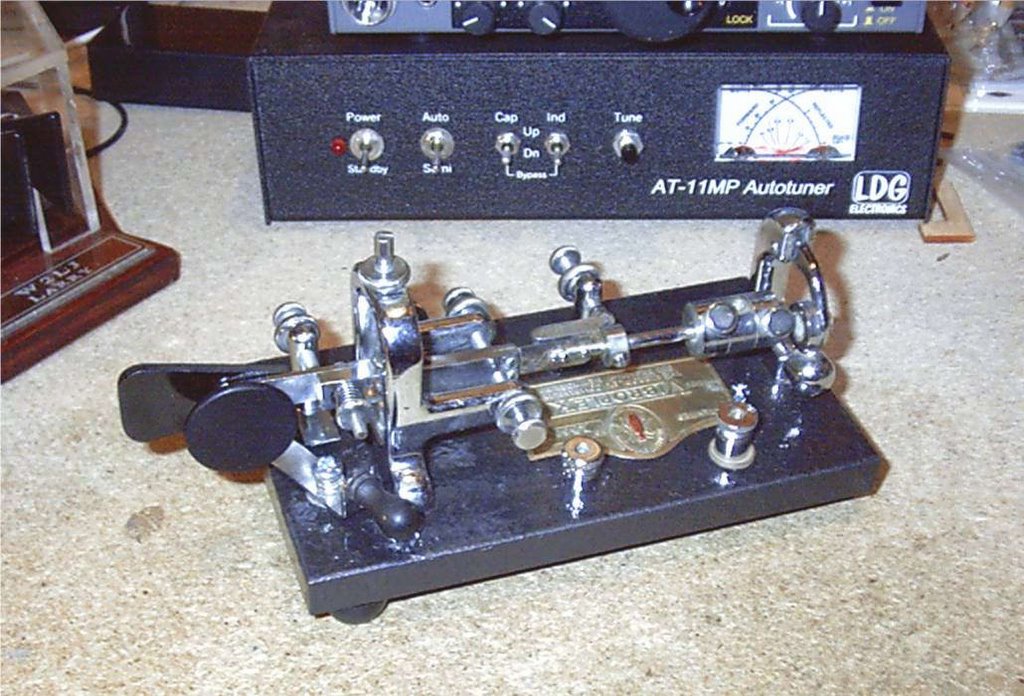 Now that my Vibroplex Original Standard has gone through its restoration process, via yours truly, now comes the time to hook the lil' bugger (pun intended) up and use it.
Hooking it up is the easy part. Using it is another thing, entirely. In actuality, it's not difficult to use at all. In fact, it's very much like using a keyer and paddles.
That's the problem!
For the past 22 years, I have been using a keyer and paddles. I used to use a Bug many years ago; but it was MANY years ago! My brain is so used to touching a paddle lever and getting a series of dits and then touching the other paddle to get a series of dahs; that it has become ingrained.
Getting on the Bug the first time wasn't too bad. I pressed the lever in one direction and got a series of well formed and well designed dits. So far, so good. I pressed the lever in the other direction and got one well formed; but interminably long dah! Oh yes, that's right ... I AM THE ONE who has to manually make the dahs! Sorry, not used to that! The tendancy is to leave my finger on the lever way too long! Unfortunately, this is International Morse Code I'm dealing with and not American Morse. There are no extremely loooooong dahs in this system!
What to do? Practice, practice and practice some more! I have been sending imaginary exchanges to my keyer with its speaker turned on. This allows me to conveniently send "off the air". And after a few evenings, I judged that I didn't sound way too terribly. So I got on the air and called a CQ on 80 Meters. A guy came back to me and was actually able to decipher what I was sending! Wow!
In reality, while it's not terrible, I'm not comfortable with the way it sounds. My code with the Bug is still a little disjointed and stacatto. My fist is indeed, legible; but it doesn't "flow" at this point. It sounds more like the orchestra tuning up than playing the actual symphony. I pride myself on my Morse being "liquid" and being easy to listen to and decipher. Maybe I'm my own worst critic; but I am not happy ...... yet.
I need some more practice; but I do think I see the light at the end of the tunnel. Maybe in a few more weeks, I'll actually feel comfortable enough to get on the air and not make a fool of myself (again). I just hope that light I see at the end of the tunnel isn't a train!
73 de Larry W2LJ
Friday, February 24, 2006
Good PR !!!
While Amateur Radio might not make the headlines everyday, we got a mention in the White House report on Hurrican Katrina. The report was very self critical on the government's role in handling the aftermath of one of the worst natural disasters in our Nation's history. Amateur Radio was mentioned in a very positive light. At least we're getting noticed somewhere!
The following appeared courtesy of Rich Moseson W2VU, editor of CQ Magazine, on the CQ Magazine e-mail reflector. Thanks, Rich, for keeping us informed!
The White House today released its review of the federal response to
Hurricane Katrina, which, according to a statement, "identifies the systemic
problems in Federal emergency preparedness and response revealed by
Hurricane Katrina - and the best solutions to address them." The report
included 17 lessons the Executive Branch learned after reviewing and
analyzing the response to Katrina; made 125 specific recommendations to the
President, and identified 11 critical actions to be completed before the
first day of the 2006 hurricane season.
*"Other organizations worked tirelessly to assist emergency responders that,
due to the storm, did not have the equipment and means to effectively carry
out their duties. Amateur Radio Operators from both the Amateur Radio
Emergency Service and the American Radio Relay League, monitored distress
calls and rerouted emergency requests for assistance throughout the U.S.
until messages were received by emergency response personnel. A distress
call made from a cell phone on a rooftop in New Orleans to Baton Rouge was
relayed, via ham radio, from Louisiana to Oregon, then Utah, and finally
back to emergency personnel in Louisiana, who rescued the 15 stranded
victims. Ham radio operators voluntarily manned the amateur radio stations
at sites such as the National Hurricane Center, Hurricane Watch Net,
Waterway Net, Skywarn and the Salvation Army Team Emergency Radio Network."
*
Finally, the report identified three immediate priorities:
1) Implementing a comprehensive National Preparedness System "to make
certain that we have a fully national system that ensures unity of effort in
preparing for and responding to natural and man-made disasters;"
2) Creating a "Culture of Preparedness" that "emphasizes that the entire
Nation - at all levels of government, the private sector, communities, and
individual citizens - shares common goals and responsibilities for homeland
security;" and
3) Implement corrective actions "to ensure we do not repeat the problems
encountered during Hurricane Katrina."
73 de Larry W2LJ
The following appeared courtesy of Rich Moseson W2VU, editor of CQ Magazine, on the CQ Magazine e-mail reflector. Thanks, Rich, for keeping us informed!
The following is from the CQ-News reflector:
From the CQ Newsroom…
The White House today released its review of the federal response to
Hurricane Katrina, which, according to a statement, "identifies the systemic
problems in Federal emergency preparedness and response revealed by
Hurricane Katrina - and the best solutions to address them." The report
included 17 lessons the Executive Branch learned after reviewing and
analyzing the response to Katrina; made 125 specific recommendations to the
President, and identified 11 critical actions to be completed before the
first day of the 2006 hurricane season.
The report also included a section titled, "What Went Right" in the Katrina
response, which singled out amateur radio operators for particular praise:
*"Other organizations worked tirelessly to assist emergency responders that,
due to the storm, did not have the equipment and means to effectively carry
out their duties. Amateur Radio Operators from both the Amateur Radio
Emergency Service and the American Radio Relay League, monitored distress
calls and rerouted emergency requests for assistance throughout the U.S.
until messages were received by emergency response personnel. A distress
call made from a cell phone on a rooftop in New Orleans to Baton Rouge was
relayed, via ham radio, from Louisiana to Oregon, then Utah, and finally
back to emergency personnel in Louisiana, who rescued the 15 stranded
victims. Ham radio operators voluntarily manned the amateur radio stations
at sites such as the National Hurricane Center, Hurricane Watch Net,
Waterway Net, Skywarn and the Salvation Army Team Emergency Radio Network."
*
Finally, the report identified three immediate priorities:
1) Implementing a comprehensive National Preparedness System "to make
certain that we have a fully national system that ensures unity of effort in
preparing for and responding to natural and man-made disasters;"
2) Creating a "Culture of Preparedness" that "emphasizes that the entire
Nation - at all levels of government, the private sector, communities, and
individual citizens - shares common goals and responsibilities for homeland
security;" and
3) Implement corrective actions "to ensure we do not repeat the problems
encountered during Hurricane Katrina."
A White House fact sheet summarizing the report is available online at
<http://www.whitehouse.gov/news/releases/2006/02/20060223.html>.
(Tnx CQ Public Service Editor Bob Josuweit, WA3PZO)
The full report is also available online at
<http://www.whitehouse.gov/reports/katrina-lessons-learned/>.
73 de Larry W2LJ
Wednesday, February 15, 2006
Subscribe to:
Posts (Atom)