It was the autumn of 1979; just about this time of year. A friend and I decided to go on vacation to the White Mountains of New Hampshire. Our goal was to photograph the beautiful reds, yellows, browns and golds of the changing New England foliage. We were not disappointed; and to this day I have those photographs tucked away.
The way south, home to New Jersey saw us take a detour to visit Cape Cod. It was there, passing through Wellfleet when I spied the sign on the road, diverting my attention to Marconi Station. I was a new Ham at the time, licensed for under a year. I was learning the ropes and was eager to soak in as much about the hobby and it's glorious past as I was able. The old ruins of the radio station beckoned; and I headed in the direction that the road signs indicated.
I was not disappointed, even though there is not much there anymore. This was the site of the first wireless communications that spanned the Atlantic. President Teddy Roosevelt used Mr. Marconi's station to send greetings to King Edward VII in Great Britain. All that was left of the giant curtain antenna were the concrete anchors that supported the giant masts in the dunes of sand. A gazebo with a diorama of the orignal radio shack and antenna displayed what was built there so many years ago.
Standing there on that chilly October day; I looked out upon the vastness that is the Atlantic Ocean. As the sea gulls cried, and the breeze howled I was able to feel the electricity in the air. Radio waves emanating forth; traveling up to the ionosphere; only to be bent - refracted back to the surface of the earth so many, many miles away. In an instant, the size of the world was conquered. Vast distances were made relatively small; but being there reminded me how really vast those distances truly are. And like Mr. Marconi, I too, travel them with ease. My meager few watts travel over the oceans and continents at the speed of light, making the world smaller; but at the same time reminding me of it's vast beauty and grandeur.
73 de Larry W2LJ

Friday, September 30, 2005


Dave Benson strikes again!
As if my 40 Meter Rockmite isn't fun enough! Dave Benson strikes again and receives a few more dollars from me. I am now the pround owner of a companion 20 Meter Rockmite to accompany the 40 Meter version.
I have put my other construction projects on the side and am constructing this 'lil beauty. It's just as easy as it's 40 Meter brother; and in fact they're pretty much identical twins. It's just about done with only the resistors and transistors to solder in to the PC board. I should have it done and ready to be enclosed some time this coming week.
If you want to treat yourself to a small radio that's fun to build and easy to operate; then check out K1SWL's Website: http://www.smallwonderlabs.com/
There are plenty of rigs to choose from should you decide you would like something more "well rounded" than a Rockmite. Whatever you might choose from Dave's inventory, I can pretty much guarantee that you won't be disappointed!
73 de Larry W2LJ
I have put my other construction projects on the side and am constructing this 'lil beauty. It's just as easy as it's 40 Meter brother; and in fact they're pretty much identical twins. It's just about done with only the resistors and transistors to solder in to the PC board. I should have it done and ready to be enclosed some time this coming week.
If you want to treat yourself to a small radio that's fun to build and easy to operate; then check out K1SWL's Website: http://www.smallwonderlabs.com/
There are plenty of rigs to choose from should you decide you would like something more "well rounded" than a Rockmite. Whatever you might choose from Dave's inventory, I can pretty much guarantee that you won't be disappointed!
73 de Larry W2LJ
Noisey conditions
For me, 40 Meters has been strange. It has been noisey, so noisey in fact, that it has almost been unusable. Same thing with 20 Meters. 80 Meters, however, has been a pleasant surprise. It has yielded a few decent ragchews over the past few evenings. I am guessing that it's just atmospheric conditions and that things will clear up in time.
Saturday, September 17, 2005
Getting Political
I know the topic of this blog is Amateur Radio and QRP in particular; but I have to get this off my chest. I have been watching the Main Stream Media for over two weeks now since Hurricane Katrina hit New Orleans with utter disgust! The way they are politicizing this natural disaster just steams me off!
I have been involved in Emergency Management for just about twenty years now. Admittedly, I'm a low level player without any real authority or expertise. I do however, "know the drill". I've been given enough training and have taken enough courses, through local government and on my own, to know how the system works.
When an emergency or natural disaster or terrorist incident of any kind occurs, the response is totally in the hands of local officials. It is up to the first responders (police, fire, EMS, public works) to handle the emergency the best they can. Once they use up their resources and realize that they are in over their heads, it becomes a county problem. The reponsibility of the county is to help the town in anyway they can - provide assistance, supplies or mutual aid if necessary. Once the resources of the county become overwhelmed, it is the responsibility of the state to take charge and do all it can. In the same vein, once the state is overwhelmed, the respective governor calls the President of the United States (POTUS) and asks him to declare an emergency which starts the wheels turning for Federal aid.
Louisiana, Mississippi and Alabama were hit by a hurricane of Biblical proportions - there is no doubt about that. But the repsonsibility of "first response" laid upon the shoulders of the mayors of the affected municipalities and the governors of these states. It was up to them to follow their emergency plans or SOPS (Standard Operating ProcedureS). It is quite evident from the events that occured that the SOPS were not followed or were woefully inadequate.
I have seen the SOP for my county; and was involved with helping to carry it out for years. The SOP is so thorough that it even details how to open the Office of Emergency Management, whom to call and what procedures to initiate if your the first officer to reach the building once a call gets issued! To this observer, it seems the response by New Orleans officials was willy-nilly at best - chaotic at worst. Their evacuation plans were not carried out; and it seems like their evacuations plans were poorly thought out from the get go. The response by local officials was not fluid and it appeared like they were not ready, untrained and were ill equipped to respond. It seems in Louisiana that everyone went off half cocked in their own little direction and that no one talked with each other. The governor appears to have been overwhelmed by the situation and was paralyzed with indecision.
So what does everyone do? Do they look at themsleves and figure out what went wrong and where? NOOOOOOOOOO !!!!!!!! Blame the POTUS and whine and cry that Federal aid was inadequate and was slow in coming, to boot! Why look at yourself when it is so much easier to just pass the buck?
If the mayor of New Orleans and the Governor of Louisiana had their acts together, that city would have been totally evacuated before Katrina struck. Heck, they had five days warning! The head of the Hurricane Center personally called the Governor and begged he to evacuate! They had plenty of buses to get the job done, too. Too bad they ended up sitting in 5 feet of water!
I don't care what the Democrats say, what the Media says, what anybody says ..... given the scope of this disaster; and the amount that was dumped in their laps, FEMA, the military and the Fedreal government acted swiftly, decisively and competently.
73 de Larry W2LJ
I have been involved in Emergency Management for just about twenty years now. Admittedly, I'm a low level player without any real authority or expertise. I do however, "know the drill". I've been given enough training and have taken enough courses, through local government and on my own, to know how the system works.
When an emergency or natural disaster or terrorist incident of any kind occurs, the response is totally in the hands of local officials. It is up to the first responders (police, fire, EMS, public works) to handle the emergency the best they can. Once they use up their resources and realize that they are in over their heads, it becomes a county problem. The reponsibility of the county is to help the town in anyway they can - provide assistance, supplies or mutual aid if necessary. Once the resources of the county become overwhelmed, it is the responsibility of the state to take charge and do all it can. In the same vein, once the state is overwhelmed, the respective governor calls the President of the United States (POTUS) and asks him to declare an emergency which starts the wheels turning for Federal aid.
Louisiana, Mississippi and Alabama were hit by a hurricane of Biblical proportions - there is no doubt about that. But the repsonsibility of "first response" laid upon the shoulders of the mayors of the affected municipalities and the governors of these states. It was up to them to follow their emergency plans or SOPS (Standard Operating ProcedureS). It is quite evident from the events that occured that the SOPS were not followed or were woefully inadequate.
I have seen the SOP for my county; and was involved with helping to carry it out for years. The SOP is so thorough that it even details how to open the Office of Emergency Management, whom to call and what procedures to initiate if your the first officer to reach the building once a call gets issued! To this observer, it seems the response by New Orleans officials was willy-nilly at best - chaotic at worst. Their evacuation plans were not carried out; and it seems like their evacuations plans were poorly thought out from the get go. The response by local officials was not fluid and it appeared like they were not ready, untrained and were ill equipped to respond. It seems in Louisiana that everyone went off half cocked in their own little direction and that no one talked with each other. The governor appears to have been overwhelmed by the situation and was paralyzed with indecision.
So what does everyone do? Do they look at themsleves and figure out what went wrong and where? NOOOOOOOOOO !!!!!!!! Blame the POTUS and whine and cry that Federal aid was inadequate and was slow in coming, to boot! Why look at yourself when it is so much easier to just pass the buck?
If the mayor of New Orleans and the Governor of Louisiana had their acts together, that city would have been totally evacuated before Katrina struck. Heck, they had five days warning! The head of the Hurricane Center personally called the Governor and begged he to evacuate! They had plenty of buses to get the job done, too. Too bad they ended up sitting in 5 feet of water!
I don't care what the Democrats say, what the Media says, what anybody says ..... given the scope of this disaster; and the amount that was dumped in their laps, FEMA, the military and the Fedreal government acted swiftly, decisively and competently.
73 de Larry W2LJ
Thursday, September 08, 2005
Public Service Radio
Since Katrina unleashed her wrath upon the Gulf states; there has been a lot of discussion on various Amateur Radio e-mail reflectors about the value of Ham Radio and emergency communications. This post is not intended to stir up any controversy or debate; it's purpose is, however, to get you to think.
We are ALL vulnerable to natural disaster, whether it be a hurricane on the south or east coasts. Blizzards in the temperature appropriate areas of our country, earthquakes and brush fires out west; flooding in the Midwest; or a tornado just about anywhere. When these things happen and devastation is widespread; your help is needed! We are seeing that this week more than ever.
Please consider volunteering your time and talents. There are many ways you can do this. Hook up with your local Office of Emergency Management and see if there is a CERT program (Community Emergency Response Team) in your area. If there is none; then maybe there's a ARES or RACES group in existence. Where these do not exist contact your local branch of the Red Cross or Salvation Army as both of these organizations have "letters of understanding" with many local Ham radio Emcomm groups.
The point is that Ham Radio is as valid and valuable as it has ever been. Maybe it's not done by Morse Code or maybe not even HF SSB anymore. Maybe it will all be done in your area with VHF/UHF FM communications or packet. Maybe Amateur Radio doesn't get the press that it deserves and maybe it's not as valued as it ought to be. But when all is said and done with Katrina, the stories WILL come out. You will hear instances of where communications systems failed and how Amateur Radio was the only way that rescues were performed, services delivered, families reunited. The ARRL had a slogan on their T-shirts for Field Day a few years ago, "Amateur Radio - When All Else Fails". That has never been more true.
But all that said, YOUR help is needed. Volunteer communicators are needed on a nationwide basis, starting with your own local communities. Get trained and be prepared. The best side benefit is that the knowledge you gain will not only help keep your community safe; but your own family safe as well. You folks who are into QRP and Homebrewing are among the most knowledgeable, brightest, most versatile, most adaptable, best trained Hams we have out there. You build, test and repair equipment. You set up and operate stations from fields, forests, oceansides, backyards, parking lots and even from inside EOCs. You are an asset to this country and its communities.
For more information about CERT - please visit: http://training.fema.gov/EMIWeb/CERT/certfaq.asp
73 de Larry W2LJ
Tuesday, August 16, 2005
1000 Miles per Watt
One of the grand awards in the QRP world is the "1000 Miles per Watt" Award. This award, which is sponsored by the QRP Amateur Radio Club International is given for accomplishing a QSO where the distance covered, divided by the power used, exceeds 1000 miles per Watt of power.
Experienced QRPers do this on a regular basis; and in fact, is probably no big deal anymore. However, the first time you do it, is a special event that you remember for the rest of your life.
I've exceeded the 1000 mile limit several times. In fact, just a few weeks ago, I had a QSO withTerry in Madison, Wisconsin. I was using my Rockmite at 500 mW out; so that QSO worked out to be over 1700 miles per Watt. As memorable as that was, my first or qualifying 1000 mile QSO was very special indeed; and it was with a far away and exotic place which made it all the more memorable.
Back in February 2004, Jeff Parker came onto the Elecraft e-mail reflector to announce that the following weekend, he would be operating from the Marshall Islands in the Pacific Ocean as V73GJ. That was all very exciting and I took note of his operating schedule. When time came, I plugged my recently completed K1 into my Butternut HF9V antenna and even though I didn't expect to, I was able to copy Jeff on 15 Meters quite well. He was calling CQ and I thought, "What the heck!". Much to my surprise, Jeff came back to me with a 559 report. I was estatic! Subsequent calculations revealed a distance of some 7000 miles seperated New Jersey from Kwajalein Atoll, where Jeff was operating. 5 Watts divided by the distance yielded a QSO that was about 1445 miles per Watt.
Not only was this my first 1000 mile per Watt QSO; but it was with a new DXCC entity that I had never worked before. Also, Kwajalein Atoll while distant and exotic, was at least a familiar name which I had heard while watching episodes of "Black Sheep Squadron" back in my youonger days. The DX in this case was not only exotic; but it also played an important part in the history of World War II.
I thought of all of this as I came across the QSL card commemorating the QSO. It was time to pony up my money and send in to the QRP-ARCI to apply for the Award and make it "official".
Thank you, Jeff!
73 de Larry W2LJ
Experienced QRPers do this on a regular basis; and in fact, is probably no big deal anymore. However, the first time you do it, is a special event that you remember for the rest of your life.
I've exceeded the 1000 mile limit several times. In fact, just a few weeks ago, I had a QSO withTerry in Madison, Wisconsin. I was using my Rockmite at 500 mW out; so that QSO worked out to be over 1700 miles per Watt. As memorable as that was, my first or qualifying 1000 mile QSO was very special indeed; and it was with a far away and exotic place which made it all the more memorable.
Back in February 2004, Jeff Parker came onto the Elecraft e-mail reflector to announce that the following weekend, he would be operating from the Marshall Islands in the Pacific Ocean as V73GJ. That was all very exciting and I took note of his operating schedule. When time came, I plugged my recently completed K1 into my Butternut HF9V antenna and even though I didn't expect to, I was able to copy Jeff on 15 Meters quite well. He was calling CQ and I thought, "What the heck!". Much to my surprise, Jeff came back to me with a 559 report. I was estatic! Subsequent calculations revealed a distance of some 7000 miles seperated New Jersey from Kwajalein Atoll, where Jeff was operating. 5 Watts divided by the distance yielded a QSO that was about 1445 miles per Watt.
Not only was this my first 1000 mile per Watt QSO; but it was with a new DXCC entity that I had never worked before. Also, Kwajalein Atoll while distant and exotic, was at least a familiar name which I had heard while watching episodes of "Black Sheep Squadron" back in my youonger days. The DX in this case was not only exotic; but it also played an important part in the history of World War II.
I thought of all of this as I came across the QSL card commemorating the QSO. It was time to pony up my money and send in to the QRP-ARCI to apply for the Award and make it "official".
Thank you, Jeff!
73 de Larry W2LJ
Thursday, August 04, 2005
Vacation Operating - Redeux
In a post or two below, I mentioned making contact with the vactioning W1OH during the NAQCC Sprint. Tonight I was calling CQ on 20 Meters, when lo and behold, VY2/W1OH came back and answered me! And tonight, instead of a quickie contest QSO, I was treated to a ragchew with Geoff.
He and his family have been vacationing up at Prince Edward Island for the past 17 years. What had started out as camping trips has evolved into extended vacation stays in rented cottages. Fortunately for Geoff, his temporary landlord has no problem with temporary Amateur Radio antennas. Geoff was using a doublet cut for 80 Meters with an antenna tuner, which allowed him to answer my CQ on 20 Meters.
Geoff's Yaesu FT-897 was doing a fantastic job from Prim Point, PEI to New Jersey. Geoff was about 100 yards away from the water; and I'm only about 10 miles from the New Jersey coast (as the crow flies) ; so maybe the RF was following the saltwater path between us.
From Google searches I have done on PEI, it looks like a pretty fantastic place to vacation. Now that I know that it can be Amateur Radio friendly - it just might be a place to visit one of these upcoming summers!
73 de Larry W2LJ
He and his family have been vacationing up at Prince Edward Island for the past 17 years. What had started out as camping trips has evolved into extended vacation stays in rented cottages. Fortunately for Geoff, his temporary landlord has no problem with temporary Amateur Radio antennas. Geoff was using a doublet cut for 80 Meters with an antenna tuner, which allowed him to answer my CQ on 20 Meters.
Geoff's Yaesu FT-897 was doing a fantastic job from Prim Point, PEI to New Jersey. Geoff was about 100 yards away from the water; and I'm only about 10 miles from the New Jersey coast (as the crow flies) ; so maybe the RF was following the saltwater path between us.
From Google searches I have done on PEI, it looks like a pretty fantastic place to vacation. Now that I know that it can be Amateur Radio friendly - it just might be a place to visit one of these upcoming summers!
73 de Larry W2LJ
Tuesday, August 02, 2005
Speaking of vacation ..........

Speaking of taking a QRP rig along with you while you're on vacation .......... Do you know those little white oval stickers that you can get from vacation spots or countries for your car? You know, the ones that have a DMK for Denmark or IRL for Ireland or LBI for Long Beach Island or OBI for the Outer Bank Islands of North Carolina?
You can get similar stickers with "QRP" on it for your car. The Hams you know will understand immediately; and you can keep everyone else guessing!
Check out the eBay store by clicking on the title above. This will take you to the Bell Imel Group LLC - Jeff Imel K9ESE owns it and carries them!
73 de Larry W2LJ
Lunchtime QRP
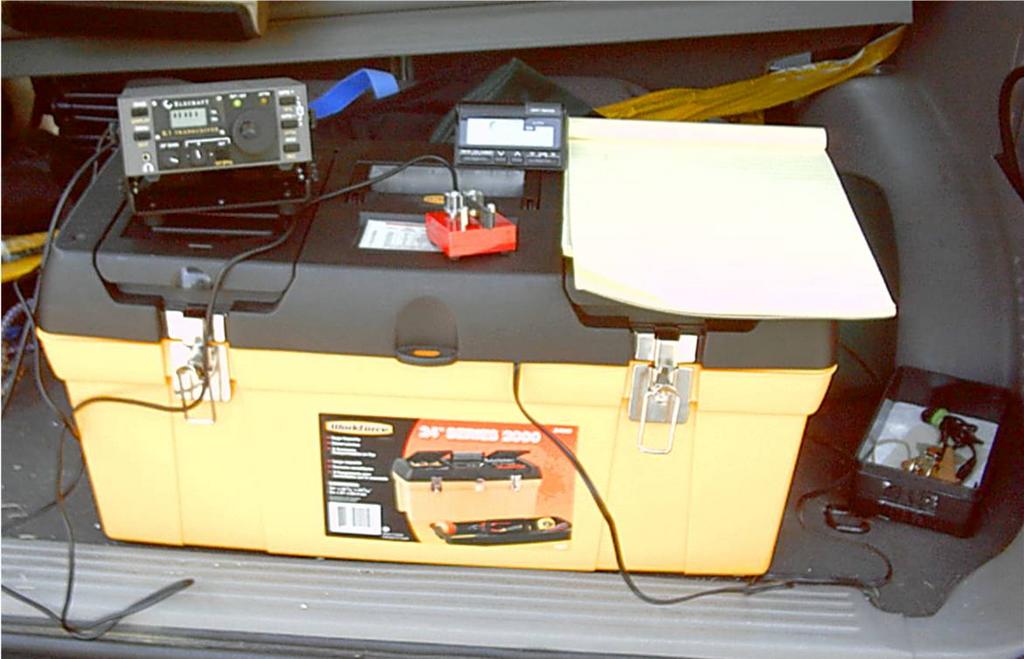
I always have my K1 in the car with me. I keep it in a tool box and have fun with it at work during lunchtime. When the weather is nice, I go out to the car, plop a Hamstick on the roof and break out the K1. More often than not, if band conditions are decent, I'll end up having a QSO.
Today, the weather has been hot; but things have been hectic at work, so I decided to take a break. I went out to my Ford Explorer; popped the 20 Meter Hamstick onto the magmount and fired up the radio and put out a "CQ" near the 20 Meter FISTS frequency of 14.058 MHz.
Much to my delight, Tom K4OFZ answered my CQ and indicated he was operating QRP, also. Cool! Band conditions were not the greatest and the QSB was deep; but we managed a 'lil QSO. I was able to learn that Tom is on vacation down at Edesto Beach in South Carolina. He was using an MFJ QRP radio to a dipole. He had a decent 559 signal into New Jersey before the QSB got so bad that it took us out.
If you get a chance; scope out Edesto Beach by doing a Google search on it. It looks like Tom knows where to go on vacation - really nice place! Would not mind being there myself.
More Hams should take some kind of QRP rigs with them when they go on vacation. It's a ton of fun operating from someplace other than home - seeing how far you can get on low power and maybe not the most ideal of antennas. A few weeks ago, I worked Geoff W1OH during the NAQCC Sprint. He was signing VY2/W1OH which meant he was vacationing at Prince Edward Island up in Canada. That's another place that I would like to travel to someday.
Ham radio - vacation - sunshine - warm air ....... does it get any better than that?
73 de Larry W2LJ
Saturday, July 23, 2005
The Joy of a Ragchew!
There is nothing better, in my mind, in the Amateur Radio experience; than a good CW ragchew. I just had the immense pleasure of spending close to an hour in conversation with Craig, N8KMY who is up in north Michigan.
Craig was using his Kenwood TS-2000 at 30 Watts to a vertical; and I was feeding my G5RV a steady diet of 5 Watts from my K2. The conversation was like a breeze; gently bounding from topic to topic as the mood moved us.
The CW was excellent at a pace of about maybe 20 - 22 wpm and Craig's fist was excellent. I need a few more QSOs like this on a regular basis. They keep my fist sharp, my ear sharp, and my gray matter nimble.
Thanks Craig es 73
de Larry W2LJ
Craig was using his Kenwood TS-2000 at 30 Watts to a vertical; and I was feeding my G5RV a steady diet of 5 Watts from my K2. The conversation was like a breeze; gently bounding from topic to topic as the mood moved us.
The CW was excellent at a pace of about maybe 20 - 22 wpm and Craig's fist was excellent. I need a few more QSOs like this on a regular basis. They keep my fist sharp, my ear sharp, and my gray matter nimble.
Thanks Craig es 73
de Larry W2LJ
Thursday, July 21, 2005
The Times - they are a changin'
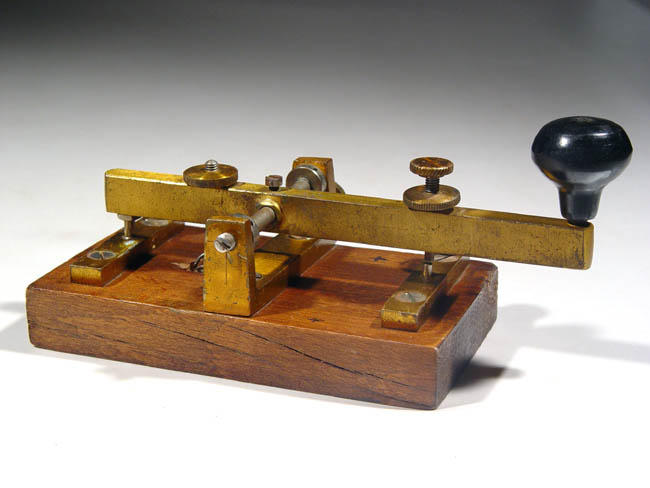
Yesterday, the FCC released it's Notice of Proposed Rule Making, where they asked for comments in reference to their proposal to amend the rules governing Amateur Radio. The proposal would eliminate the requirement of a Morse Code test to qualify for an Amateur Radio license.
As a proponent of the use of Morse Code; you probably think I'm depressed and sullen by this development. Disturbed, yes ....... depressed and sullen? No.
Morse Code is a very popular means of communication in Amateur Radio circles. It will not only survive; but will probably thrive. In fact, we may yet even see a "renaissance" of Morse Code on the Ham bands.
My disturbed feelings come not so much from the elimination of the Morse Code requirement. What I feel bad about is the continuing trend where hard work, responsibility and commitment seem to be negatives instead of positive attributes. Let's face it, the Morse Code requirement was removed because of all the whining and gnashing of teeth that Morse Code was too hard to master; and therefore it had become exclusionary. (Have I thrown enough PC BS at you on that one?)
An Amateur Radio license, like a lot of other things, is a privilege and not a God given right. I think people get confused here. In order to earn that privilege you had to take a Morse Code test as well as a written exam. The problem is there are too many "wanna-be's" out there who want the privilege without the work. In way too many cases these days, that seems to be the standing order of the day. And again, in this case, the FCC caved to the PC correct crowd and is allowing this to happen.
In the mid-70s when I first wanted to get licensed, I tried learning the code as a teenager. I failed miserably. Several years after college, I tried again. It was no easier the second time; but I wanted it badly enough and succeeded. A badge of courage? Maybe. Did it kill me? No; and it won't kill anyone else, either.
If this proposal passes; and I'm sure it will, then it will be the end of an era. Who knows what will be targeted next; but I am willing to bet that it will be the CW portions of the Amateur Radio spectrum. The day that those disappear is the day you can look for all of my equipment on eBay.
I'll post more about this topic when I'm not in such a dour mood.
73 de Larry W2LJ
Saturday, July 16, 2005
MOCADing in Lake George, NY
One of my goals for 2005 is to make at least one QRP QSO each day of this year. I had this goal in mind; and it became reinforced when the North American QRP CW Club offered it's "QSO a Day" award. So far, for every day this year, since January 1st, I have made at least on QRP CW QSO a day. Thus, MOCAD or Make One Contact A Day.
There have been days when it has been oh, so difficult. In early January and February there were a couple of days when we had mass coronal ejections so severe that the bands sounded totally and unequivocally dead. Even then, I still managed to eke out at least one QRP CW QSO a day.
Last week, however, was a challenge of a different color. Keeping my goal alive while going on vacation with my wife and kids to Lake George, NY. It would be a test of operating with QRP power on a portable basis with "compromise" antennas for the entire week.
We stayed at a great place, the Stepping Stones Resort in Diamond Point, NY. The place is owned and operated by a fantastic husband and wife team - Chuck and Ronnie. Chuck didn't even bat an eye when I set up my PAC-12 antenna on our parking apron in front of our cottage. In fact, some of our neighboring vacationers had relatives who are or were hams and they all took my portable operating in stride.
The goal was to make a QSO each day in as quick a fashion as possible; so as to maximize my vacation time with my wife and kids. It was definitely difficult, being in a situation where I wasn't really aware of the solar weather and how the bands were going to be. And once or twice, I really didn't think that I was going to make it. But each day, with either my PAC-12 or my Hamsticks magmounted to my Ford Explorer, I managed to get in a QSO or two.
20 and 40 Meters were the bands I decided to stick with; as they are usually the most reliable for me. On a couple of days, both bands were strangely quiet, devoid of any signals to speak of. The worst day was Wednesday, when I ended up working Bob KF4GDX. Bob and I have worked each other before; and our amazingly short QSO ended up being each of us telling each other how crappy the bands were! But a QSO, however short, is a QSO and I was mighty glad to be able to add it to the log.
I tried out several different strategies; and learned from each one. First, I tended to hunt on and around the FISTS watering hole frequencies. FISTS is a club with members who are dedicated to keeping Morse Code alive. They tend hang near the ".058" frequencies, such as 7.058, 14.058, 3.558, etc. More often than not, I was able to work a FISTS member who was just hanging around. Second, one day I was successful by "tailending". I tuned around listening for a strong signal and called that station as soon as he completed the QSO he was in when I found him. The Ham in question came back to me and we exchanged signal reports as well as the basic info. The last strategy was one of desperation that worked nicely. One day as it was getting close to 2400 UTC and I still needed that QSO; but the bands sounded dead - I ended up calling CQ anyway. And wouldn't you know it, I ended up with a QSO in the log for my efforts! So it just goes to show that even when a band sounds dead, it can't hurt to put out a CQ.
I was quite thankful, however, that I was able to keep my operating time to a minimum while still reaching my radio goal. My other and most primary goal was to have fun with my family; and I'm glad to be able to say that I reached that goal, too.
73 de Larry W2LJ
There have been days when it has been oh, so difficult. In early January and February there were a couple of days when we had mass coronal ejections so severe that the bands sounded totally and unequivocally dead. Even then, I still managed to eke out at least one QRP CW QSO a day.
Last week, however, was a challenge of a different color. Keeping my goal alive while going on vacation with my wife and kids to Lake George, NY. It would be a test of operating with QRP power on a portable basis with "compromise" antennas for the entire week.
We stayed at a great place, the Stepping Stones Resort in Diamond Point, NY. The place is owned and operated by a fantastic husband and wife team - Chuck and Ronnie. Chuck didn't even bat an eye when I set up my PAC-12 antenna on our parking apron in front of our cottage. In fact, some of our neighboring vacationers had relatives who are or were hams and they all took my portable operating in stride.
The goal was to make a QSO each day in as quick a fashion as possible; so as to maximize my vacation time with my wife and kids. It was definitely difficult, being in a situation where I wasn't really aware of the solar weather and how the bands were going to be. And once or twice, I really didn't think that I was going to make it. But each day, with either my PAC-12 or my Hamsticks magmounted to my Ford Explorer, I managed to get in a QSO or two.
20 and 40 Meters were the bands I decided to stick with; as they are usually the most reliable for me. On a couple of days, both bands were strangely quiet, devoid of any signals to speak of. The worst day was Wednesday, when I ended up working Bob KF4GDX. Bob and I have worked each other before; and our amazingly short QSO ended up being each of us telling each other how crappy the bands were! But a QSO, however short, is a QSO and I was mighty glad to be able to add it to the log.
I tried out several different strategies; and learned from each one. First, I tended to hunt on and around the FISTS watering hole frequencies. FISTS is a club with members who are dedicated to keeping Morse Code alive. They tend hang near the ".058" frequencies, such as 7.058, 14.058, 3.558, etc. More often than not, I was able to work a FISTS member who was just hanging around. Second, one day I was successful by "tailending". I tuned around listening for a strong signal and called that station as soon as he completed the QSO he was in when I found him. The Ham in question came back to me and we exchanged signal reports as well as the basic info. The last strategy was one of desperation that worked nicely. One day as it was getting close to 2400 UTC and I still needed that QSO; but the bands sounded dead - I ended up calling CQ anyway. And wouldn't you know it, I ended up with a QSO in the log for my efforts! So it just goes to show that even when a band sounds dead, it can't hurt to put out a CQ.
I was quite thankful, however, that I was able to keep my operating time to a minimum while still reaching my radio goal. My other and most primary goal was to have fun with my family; and I'm glad to be able to say that I reached that goal, too.
73 de Larry W2LJ
Thursday, July 07, 2005
The one that got away.
Twenty Meters was really nice last night. I got on at about 0130 UTC and worked Bert DJ4EL on 20 Meter CW. He was running 100 Watts and I was running 5, as usual. Bert gave me a 559 report, which I was satisfied with. The nicest thing about it, though; was that it was a QSO with a DX station and not a DX QSO. I get really tired of and discouraged with, "599 tnx es 73 ..... QRZ?" Our conversation lasted only about ten minutes or so; but at least I know that Bert is retired from working for the German Tax Office. In turn, Bert knows that I am 48 and work in the professional photo industry. Ground breaking diplomatic relations? Hardly ...... just two Hams shooting the breeze.
The one that got away, however was a bit on down the band. While tuning through, I heard YI6LZ handing out contacts left an right. YI6 ...... plug the prefix into Win-EQF to see that that's Iraq! Wow, that would be a cool prize via QRP.
My wife was working, the kids were in bed, so I figured, "What the heck?". About 45 minutes into the fray, after sending "W2LJ" for what seemed like forever, I heard the op come back with "W2L?". HE HEARD ME !!!!!!!!! I slowed down the speed again and sent my call, a bit more slowly this time. Again, he comes back, "W2L?". I try again; but alas, it was for naught. A stronger station jumped all over me and I hear him come back to a W4 station. Yeah, right .... W4whatever sounds a lot like W2L? !!!!
ARRRRRRRGGGGGGGGGHHHHHHHHHHHH !!!!!!
Fortunately, I'm addicted enough to QRP not to let it bother me too much. Yes, it would have been a real coup to have scored an Iraqi station with 5 Watts. But, there'll be another day and another time. Maybe next time there will be more sunspots!
73 de Larry W2LJ
The one that got away, however was a bit on down the band. While tuning through, I heard YI6LZ handing out contacts left an right. YI6 ...... plug the prefix into Win-EQF to see that that's Iraq! Wow, that would be a cool prize via QRP.
My wife was working, the kids were in bed, so I figured, "What the heck?". About 45 minutes into the fray, after sending "W2LJ" for what seemed like forever, I heard the op come back with "W2L?". HE HEARD ME !!!!!!!!! I slowed down the speed again and sent my call, a bit more slowly this time. Again, he comes back, "W2L?". I try again; but alas, it was for naught. A stronger station jumped all over me and I hear him come back to a W4 station. Yeah, right .... W4whatever sounds a lot like W2L? !!!!
ARRRRRRRGGGGGGGGGHHHHHHHHHHHH !!!!!!
Fortunately, I'm addicted enough to QRP not to let it bother me too much. Yes, it would have been a real coup to have scored an Iraqi station with 5 Watts. But, there'll be another day and another time. Maybe next time there will be more sunspots!
73 de Larry W2LJ
Wednesday, July 06, 2005
Logging in the field.
Operating in the field is fun; and it gives a good chance to get out into the fresh air and sunshine. There's nothing quite like having a QSO on 20 meters while stationed next to a small stream; or in a park or open field, listening to the birds chirp and to the other sounds of nature.
Logging those contacts though, has always been a pain in the butt for me. I used to use the ARRL mini-logbooks; but invariably I would spill something on them, get them wet, have the pages become wind blown, dog-eared and messy. Writing notes about QSOs and then putting the pieces of papers in my pocket to transfer to my main log later was not the best solution, either.
The one day, I read an article on the WWW about using a Palm Pilot for logging QSOs away from the main shack. It seemed like a brilliant idea to me! A trip to eBay and a winning bid later ($26) procured an entry level Palm Pilot, the m105, for me.
Looking for logging programs revealed plenty! I finally settled on two - "QSO Diary" by Ray Goff G4FON and "Ham Pilot" by Chris Williams. "QSO Diary" is freeware and "Ham Pilot" is shareware with a $5 donation requested if you want to register the program.
Both programs are intuitive and quite easy to use. I finally settled on "Ham Pilot" for one reason. I subsequently purchased an optional, folding keyboard for my m105. It makes data entry so much easier instead of relying on the stylus all the time. With "Ham Pilot" hitting the enter button on the keyboard will move the cursor from field to field. The other programs require that you select each field with the stylus - a major drawback in my mind.
The Palm allows me to log my entries just as if I were doing it on my laptop in the shack at home. The price if the Palm is a mere fraction; as are the weight and size. A portable computerized logging system that is small, lightweight, efficient and runs on two AAA batteries. You can't beat that with a stick!
73 de Larry W2LJ
Logging those contacts though, has always been a pain in the butt for me. I used to use the ARRL mini-logbooks; but invariably I would spill something on them, get them wet, have the pages become wind blown, dog-eared and messy. Writing notes about QSOs and then putting the pieces of papers in my pocket to transfer to my main log later was not the best solution, either.
The one day, I read an article on the WWW about using a Palm Pilot for logging QSOs away from the main shack. It seemed like a brilliant idea to me! A trip to eBay and a winning bid later ($26) procured an entry level Palm Pilot, the m105, for me.
Looking for logging programs revealed plenty! I finally settled on two - "QSO Diary" by Ray Goff G4FON and "Ham Pilot" by Chris Williams. "QSO Diary" is freeware and "Ham Pilot" is shareware with a $5 donation requested if you want to register the program.
Both programs are intuitive and quite easy to use. I finally settled on "Ham Pilot" for one reason. I subsequently purchased an optional, folding keyboard for my m105. It makes data entry so much easier instead of relying on the stylus all the time. With "Ham Pilot" hitting the enter button on the keyboard will move the cursor from field to field. The other programs require that you select each field with the stylus - a major drawback in my mind.
The Palm allows me to log my entries just as if I were doing it on my laptop in the shack at home. The price if the Palm is a mere fraction; as are the weight and size. A portable computerized logging system that is small, lightweight, efficient and runs on two AAA batteries. You can't beat that with a stick!
73 de Larry W2LJ
Thursday, June 30, 2005
Visit to the Barbershop
Last evening, I was able to participate in yet another fun QRP contest. This was another Sprint, that is, a contest lasting only a couple of hours. This Sprint is only held on a 5th Wednesday of a month - so it's only a semi-regular event which makes it all the more special.
This sprint is called the QRP Barbershop Sprint; and it is the product of the fertile mind of Lloyd Lachow K3ESE. The suffix of Lloyd's callsign is ESE and in Morse Code that sounds like the old "shave and a haircut - two bits" ..... dit-dididit-dit ... ditdit. Lloyd noticed that there are a lot of dedicated QRPers out there who share his suffix - Monte N5ESE, Bryan W0ESE, Scotty W1ESE and Jeff K9ESE just to name a few.
The idea of the Sprint is that the participants, "the customers" work as many stations as possible. But in addition, "the customers" have to hunt for and chase down "the barbers" and, by completing an exchange, get a shave and a haircut. I think Lloyd was able to round up about 8 or 9 barbers for last night's event; which is no mean feat in and of itself.
A new twist was added for this month. Monte N5ESE was named "the crewcut barber" in that he was selected to run his station at QRPp levels - less than 1 Watt. Anyone who completed the exchange with Monty received 2500 bonus points.
The Sprint ran for two hours, from 0100 to 0300 UTC. and it was a tough go right from the get go. We had a few thunderstorms pass through the area last night; so right off the bat, I lost about 30 - 45 minutes worth of operating time. The station had to be shut down, for safety's sake, when the lightning and thunder were in the area. When I was able to be on the air, the noise from all the atmospheric interference was atrocious! 80 Meters was just about unusable and 40 Meters, while usable was a headache generator! 20 Meters was quiet; but stations using that band were very weak.
By the time the event ended, I had manged to complete 20 QSOs and work five of 'the Barbers"; and I managed to chase down the elusive N5ESE who was running about 500 mW from Texas.
It's definitely a memorable evening when you get five haircuts in one night!
73 de Larry W2LJ
This sprint is called the QRP Barbershop Sprint; and it is the product of the fertile mind of Lloyd Lachow K3ESE. The suffix of Lloyd's callsign is ESE and in Morse Code that sounds like the old "shave and a haircut - two bits" ..... dit-dididit-dit ... ditdit. Lloyd noticed that there are a lot of dedicated QRPers out there who share his suffix - Monte N5ESE, Bryan W0ESE, Scotty W1ESE and Jeff K9ESE just to name a few.
The idea of the Sprint is that the participants, "the customers" work as many stations as possible. But in addition, "the customers" have to hunt for and chase down "the barbers" and, by completing an exchange, get a shave and a haircut. I think Lloyd was able to round up about 8 or 9 barbers for last night's event; which is no mean feat in and of itself.
A new twist was added for this month. Monte N5ESE was named "the crewcut barber" in that he was selected to run his station at QRPp levels - less than 1 Watt. Anyone who completed the exchange with Monty received 2500 bonus points.
The Sprint ran for two hours, from 0100 to 0300 UTC. and it was a tough go right from the get go. We had a few thunderstorms pass through the area last night; so right off the bat, I lost about 30 - 45 minutes worth of operating time. The station had to be shut down, for safety's sake, when the lightning and thunder were in the area. When I was able to be on the air, the noise from all the atmospheric interference was atrocious! 80 Meters was just about unusable and 40 Meters, while usable was a headache generator! 20 Meters was quiet; but stations using that band were very weak.
By the time the event ended, I had manged to complete 20 QSOs and work five of 'the Barbers"; and I managed to chase down the elusive N5ESE who was running about 500 mW from Texas.
It's definitely a memorable evening when you get five haircuts in one night!
73 de Larry W2LJ
Monday, June 27, 2005
Field Day 2005

Field Day dawned bright and sunny - a portent of the weather for the day.
I got up early and did some basic chores. I ran out to Staples and picked up some ink for the inkjet printer and to the grocery store to do the shopping for the week. After putting all the purchases in their proper places; I began to get ready for Field Day while my wife began getting ready to go to work.
First, I installed the new ink cartridges in my printer and printed up some logging and dupe sheets. Logging was going to be done the old fashioned way - with paper and pencil as Field Day was to be a total battery operation. I would use mini logging and dupe sheets which were formulated and posted to QRP-L and the Elecraft reflector by Wayne Burdick N6KR. Outdoor set up was easy for a solo operation. My trek was not far at all; just to the backyard patio table. And since I do a decent amount of QRP portable operating, I pretty much have it down to a routine, anyway. It was just a matter assembling the PAC-12 and the Buddipole. I could have used my G5RV and Butternut HF9V; but that wouldn't have been in the spirit of doing this as a portable station instead of a home station.
My wife, who is a registered nurse, left for work about 1:30 in the afternoon. With a half hour left until festivities began, I was ready to go. As the magic hour of 2:00 struck, I sat down to make a few QSOs. With 5 Watts, I tend to use the search and pounce method and this was especially true with temporary, portable antennas. After a few QSOs in the log, it began:
"Watcha doin' Daddy"?
"Playing radio, sweetie."
One or two more QSOs.
"Daddy would you push me on my swing?"
"Sure Joey!" Off from the radio to push my son on the swing for a while. I sat down to make one or two more QSOs.
"Daddy, I'm thirsty!"
"Okay, Cara, what would you like .... water, juice, milk ????"
"No Daddy, would you make me and Joey chocolate milk shakes?"
Sigh ....... and so it went. My Field Day operating during daylight hours could best be described as a shotgun effort. A few blasts here and there amongst taking care of "Daddy Duties". But my kids come first before radio - and I was glad to be able to spend time with them.
Later that night, after giving them a bath and putting them to bed; I put in a more serious effort. From about 9:00 PM until 11:00 PM, I was able to put in a decent effort; and made about 40 QSOs in those two hours. Even though I sprayed the area with "OFF" backyard outdoor fogger and applied Cutter's bug repellant to my skin, the insect attack started to become relentless. The Japanese Beetles laughed at the spray and the citronella candles. They bombed me like I was Pearl Harbor! The moths were doing a frenzied dance into the picnic table lights. After much swatting and shooing, I had had enough and pulled the plug for the night.
The next morning, I went out and pulled a few more QSOs out of the aether before leaving for Mass. Then when we got home; the kids wanted to go to the community pool (it was a very hot weekend, after all!) - so that put an official end to my Field Day effort for 2005.
I learned two things, however. For next year, I will purchase a tent or a screened canopy to take care of the bug problem. Next year, I will also put up a temporary doublet or other sort of wire antenna. The PAC-12 worked great to all areas of the country; but I think I'd like to compare it's peformance side by side with a more conventional wire antenna. All in all, I was pleased with my results - over 50 QSOs and 22 states in just a few accumulated hours of operating time with 5 Watts of power. The bottom line was that I had a great time. I hope the rest of you did too!
73 de Larry W2LJ
Wednesday, June 22, 2005
Rocks in my head
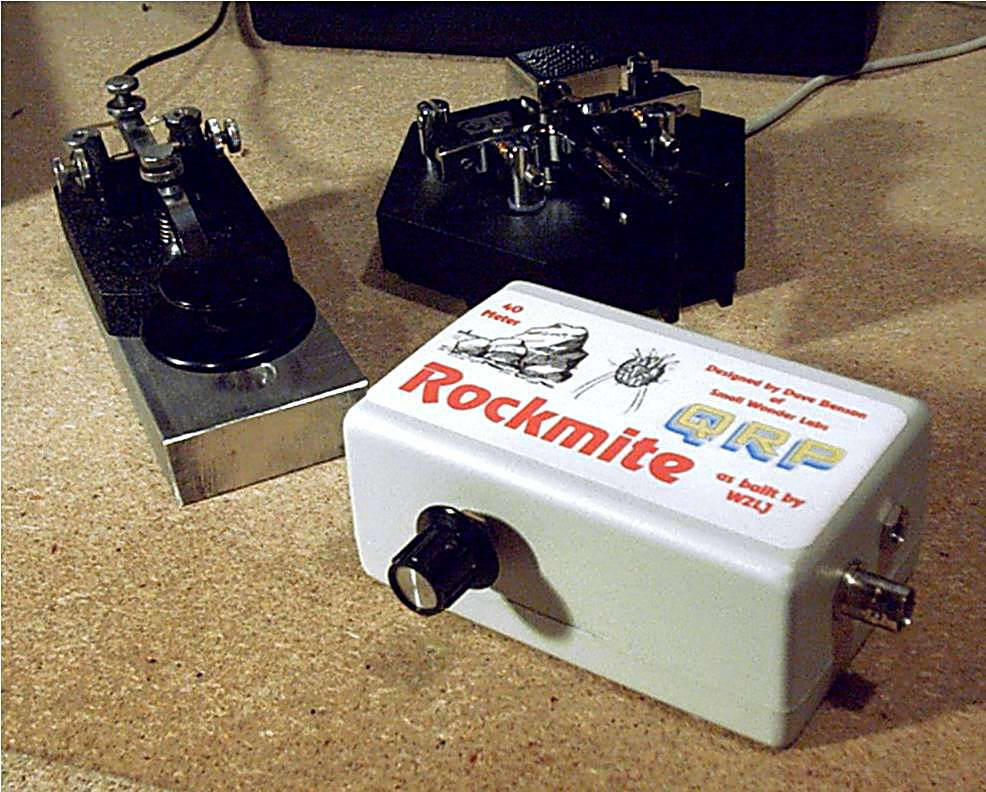
Last year, I purchased and assembled a Rockmite kit for 40 Meters. For those of you not familiar with the Rockmite series of transceivers; Rockmites are monoband radios that are crystal controlled and are capable of putting out about 250mW for the stock version.
I built my Rockmite last year; but then purchased my K2 and the Rockmite circuit board kind of fell on the wayside. Recently, I had put it in an enclosure and just tonight I had my first two QSOs with it.
This is really my first venture into the world of QRPp (output power of less than 1 Watt) and it was satisfying, exhilirating and a ton of fun. I called CQ for a bit to see what would happen; and was answered by Phil KC4QQ out of Lake City, TN. We had a nice QSO going until QRM and QSB did my flea power signal in. But it was a completed QSO, by the rules, as we did indeed exchange the basics - RST, name and QTH.
A few moments later I heard a station calling CQ and decided to give it my best shot. Frank NF8M out of Novi, Michigan was calling CQ and he signed NF8M/RM. John was using a Rockmite also! Since both rigs are crystal controlled and are on the same frequency; I figured he'd probably hear me call him. My hunch was correct! We exchanged names, QTHs, RSTs and antenna info. before Frank decided to go casting for other Rockmite users.
It is truly amazing how far 500 milliWatts can go! I received a solid 549 signal report from Frank, which is truly not bad at all. There are many times when I use the K2 with the full QRP Gallon (5 Watts !!!!) and get only a 559 report - so 549 was totally acceptable.
I haven't really done much QRPp work until tonight. I think I may be getting hooked! The fun and excitement and satisfaction equals any that I've ever received acquiring a new country with QRO power.
73 de Larry W2LJ
Wednesday, June 15, 2005
Working the world with just a few Watts
So the HF9V is back in operation; and it's time to put it through its' paces. I tune around 20 Meters and at 2207 UTC on June 14th, I put out a CQ. My thought was that if I was lucky, I'd work a FISTS station or two. Sure enough, out of the background hiss comes a weak station pounding out my callsign. The QSB is tough and the atmospheric noise is kind of high. I ask for a repeat and this time the call comes through! It's IK/DL4NDE.
The operator's name is Bernd; and he lives in Germany; but is on vacation (holiday?) in Italy. Bernd is using the venerable Heathkit HW-8 to a dipole. Because of conditions, the CW is slow; but we exchange information and pleasantries. The QSO lasts only about 15 minutes but once again, just a few Watts have spanned the globe.
My 5 Watts have jumped a vast and mighty ocean; as have Bernd's 4 Watts coming back to me. With less power than is consumed by a nightlight bulb, effective communications occur between Italy and the United States. The thought of the distance involved is fascinating. It would take approximately nine hours to fly that distance in a 747. Our little QRP rigs closed that gap at the speed of light. Somewhere, Mr. Marconi is smiling.
Amateur Radio is magic. I dare anyone to tell me differently.
73 de Larry W2LJ
The operator's name is Bernd; and he lives in Germany; but is on vacation (holiday?) in Italy. Bernd is using the venerable Heathkit HW-8 to a dipole. Because of conditions, the CW is slow; but we exchange information and pleasantries. The QSO lasts only about 15 minutes but once again, just a few Watts have spanned the globe.
My 5 Watts have jumped a vast and mighty ocean; as have Bernd's 4 Watts coming back to me. With less power than is consumed by a nightlight bulb, effective communications occur between Italy and the United States. The thought of the distance involved is fascinating. It would take approximately nine hours to fly that distance in a 747. Our little QRP rigs closed that gap at the speed of light. Somewhere, Mr. Marconi is smiling.
Amateur Radio is magic. I dare anyone to tell me differently.
73 de Larry W2LJ
Antenna problem solved
Without the availibility of an antenna analyzer, I was able to figure out my antenna problem using a process I like to call "troubleshooting by elimination"; or otherwise known as common sense.
As I mentioned before, my Butternut HF9V went "deaf". I couldn't hear signals through it; or even more strangely, would stop hearing signals though it as soon as I applied RF energy to the antenna. Taking off the coax from the 75 Ohm matching stub; and hooking up my K1 and battery yielded plenty of signals. In my mind, that pretty much eliminated the antenna proper.
The next step was to remove the 75 Ohm matching stub for examination. The matching stub, as supplied by Bencher, is nothing more than a 15 foot length of RG-11 coax with a PL-259 on one end and two ring terminals on the other. One ring terminal is connected to the center conductor, the other to the shield. Examination revealed that the connection to the ring terminal for the center conductor was pretty badly frayed. The center conductor is multi-stranded wire and about 75% of the strands had broken. The logical step at this point was to replace both ring terminals and the PL-259 on the other end. A few minutes worth of work; and this was done. I trotted out to the antenna and installed my newly repaired matching stub. Unfortunately, the result was the same. The antenna was either deaf; or would soon go deaf after applying enough RF to send out a "QRL?".
The only left that could be bad was the coax itself. I kept on asking myself how coax could go bad. I have no idea. When I installed it, I had weatherproofed it pretty well to my own satisfaction; so water pentration was pretty much out. The only thing left to do at this point was to replace it, cross my fingers and to hope for the best. Thinking that maybe, just maybe, my two children might have damaged it by walking on it, stomping on it; or possibly by whacking it, I decided to go with something more robust. I had been using mini RG-8 because it's so flexible and easy to work with. This time I went with super low-loss "standard thickness" RG-8. Since I've gone totally QRP, I figured the less lossy cable could only be a benefit. I ordered 150 feet from the Wireman; and when the first opportunity for a small amount of free time presented itself, I installed it.
I went back down to the shack and hooked up the PL-259 to my antenna switch. I turned on the K2, switched on the HF9V and was greeted by plenty of loud signals which were quite comparable to the signals received by my G5RV. A simple little amount of switching between the two bore this out. The next test was to apply some RF and see what would happen. I found a clear spot on 20 Meters and sent out a "QRL?" in Morse, of course! To my relief, the antenna seemed to be whole again! This was quickly followed by a short QSO with another QRP station and the matter was finished.
Moral of ths story? If you're a married Ham with little children who play in your backyard; then do yourself a favor when it comes to picking out the coax for your antenna system. Forgo the more flexible cable and purchase the heavy duty stuff. Then maybe you won't be scratching your head someday, like I was!
73 de Larry W2LJ
As I mentioned before, my Butternut HF9V went "deaf". I couldn't hear signals through it; or even more strangely, would stop hearing signals though it as soon as I applied RF energy to the antenna. Taking off the coax from the 75 Ohm matching stub; and hooking up my K1 and battery yielded plenty of signals. In my mind, that pretty much eliminated the antenna proper.
The next step was to remove the 75 Ohm matching stub for examination. The matching stub, as supplied by Bencher, is nothing more than a 15 foot length of RG-11 coax with a PL-259 on one end and two ring terminals on the other. One ring terminal is connected to the center conductor, the other to the shield. Examination revealed that the connection to the ring terminal for the center conductor was pretty badly frayed. The center conductor is multi-stranded wire and about 75% of the strands had broken. The logical step at this point was to replace both ring terminals and the PL-259 on the other end. A few minutes worth of work; and this was done. I trotted out to the antenna and installed my newly repaired matching stub. Unfortunately, the result was the same. The antenna was either deaf; or would soon go deaf after applying enough RF to send out a "QRL?".
The only left that could be bad was the coax itself. I kept on asking myself how coax could go bad. I have no idea. When I installed it, I had weatherproofed it pretty well to my own satisfaction; so water pentration was pretty much out. The only thing left to do at this point was to replace it, cross my fingers and to hope for the best. Thinking that maybe, just maybe, my two children might have damaged it by walking on it, stomping on it; or possibly by whacking it, I decided to go with something more robust. I had been using mini RG-8 because it's so flexible and easy to work with. This time I went with super low-loss "standard thickness" RG-8. Since I've gone totally QRP, I figured the less lossy cable could only be a benefit. I ordered 150 feet from the Wireman; and when the first opportunity for a small amount of free time presented itself, I installed it.
I went back down to the shack and hooked up the PL-259 to my antenna switch. I turned on the K2, switched on the HF9V and was greeted by plenty of loud signals which were quite comparable to the signals received by my G5RV. A simple little amount of switching between the two bore this out. The next test was to apply some RF and see what would happen. I found a clear spot on 20 Meters and sent out a "QRL?" in Morse, of course! To my relief, the antenna seemed to be whole again! This was quickly followed by a short QSO with another QRP station and the matter was finished.
Moral of ths story? If you're a married Ham with little children who play in your backyard; then do yourself a favor when it comes to picking out the coax for your antenna system. Forgo the more flexible cable and purchase the heavy duty stuff. Then maybe you won't be scratching your head someday, like I was!
73 de Larry W2LJ
Saturday, May 28, 2005
Antenna woes!
I have two antennas at station W2LJ. One is a G5RV at about 30 feet, or so. The other is a ground mounted Butternut HF9V vertical. I was on 20 Meters the other night and the station I was trying to work on the G5RV was kid of weak; so I decided the switch over to the Butternut. Imagine my surprise when the Butternut came up deaf! I was hearing nothing; not even background QRN.
Unfortunately, I lack an antenna analyzer; so I needed to do some basic detective work. Basicaly, I knew there could only be a few things wrong. I decided to start with the concept of, "it's either the antenna itself or the feedline". A basic ohmmeter check of the coax revealed no shorts. I then decided to take the lightning arrestor out of line - maybe something was wrong with that. So I put a barrel connector in it's place; only to get the same results.
Scratching my head for an idea of what to do next, I decided to break out my K1 and 12V SLA battery and hook it right to the HF9V's 75 ohm coax matching stub. Viola! Plenty of signals! So at least now I know the antenna itself is okay. The amazing thing is that when I put everything back together; a trip to the shack shows that everything is back to normal. I'm hearing all kinds of stations and even manage to work a few Europeans with 5 Watts and the K2.
I go back outside to wrap the connections up in electrician's tape, when I notice it. The jacket has backed away some on the 75 ohm matching stub. Right next to the PL-129, I can see tarnished braid. The antenna is working for now; but the first chance I get when we get some dry weather, I will replace both PL-259's. I don't need intermittent headaches!
73 de Larry W2LJ
Unfortunately, I lack an antenna analyzer; so I needed to do some basic detective work. Basicaly, I knew there could only be a few things wrong. I decided to start with the concept of, "it's either the antenna itself or the feedline". A basic ohmmeter check of the coax revealed no shorts. I then decided to take the lightning arrestor out of line - maybe something was wrong with that. So I put a barrel connector in it's place; only to get the same results.
Scratching my head for an idea of what to do next, I decided to break out my K1 and 12V SLA battery and hook it right to the HF9V's 75 ohm coax matching stub. Viola! Plenty of signals! So at least now I know the antenna itself is okay. The amazing thing is that when I put everything back together; a trip to the shack shows that everything is back to normal. I'm hearing all kinds of stations and even manage to work a few Europeans with 5 Watts and the K2.
I go back outside to wrap the connections up in electrician's tape, when I notice it. The jacket has backed away some on the 75 ohm matching stub. Right next to the PL-129, I can see tarnished braid. The antenna is working for now; but the first chance I get when we get some dry weather, I will replace both PL-259's. I don't need intermittent headaches!
73 de Larry W2LJ
Subscribe to:
Posts (Atom)