I saw on Facebook this morning, that many were thanking the VK0EK expedition for the ATNO and were thanking them, in general, for a wonderful DXpedition. I would suspect they have gone QRT.
And I would guess I'm in the minority as I'm not in any of their logs. In fact, I never even heard them decently well enough to work them. There were a couple of times that I could tell they were on a given frequency, but they never loud enough that I would be able to hear my own call come back to me, on the off-chance that they would have heard me. It didn't seem right to just add to the QRM.
Am I disappointed? You're darn tootin' I am! Working VK0EK would have been an ATNO for me and I sure as heck would love to have them in my DXCC tally. But I'm not depressed about it.
It all goes back to that post a few weeks ago about balance. Yes, I do not have Heard Island as an entity worked. However, the sun is still shining, the birds are still chirping, our solar system is still plowing its way throughout the galaxy. I still have to go to work tomorrow and earn a living.
And while I didn't work them, and life goes on, I still applaud their effort. It's not easy to go to a remote island near Antarctica, and brave the elements and hardships to provide the rest of us Amateur Radio ops with a bunch of excitement and fun.
Thank you Team VK0EK - even though I'm not in your log - thank you for a job very well done, indeed!
72 de Larry W2LJ
QRP - When you care to send the very least!

Sunday, April 10, 2016


Sunday, April 03, 2016
A popular misconception
I saw this on Facebook:

"Why do we always congratulate the QRP operators...?!?! The ones who REALLY need congratulating are the guys/gals who smash the headphones to their head, desperately trying to make sense out of the distant RF they're hearing to make the QSO. The "skill" in QRP operation is not so much the operator employing it, but the operator trying to pull it out of the mud!"
So let's examine this for a bit ..... is this true?
A lot of times ..... yes. A lot of time the credit should go to the stations that pull out our sometimes weak signals. And for these times, we offer a hearty "Thank You!"
However, there's a popular and stubborn misconception, or premise here at work here, if you will:
"QRP = Weak Signal"
Many times, this IS the case, but many times IT IS NOT.
This is where propagation and band conditions come into play, my friends. And if you've spent any time at all on the HF bands, you would know better than to make the above statement, because a weak signal can be produced by any station. It's not necessarily an indicator of how much power they're running.
Many have been the times when I've had problems pulling a 100 Watt or better signal out of the muck. This could be due to the fact that the station I was trying to work was in the skip zone, the band on which we were working was only "so-so" that day, or for a plethora of other reasons.
Many have been the times when other QRPers have literally blown the cans off my ears with their 5 Watt signals (N9NE comes to mind, on a regular basis). So in the end, you really can't "'judge the book by its cover", nor make assumptions about the station based on the loudness of its signal.
The station that's pinning your needle just might be a QRPer, while the station that you can barely hear may be running a kilowatt. It's all in the antenna, the band, and the ionosphere, and how all these elements are interacting at the moment.
So what's the lesson to be learned?
1) Don't be afraid to try and work the weak ones. I have been guilty of this myself. There have been instances where I thought "Oh, this guy is never going to hear my 5 Watts!", only to find out that he was running 100 Watts, or better ........ but for whatever reason, he was hearing me much better than I was hearing him.
2) Propagation is not always reciprocal. (This is #1 in reverse.) Just because the station you are hearing is 20 dB over 9 doesn't necessarily mean you will be heard equally as well at their end. There may be a high background noise level on their end that you don't know about. Yes, it IS frustrating as all get out, but don't beat yourself up because the "loud one" didn't hear you. Sometimes, it just works out that way.
3) Power is relative, but it's not an absolute. So as I've said so many times before, you should just forget that you're a QRPer. You're just another fish in the Amateur Radio sea. A smaller fish for sure, but just another fish. And sometimes, just sometimes, the smaller fish gets away with snagging the bait and swimming away to play another day, while the big fish gets snagged by the hook and ends up on the dinner plate.
72 de Larry W2LJ
QRP - When you care to send the very least!
Friday, April 01, 2016
Hanging it up
After 11 years of blogging about Amateur Radio, QRP and CW, I've come to the conclusion that everything that needs to be said has been said. I've run out of ideas and new ways to express the old ones.
So with this blog post, this will be the end of "QRP - Do More With Less".
It's been a good run and I'd like to thank all of you out there who have been faithful readers over these past 11 years, but I think it's time to hang it up.
72 de Larry W2LJ
QRP - When you care to send the very least!
So with this blog post, this will be the end of "QRP - Do More With Less".
It's been a good run and I'd like to thank all of you out there who have been faithful readers over these past 11 years, but I think it's time to hang it up.
72 de Larry W2LJ
QRP - When you care to send the very least!
April Fool!
Didn't think I was going away that easily, did you? Naah, I enjoy this too much and will keep on going, the Good Lord willing and the creek don't rise!
Thursday, March 31, 2016
Isn't that horse dead yet?
Yet another thread on QRP-L on why the Yaesu FT-817 is better than the Elecraft KX3.
Sheesh! Haven't we beaten that horse to death yet?
Maybe it is, maybe it isn't. Different strokes for different folks. Either way, I thought we all outgrew those "My Dad is bigger than your Dad" arguments when we were about 7 years old.
Give it a rest, already, it's getting old.
72 de Larry W2LJ
QRP - When you care to send the very least!
Wednesday, March 30, 2016
My log book experimentation obsession - has it come to an end?
Let's see if I get the timeline straight ..... things get fuzzier as one grows older!
For the first 15 years or so of my Amateur Radio career, I used the "ol' stand by" ARRL paper log books for logging my QSOs. I think everyone did - well, log books, I mean. If you didn't use the ARRL ones, you probably used giveaways that used to be handed out as promotional items by Yaesu and Kenwood, or perhaps you just used a regular spiral notebook or loose leaf in a binder.
About the mid 80's, I discovered Log-EQF and used it for several years. It was fast, intuitive and did not require much in the way of computer processor power. It was a DOS based program with a UNIX look and feel to it. It was great because the comments space for each QSO was vast, and my log book became sort of a QSO diary in addition to recording the essential QSO data. The fact that it ran great on 80286 and 80386 machines was icing on the cake.
As Windows developed and became more popular, Log-EQF transformed into Win-EQF. I thought that with the transition to becoming a Windows based program that the developers would update the look and make it appear more like other Windows programs. Sadly, they kept the UNIX appearance and I guess I'm shallow - but I wanted something that was more aesthetically pleasing.
So I purchased a copy and switched over to AC Log for a while. I did that based on the raves everybody was giving it (and still do). Having a a junker computer at the time, the program would hesitate on me as I tabbed through the data entry fields. The biggest glitch would come when I tabbed from the last "normal" field to one of the custom fields that I had renamed "Rig/Ant". The program would freeze up on me for about 3 or 4 seconds before jumping to the custom field. Not sure what that was (as I stated above, it was probably due to not having enough processor power or perhaps not enough RAM installed), but it drove me mad, particularly while trying to simultaneously log and carry on a QSO.
So while I kept using AC Log, I kept looking for alternatives. Here were my three main requirements:
1) The program had to be aesthetically pleasing to the eye.
2) The program had to be relatively easy and intuitive to use.
3) The program had to work well with my less than state of the art computer.
4) The program didn't have to be free, but that would be a bonus.
I think I downloaded and tried just about every freebie and/or demo logging program out there. Some worked great, but didn't have the features I wanted, while others had the features I wanted, but didn't work on my computer. I settled upon three different programs - Ham Radio Deluxe, the DX Labs Suite and Log4OM.
The DX Lab Suite is about as complete as they get. If you want a feature in a log book program, "It's in there!" as the old spaghetti sauce commercial goes. The problem was that so many bells and whistles came with a steep learning curve. This program takes a long while to become comfortable with and I never did.
Log4OM was easy to use, easy to set up, pleasing to the eye and full featured. You would think this would end up being my choice, right? Well, it did - but not right away. For a while, it came in second.
For a time, I went with Ham Radio Deluxe, back when it was run and maintained by Simon Brown. It had everything I wanted, was relatively easy to use and pretty intuitive, and was very easy on the eyes. It was free, but I was sending a donation to Simon every now and then for all his hard work.
Then he went and sold the rights to it. HRD became a commercial product and I even bought the rights to it for one year. Improvements were made and it ran well on my XP computer. Then I bought a laptop which had Windows 7 on it, and unfortunately I had some trouble getting HRD to work correctly. Eventually, I got it working just fine, until one day when Windows went and updated on me. The next day, all my previous efforts went for naught and all went kaput in my HRD world. I started getting all kinds of new errors and lo and behold, my year's worth of support had run out, and I ran out of patience (which has never been my strong suite).
So I went back to Log4OM, my second runner up, and I'm so glad I did. In addition to being easy and intuitive to use, there were several other things about it that made me additionally happy about the change.
1) It installed, quickly, easily and without a hitch.
2) The interface between Log4OM and LotW and eQSL are so simple, even I was able to figure them out.
3) I have since upgraded to Windows 10 and have had several windows updates and Log4OM keeps on ticking like nothing has ever changed.
4) There's actually a comprehensive User's Manual available on-line that you can download to refer to any time you need it.
5) There's a forum at the Log4OM Website that Danielle IW3HMH and Terry G4POP monitor and you actually get answers to questions. And they'll even incorporate suggestions and features into future releases of the program, if they deem it worthwhile.
6) Their DX Cluster tab is the bomb! If you hook up your rig to the program via CAT control, you can enable the program so that as you change bands, the Cluster will display spots only for the band that you're currently on. Other software programs probably offer that feature as well, but Log4OM does it so nicely.
I have been a happy Log4OM user now for a couple of years and an so happy that I'm not even tempted to go and look at "new kids on the block" when they pop-up from time to time.
And to answer any skeptics out there, no, I don't receive any consideration or kick-back from Danielle or Log4OM for relating my experiences here, I'm just a happy, very satisfied user and am hoping that others can be, too. And I intend on being a happy, very satisfied user for a long, long time.
As for AC Log, it works quite well on my current laptop with no issues. I use it for keeping the NJ2SP log, as many other members of the South Plainfield Amateur Radio Club use AC Log as their primary logging software and I can easily share the file with them. For personal use, Log4OM has features that I like that AC Log doesn't, and I like those features too much do without.
72 de Larry W2LJ
QRP - When you care to send the very least!
Tuesday, March 29, 2016
They're still up!
My antennas, that is.
After yesterday afternoon and last night, I expected to wake up to find my W3EDP at ground level and my Butternut HF9V bent at 90 degrees somewhere along its length. In retrospect, my fears were probably silly as my antennas withstood Hurricane Sandy with nary a whimper, but ...........
Last evening, as I lay in bed, struggling to fall asleep, the winds were howling, and I do mean HOWLING. Not an exaggeration, they were dong their best to imitate a freight train passing underneath our windows. But, thanks be to God, both antennas are still up, working, functional and never the worse for wear. Dodged another bullet - whew!
I find myself in somewhat of a quandary. I e-mailed my buddy, Bob W3BBO about this. I see all the posts on Facebook about the Heard Island DXpedition. All these people seem to have worked them on so many bands and with so many different modes.
I just can't bring myself to even bother trying.
It's not that I don't need them. Working VK0EK would be an ATNO for me. Never worked Heard Island before, It just seems, that for some reason or other, I just don't feel like jumping into the fray. On the other hand, Yosemite National Park was on 20 Meter SSB last night, I spent close to half an hour unsuccessfully trying to bust that pileup, before they faded into oblivion. So it's not that my competitive instinct has disappeared. Not sure what my problem is.
I'm sure whatever it is, that like everything else, it's cyclical and one day I'll be jumping into the DXpedition pileups with both feet again.
72 de Larry W2LJ
QRP - When you care to send the very least!
Sunday, March 27, 2016
Easter Sunday - 2016

"Why do you search for the Living One among the dead?
He is not here, He has been raised up"
2016 years later, that tomb is STILL empty.
Wishes for a Blessed and Joyous Easter to all of you and your families and loved ones,
Larry W2LJ
Friday, March 25, 2016
Good Friday - 2016

Yet it was our infirmities that he bore, our sufferings that he endured, While we thought of him as stricken, as one smitten by God and afflicted.
But he was pierced for our offenses, crushed for our sins, Upon him was the chastisement that makes us whole, by his stripes we were healed.
We had all gone astray like sheep, each following his own way; But the LORD laid upon him the guilt of us all.
Though he was harshly treated, he submitted and opened not his mouth; Like a lamb led to the slaughter or a sheep before the shearers, he was silent and opened not his mouth.
Oppressed and condemned, he was taken away, and who would have thought any more of his destiny? When he was cut off from the land of the living, and smitten for the sin of his people,
A grave was assigned him among the wicked and a burial place with evildoers, Though he had done no wrong nor spoken any falsehood.
Good Friday blessings - W2LJ
Thursday, March 24, 2016
QRPTTF - Saturday, April 23rd
Paul NA5N put this preliminary announcement on QRP-L the other day. Like the NJQRP Skeeter Hunt, QRPTTF will be incorporating NPOTA into the mix:
Gang,
I've been working on the 2016 QRP To The Field website, rules, links, deleting old stuff, etc. all night, but taking longer than I thought. So to not cause any further delay, here's a HEADS UP on this year's QRPTTF.
Open to all QRPers, SOTA ops, and ARRL NPOTA participants (running QRP)
DATE: Saturday, April 23, 2016
TIME: 0800-1800 your local time U.S.
THEME: "Park It Here"
Operate from any National Park, State Park, or AOP (Any Ole Park). This is designed to be compatible with the ARRL's NPOTA - for those participating in the ARRL's National Parks On The Air. Thus, QSOs for QRPTTF will also count for the NPOTA if operating from an NPS qualified park or facility. If more convenient, operate from a nearby State Park, Municipal Park, or other park for the "Park" multiplier. SOTA stations operating from a qualified summit (and who doesn't?) also count as a "Park" multiplier.
That should be enough for now to mark your calendars, charge your batteries, dust off your field rig, and come up with a good excuse on why you will be gone Saturday, April 23.
Website coming soon.
72, Paul NA5N
I've said this before ... when you come right down to it, NPOTA is perfect for QRPers. It doesn't have to be complicated, it doesn't have to be a mini Field Day (unless you want it to be, of course). Personally, when it comes to portable ops, I feel the simpler, the better - a la` Jim W1PID, Steve WG0AT and countless others .....a rig, a battery and an antenna, and a whole lotta fun..
There's nothing like QRP and the Great Outdoors!
72 de Larry W2LJ
QRP - When you care to send the very least!
Tuesday, March 22, 2016
The Radio Amateur's Code
The Radio Amateur's Code
CONSIDERATE...He/[She] never knowingly operates in such a way as to lessen the pleasure of others.
LOYAL...He/[She] offers loyalty, encouragement and support to other amateurs, local clubs, the IARU Radio Society in his/[her] country, through which Amateur Radio in his/[her] country is represented nationally and internationally.
PROGRESSIVE...He/[She] keeps his/[her] station up to date. It is well-built and efficient. His/[Her] operating practice is above reproach.
FRIENDLY...He/[She] operates slowly and patiently when requested; offers friendly advice and counsel to beginners; kind assistance, cooperation and consideration for the interests of others. These are the marks of the amateur spirit.
BALANCED...Radio is a hobby, never interfering with duties owed to family, job, school or community.
PATRIOTIC...His/[Her] station and skills are always ready for service to country and community.
The original version of this was written in 1928, by Paul M Segal W9EEA, and it's been modified over the years as things change with the times. The core message remains the same though, as it's pretty much timeless.
The one trait that I want to touch upon today, is the "Balanced" one.
The Radio Amateur is:
BALANCED...Radio is a hobby, never interfering with duties owed to family, job, school or community.
Sometimes, I think we forget this one the most, and the evidence is not that hard to find. Take a wander on over to Facebook, or listen to a repeater and it's pretty obvious that some of us become seriously preoccupied or obsessed with such activities as NPOTA, contesting, DXing, county hunting, SOTA, etc.
Amateur Radio, on the whole, and these activities in particular are good and wholesome things. For instance, I'm certain that a lot of our wives, husbands and significant others would rather have us in the shack, yakking away on our radios than spending the month's mortgage money in bars,saloons, casinos or race tracks.
But it's easy to lose focus and become obsessed. Radio sport that involves chasing that elusive country, county, SOTA peak, NPOTA entity or whatever should never become the focus of our lives, or our reason for being. Just as purchasing that new rig, antenna, or piece of test equipment should never result in being unable to pay the mortgage, rent or put food on the table. It should also never result in the kid's college fund being raided.
Do you enter the shack on a Friday night for a contest, only to emerge late Sunday evening or early Monday morning? That's not good, my friends.
Even an essential thing can become bad, if you're not careful. Are you that someone who HAS to be at every civic function or training class? Even public service, as worthy and noble a cause as it is, should never become between you and your family. Before going out to respond to any disaster or emergency, the health and welfare of your loved ones should always be your top priority. If they're not taken care of, you don't go.
The bottom line is that there's more to life than Amateur Radio. In our quest to satisfy our passion, sometimes we forget that. Family, friends, loved ones and those relationships are way more important, and should always come before getting that high score, or working that 300th country or buying that newest, latest and greatest radio.
Always keep in the back of your mind that the greatest gift you can give your family is your time. If you're doing OK with that, then you're doing a good job with the "Balanced" part of The Radio Amateur's Code.
72 de Larry W2LJ
QRP - When you care to send the very least!
Saturday, March 19, 2016
I had hoped for better results
As planned, I went and activated Morristown National Historical Park (HP28) for NPOTA. Things didn't turn out as well as I had hoped; but it was still a good time nonetheless.

I got to the park on time, right before Noon (1600 UTC). I allowed my TomTom GPS unit to bring me up to Jockey Hollow via a new route which I had never taken before. This brought me up through the Great Dismal Swamp, which is designated as a National Wildlife Refuge. It is truly a beautiful area and as I was driving through, I could see herons and egrets and all sorts of birds in the marshes. Seeing that the Great Dismal Swamp is designated as a National Wildlife Refuge, I was wondering why it's not listed as one of the NPOTA WR entities. A little Googling revealed that the Swamp is administered by the United States Fish and Wildlife Service and not the National Parks Service. That's a shame because that would be a really beautiful area to set up a portable operation from.
Anyway, I got to the Park and got set up, which by now, only takes me a few minutes. After so many lunch time QRP sessions, I could do this in my sleep, or with my eyes shut.

Since I was planning on operating some SSB in case there was a lack of activity, I brought along my big, heavy Werker deep cycle battery. I figured that this way, I could operate for an extended period of time at the 10 Watt SSB level if I needed to. And boy, did it turn out that I needed to!
The first thing I did after setting up was tune to around 14.061 MHz - the neighborhood of the QRP Watering Hole. I was shocked by what I heard - wall to wall CW signals! There was literally nowhere to sit where there wasn't a station calling "CQ TEST". I didn't realize that today was the RUDX, the Russian DX Contest - and boy, it filled the band!
I went on up to 17 Meters and heard some Europeans that were very loud. Knowing that meant the band was wide open, I easily found a clear spot at 18.082 MHz and proceeded to call "CQ NPOTA". The band was wide open, but as it turned out, there wasn't much if any activity. I worked K0IG right off the bat and then ...... nothing.
Not wanting to waste too much time, I got out of the Jeep and switched from the Buddistick to my 40 Meter Hamstick. I went down to 7.037 MHz, called CQ and was greeted by the normal NPOTA pileup. I was stoked and began to work station after station. The only bad thing was that the initial pileup lasted for only a few minutes, and then I began the monotonous routine of calling "CQ NPOTA" and waiting minutes in between answers.
Getting bored, I decided to give 20 Meters another try. Off came the Hamstick and up went the Buddistick. I called CQ for a bit and got a couple of QSO completed on 14.060 MHz, but it was tough. The stations calling me were loud, but their calls were being blanketed by even louder DX stations. Those guys had to be using mondo power. How much do they allow over in Europe, anyway?
Sitting there, disappointed as heck, I was ready to pack it in and head home a bit early. Then an inspiration occurred that maybe I should give 20 Meter SSB a whirl. Even though I'm not an avid fan of SSB, I decided to give it a shot. I was rewarded with a small run of about a dozen stations before that too, ended up petering out.
I had gone up to HP28 with a spiral notebook, thinking I would fill pages with call signs. After all, my outing to TR23 in January netted me over 80 QSOs. For some reason. I was thinking I would break that record easily. Just the opposite happened! I ended up with only 27 QSOs - but you know what? I discovered that a bad day of Amateur Radio is STILL better than a good day at work. So I'm a happy camper, anyway.
This only gives me more incentive to go back up to HP28 later this year, but this time throw a wire into a tree. I know that's kind of verboten, and on Facebook, someone actually related how they were asked to leave a park the other day for doing that. With that in mind, just before I left, I went to the visitor center and explained that I was an Amateur Radio operator and what NPOTA was (she knew what it was, by the way) and asked if there was any prohibition about wires in trees. She said as long as it was temporary, and would cause no damage and would not interfere with anyone else's visit, that they were OK with it.
So when I got back to the car, just for the heck of it, I attempted to launch a line over a limb just to see how it would go. 30 plus feet on the first try.
I'll be back, Jockey Hollow!
72 de Larry W2LJ
QRP - When you care to send the very least!
Thursday, March 17, 2016
Easy listening
I had a wonderful experience today during my lunch time QSO. Not hearing any NPOTA or SOTA station on 20 Meters, I decided to go on up to 17 Meters. There was not much activity there, so I decided to call CQ around 18.086 MHz.
I was answered by Benny K5KV - who I can only describe as "The Master Bug Fist".
His fist was as smooth as melted chocolate on a hot fudge sundae on a Saturday in August. At first I thought he was using a keyer and paddles. But when he came back to me and said, "I switched to a slower bug for you ......", I was like "Oh .... wow!" (I was loafing around 20 WPM.)
It's not often you hear a bug fist as smooth as Benny's. Most bug fists (mine included) have a swing to them, as it's really, really hard to get that dit to dah changeover and the timing ratio down. Like many people, I tend to accentuate the dahs, as they are totally manually generated. As a result, my bug fist is not as smooth as I would like it to be.
Benny's is as close to perfection as you can get. In fact, Benny's fist is so smooth as to be musical. He had the spacing and rhythm down pat. His is a fist you could listen to all day .... where the words just appear on a piece of paper that's inside your brain. The definition of armchair copy.
I wish that I had a recording device with me so that I could share the experience with all of you. It was THAT good.
72 de Larry W2LJ
QRP - When you care to send the very least!
Wednesday, March 16, 2016
Weather forecast is looking good
The weather is looking good for Saturday for my planned expedition to Morristown National Historical Park (NPOTA HP28) this coming Saturday. Sunny with high temperatures in the upper 40s (9C) Hopefully, there will be no curve balls out of Left field that will preclude me from going.
The plan is to leave the house somewhere around 11:00 AM (1500 UTC) and be up there and on the air by around 12:00 Noon (1600 UTC). I plan on working 40, 20 and 17 Meters - CW around the QRP watering holes. I'll be packing some water and snacks and hope to stay for three or four hours. I am going to see if I can get the PAR END FEDZ 40/20/10 up in a tree in the parking lot. If not, I'll just rely on the Buddistick for 20 and 17 Meters and a Hamstick for 40 Meters.
Last Saturday, I went to the Cherryville hamfest out in Flemington, NJ which is run by the W2CRA, Cherryville Repeater Association. This was the very first hamfest that I ever went to as a newbie Ham back in 1979, and it's always held a special place for me. Unfortunately, over the years (and especially since the dawn of eBay) the Cherryville hamfest seemed to be on the down slope. Like a lot of hamfests, it suffered from poor attendance, lack of vendors, etc was plaguing it - and seemed to be spiraling towards its death knell.
Happily, between last year and this year, that trend seems to be reversed. Attendance is still nowhere near where it used to be, but it's growing. The number of vendors is still down (but again, growing), and for the most part the really bad junk is gone - and by junk I mean non-ham related garbage. I mean really, who wants to buy a roto-tiller at a hamfest? Sure there's still lots of non-Ham stuff to be seen, but it also seems there are more and more treasures to be found.
I purchased some new SO-239 chassis connectors as well as two old butterfly type variable capacitors that I got for five bucks. The capacitors have long stems on them, so they should be useful in my magnetic loop antenna project. I need to clean them up with some contact cleaner, but some initial testing seems to indicate that they are in the 200 pF range. KJI Electronics was there, and I purchased a Diamond antenna for my VHF/UHF handheld. What a difference when you buy the real brand and not a cheap knock-off!
Before I forget ........ I have a friend who has a "hardly used, very good condition" SGC-2020 QRP radio that he wants to sell. I am not privy to the price. But if you're interested, send an e-mail to w2lj@arrl.net and I will forward it on to him. He's not looking for eBay type money, but he's not interested in getting taken, either.
72 de Larry W2LJ
QRP - When you care to send the very least!
Monday, March 14, 2016
Respect and learning
Whew!
There's an ongoing discussion on the ARRL NPOTA page on Facebook. It appears that a newbie Ham activated a Historic Site and posted a picture about it on Facebook. The problem is, that from the picture posted, it's apparent that the operation took place in front of the site, on a street instead of on the actual property of the Historic Site. As a result, his activation was disqualified.
In NPOTA rules, that's a no-no, unless you get dispensation from the ARRL after explaining mitigating circumstances. In the case of an Historic Site, an NPOTA activation has to take place on the actual site, its parking lot or driveway - not on the public street in front of it, as that space in NOT administered to by the National Park Service.
Instead of dealing with the mistake and the ensuing disappointment, the newbie Ham resorted to what only can be politely described as a ...... umm, err ............ lengthy bout of whining. He was whining about why he thought the rule was faulty, in his case, and then he started whining about the rules in general and about Sean Kutzko, the NPOTA Administrator, in particular. He also whined about the lack of a prompt response and how he perceived that others in the group were "disrespecting him."
I try to stay away from such threads as they quickly become emotional quicksand. The guy is disappointed and seems to be hurt by what he believes to be a lack of support from the Ham Community in general. But I had to reply. Basically this is what I said ......
"(Name withheld), yes, you're right, we all started from nowhere. And we've all made our share of mistakes. You can choose to learn from it, carry on and have the satisfaction of having gained some experience, or you can choose to stew about it. Not trying to be snarky or disrespectful, but each and every one of us has been down that road. Just remember that nothing worthwhile comes easy ..... and as a wise old boss of mine once said, "Respect is earned and not granted."
I've noticed that some of the younger generation can't seem to refrain from using the "vulgar vernacular" of the streets in their posts. There's no need for street language or "cussing" in a discussion with people who are other than your immediate circle of friends. IMHO, using that type of language is not conducive to earning the respect you are so desperately seeking.
And then the matter of making the mistake. So what? We've all made them. Some way more serious and costly than this. All he lost was time, basically. Some (many) of us have made mistakes that have cost money, like blowing up power supplies, or frying finals, for example. But even there, you have the choice on how you want to handle it. You can learn from your mistake and move on, or you can throw yourself a pity party (to be blunt).
It's smarter to move on and learn. If he's like most of us, he won't make the same mistake again.
72 de Larry W2LJ
QRP - When you care to send the very least!
Friday, March 11, 2016
Thinking
Even though the long range forecast for Saturday, March 19th is calling for rain and drizzle, I am contemplating doing another NPOTA activation. The weather this time of year is always changing, so I am hoping that next Saturday will actually turn out nice.
This time I have a hankering to go on up to HP28, Morristown National Historical Park, which actually consists of four different areas:
1) The Ford Mansion
2) Washington's Headquarters Museum
3) Jockey Hollow
4) Fort Nonsense
The best area for operating without causing too much undo commotion to anyone else, is from the parking lot at Jockey Hollow. Jockey Hollow is where the Continental Army wintered in 1779-1780 - a winter which turned out to be way more severe than the previous winter, which has become better known as "The Winter at Valley Forge".
That's where Dave KD2FSI activated HP28 back in January (and where I logged for him as he handled his really first big HF pileup). I noticed some pretty tall trees right next to the parking spots (the parking lot is big), so maybe I can quietly throw my PAR END-FEDZ 40/20/10 into one of them. Of course, the main bands for operating will be 40 and 20 Meters. As is always the case for W2LJ, operations will be primarily CW - but I am thinking of perhaps even doing a little QRP SSB if activity on the CW bands gets lax. I'm not sure if HP28 has been activated via CW. Maybe I can be the first.
This weekend, if I get the time, I would like to finally experiment with building a magnetic loop antenna for 40 - 10 Meters. I have some coax in the basement that's too short for anything else and would serve well, I think. I have a 365pF variable cap that I got from eBay. I have been reading some articles lately and it doesn't look like building a rudimentary loop would be all that difficult. If I have success with it, maybe I can eventually come up with a homebrewed version of the AlexLoop WalkHam model that I can use for portable ops. It might prove to be a viable option when I want to be away from the Jeep, and yet I can't hang an EFHW, or doublet.
72 de Larry W2LJ
QRP - When you care to send the very least!
Thursday, March 10, 2016
Is there anything as frustrating?
As answering a CQ from a guy who's louder than all get out .... only to hear him continue to call CQ in your face?
72 de Larry W2LJ
QRP - When you care to send the very least!
72 de Larry W2LJ
QRP - When you care to send the very least!
Thursday, March 03, 2016
A very special evening
The South Plainfield Amateur Radio Club has two meeting nights each month. The fourth Wednesday of each month is our "official" business meeting, where we take care of all the normal matters that come before any Amateur Radio club.
 Designed by Dave Hackett KD2FSI
The first Wednesday of each month is our informal "Operating Night" meeting. This tradition was instituted by our founding and current Club President, Marv K2VHW. His idea was to have an evening set aside where the older members of the club could meet with the newer Amateur Radio ops and engage with them about some radio or operating related topic.

Marv has been down and out with some back troubles, so at our February meeting, Ron N2LCZ. our Recording Secretary, suggested that for the March operating night, that we should do an NPOTA activation. The Washington-Rochambeau National Historical Trail (TR23) runs right in front of our meeting place, the South Plainfield CERT Building, which is on the corner of Hamilton Boulevard and New Market Avenue - Hamilton Boulevard is part of the trail.
We are, quite literally, only about 25 feet or so from the roadway, and the Trail. Our meeting place was originally a gasoline filling station that was converted by the South Plainfield Police Department into a satellite Community Policing Building. When the SPPD took over the mantle of Emergency Management, they generously offered use of the building to the South Plainfield CERT/RACES team. SPARC is allowed to use the building for its meetings.

So last night we got together to put NJ2SP on the air. Dave KD2FSI set up some equipment, his Yaesu HF transceiver and ran some coax out to the screwdriver antenna on his van. Power was provided by a Werker deep cycle battery. We started out on 20 Meters, where unfortunately, we had a close to S9 noise level. Even so, we made QSOs from the West coast to Suriname.
When 20 Meters dried up, we switched over to 40 Meters where the background noise level was slightly lower, but the incoming signals were much louder. And that's where the bulk of our 51 QSOs were made. We were busy for the better part of an hour.
The best part about it all was that neither Dave or I made the QSOs. I sat there as a logger and "QSO Coach" (and control operator) while some of the other members of SPARC, who have no regular access to HF took over. It was not hard to tell that they had a blast and after one or two QSOs, they were behaving like HF veterans.
The high point of the evening was when a visiting YL sat down and took over the microphone. I scribbled out a brief script for her, so she would know what to say and she took off and hit the ground running. 40 Meters seemed like it was quieting down, but as soon as her voice went over the air, the dam broke loose and we had another pileup on our hands. Lee Ann has visited our club a few times and is deciding whether or not she would like to pursue obtaining her own license.
I am willing to bet that last night sealed the deal.
72 de Larry W2LJ
QRP - When you care to send the very least!

The first Wednesday of each month is our informal "Operating Night" meeting. This tradition was instituted by our founding and current Club President, Marv K2VHW. His idea was to have an evening set aside where the older members of the club could meet with the newer Amateur Radio ops and engage with them about some radio or operating related topic.

Designed by Dave Hackett KD2FSI
Marv has been down and out with some back troubles, so at our February meeting, Ron N2LCZ. our Recording Secretary, suggested that for the March operating night, that we should do an NPOTA activation. The Washington-Rochambeau National Historical Trail (TR23) runs right in front of our meeting place, the South Plainfield CERT Building, which is on the corner of Hamilton Boulevard and New Market Avenue - Hamilton Boulevard is part of the trail.
We are, quite literally, only about 25 feet or so from the roadway, and the Trail. Our meeting place was originally a gasoline filling station that was converted by the South Plainfield Police Department into a satellite Community Policing Building. When the SPPD took over the mantle of Emergency Management, they generously offered use of the building to the South Plainfield CERT/RACES team. SPARC is allowed to use the building for its meetings.

So last night we got together to put NJ2SP on the air. Dave KD2FSI set up some equipment, his Yaesu HF transceiver and ran some coax out to the screwdriver antenna on his van. Power was provided by a Werker deep cycle battery. We started out on 20 Meters, where unfortunately, we had a close to S9 noise level. Even so, we made QSOs from the West coast to Suriname.
When 20 Meters dried up, we switched over to 40 Meters where the background noise level was slightly lower, but the incoming signals were much louder. And that's where the bulk of our 51 QSOs were made. We were busy for the better part of an hour.
The best part about it all was that neither Dave or I made the QSOs. I sat there as a logger and "QSO Coach" (and control operator) while some of the other members of SPARC, who have no regular access to HF took over. It was not hard to tell that they had a blast and after one or two QSOs, they were behaving like HF veterans.
The high point of the evening was when a visiting YL sat down and took over the microphone. I scribbled out a brief script for her, so she would know what to say and she took off and hit the ground running. 40 Meters seemed like it was quieting down, but as soon as her voice went over the air, the dam broke loose and we had another pileup on our hands. Lee Ann has visited our club a few times and is deciding whether or not she would like to pursue obtaining her own license.
I am willing to bet that last night sealed the deal.
72 de Larry W2LJ
QRP - When you care to send the very least!
Tuesday, March 01, 2016
Going QRT on HF
I rarely mention other's blog posts directly on this blog, the reason being that I hesitate to be seen as plagiarizing another's ideas or content. But I am going to make an exception in this instance.
Yesterday, I was reading Jeff KE9V's post on his blog "Perturbation". He was telling of his experience of coming across someone's QRZ page and how they stated that they had left HF for good. I'm not going to reproduce Jeff's work on this blog, you can go read it for yourselves here.
Jeff mentioned that he was startled by the reality of the announcement. I for one, can't even wrap my brain around the concept.
2016 marks my 38th year as a licensed Amateur Radio operator. Since the day that I first learned about Amateur Radio - what it is, what you could do with it, what the possibilities are - my eyes were always on being an HF operator, first and foremost. I had a laser like focus on it. For me, operating on the HF bands has, is and always will be what Amateur Radio is all about.
Yes, I realize there are more facets to this hobby than appear on the Hope diamond. I am in no way denigrating those other facets or saying that those are some way invalid. No, this is just a very personal thing. To ME, Amateur Radio is all about HF. That's not to say that I haven't enjoyed some of those other facets, myself. I have communicated through satellites, I've taken a whirl at packet back in the day when that was the fad du` jour. But through it all, the one constant throughout my Amateur Radio career has been the ability to operate on the HF bands.
Maybe it's because I've never owned a "Super Station". Maybe it's because my antennas have never been more than wires and verticals. Maybe it's because I've never had as much time to devote to this pastime as I would like ...... there's so much more to do, so many challenges to tackle. And, sadly, so little time to do it in.
I doubt I will ever make DXCC Honor roll. I'm not what you would consider a "Bigtime DXer", but I still get a thrill each time I work an ATNO. I enjoy the challenges of the QRP Foxhunts and the outdoor QRP sprints, but I don't consider myself a big time contester.
Like everyone else, I get my "feast or famine' times. 38 years is a long time to be doing any one thing and yes, there have been times that I haven't touched the rig in months. There are days when life gets so consuming, that I don't even feel like being bothered. But this is normal, and I know that these times pass. And even during those periods of non-operating, I was always comforted by a thought in the back of my mind that my radio was always there, in the shack, like a loyal hound waiting for me to come and play with it.
On the flip side of the coin, there have been times when I have had to send a rig away for warranty repair and was left alone without a backup. I felt like a part of me was missing. Not an addiction, but still an essential and big part of my life. Maybe I'm being shortsighted, but I cannot imagine the day will come when I will NEVER get excited about sitting behind the rig and throwing out my "fishing line" to see what I can catch.
My grandfather, a wise Polish man, once told me that everyone has to have a passion in life. Something a person can get excited about and forget about their cares and worries, even if it's just for a little while. I have two such passions in life - Amateur Radio and baseball. They both have a place in my existence. I control them and not the other way around, but life would be a lot duller and more gray without them. Even though I understand the science and the theory behind Amateur Radio, it still maintains an air of something "magical" for me. I hope and pray it always will.
72 de Larry W2LJ
QRP - When you care to send the very least!
Monday, February 29, 2016
For those of us who are less technically inclined.
You may be like me. I've been at this hobby for a while now. I've built a ton of kits, made a bunch of antennas, passed all my exams with no problem. I was in the electronics repair biz for over 20 years, trouble shooting and repairing circuit boards down to the component level. But yet, to this day, I can open up a "QRP Quarterly" or a "QST" and look at the technical articles and feel like they are "WHOOSH" - about a mile over my head.
For those of you in the same boat, I would highly recommend the contents of the You Tube channel provided and maintained by Alan Wolke W2AEW. Alan is a fellow member of the Raritan Valley Radio Club. As a VE, I've attended a couple of Ham Crams where Alan was the lead instructor - I can readily testify that Alan knows his stuff, inside and out, upside down and backwards.
Alan has "The Knack" in more ways than one. Not only is he technically gifted, but the also has the ability to take the Greek out of electronics (no offense to my friends from Greece or of Greek decent), and make difficult concepts understandable, in plain English. And that's a pretty good talent to have when you're a Technical Specialist for Tektronics.
In addition to Alan's You Tube channel, to which I think just about every Amateur Radio op should be subscribed to, Alan gave an excellent interview to Eric on "QSO Today". You can listen to it here - http://www.qsotoday.com/podcasts/w2aew
Now, I'm not saying that if you watch all of Alan's videos that you'll be able to instantly comprehend every technical article you read in any Amateur Radio publication. But I can tell you that more and more of the content will be understandable and that you won't be totally clueless - like I used to feel. I'm getting better, but still have a long way to go.
72 de Larry W2LJ
QRP - When you care to send the very least!
Saturday, February 27, 2016
Red Letter Day
Today was a very, very good day at the W2LJ Shack. I worked a bunch of NPOTA entities, as well as some friends and a notable station. It was my best day as an NPOTA Chaser so far.
The day kicked off to about as good a start as possible when I saw my QRP buddy Marc W4MPS spotted on the DX Cluster. He was activating NM29 in North Carolina on 40 Meters.

It was good to hear Marc (it was an SSB QSO), and things continued to roll on from there. I worked:
K5CM at MP04 on 40 Meter CW.
N2CX at WR39 on 40 Meter CW. For those of you who don't know, Joe N2CX is one half of the brain trust of the NJQRP Club.
KC3RW at NS33 on 40 Meters SSB.
KB3WAV and KC3RW at NS33 on 40 Meter SSB.
N2APB at TR21 on 40 Meter CW. George N2APB is the other half of the NJQRP brain trust!
NC4PC at BF07 on 40 Meter SSB.
KM4KFB at TR16 on 20 Meter SSB.
W4UAL at TR12 and PV12 on 20 Meter SB.
Then, taking a break from NPOTA Stations, I worked Marc WA2FON on 40 Meter SSB. Marc was SOTAing on the top W2/GC-010, Bearpen Mountain in the Catskills in New York.

Back to NPOTA, I worked W5RE at NP18 on 20 Meter CW. From there, I took a hop over to 17 Meters and busted the pileup to work KG4EU, the other Amateur Radio op at Guantanamo Bay, in Cuba. So now I can say I worked them both.
Back to NPOTA again, I worked KA4CDN at DZ11 on 40 Meter CW.
KB3WAV again, but this time at DZ01 on 40 Meters SSB.
Then I worked K6KPH, the famous Maritime Radio Historical Society Station, who was at NPOTA SS10. That was a pretty good pileup. Every CW Op worth their salt is familiar with the famous K6KPH call sign. I ended my NPOTA day by working KV4T and TR02 on 17 Meters CW.
It was good to hear so many NPOTA stations on CW (for a change) and I worked each one with 5 Watts, even K6KPH. I also worked K4M, which is a Special Event station honoring Samuel Morse, being operated by the Radio Operadores del Sur de Puerto Rico.
So it was a good day, a good day, indeed!
72 de Larry W2LJ
QRP - When you care to send the very least!
The day kicked off to about as good a start as possible when I saw my QRP buddy Marc W4MPS spotted on the DX Cluster. He was activating NM29 in North Carolina on 40 Meters.

From Field Day 2015, when W4MPS joined in the SPARC Field Day effort.
It was good to hear Marc (it was an SSB QSO), and things continued to roll on from there. I worked:
K5CM at MP04 on 40 Meter CW.
N2CX at WR39 on 40 Meter CW. For those of you who don't know, Joe N2CX is one half of the brain trust of the NJQRP Club.
KC3RW at NS33 on 40 Meters SSB.
KB3WAV and KC3RW at NS33 on 40 Meter SSB.
N2APB at TR21 on 40 Meter CW. George N2APB is the other half of the NJQRP brain trust!
NC4PC at BF07 on 40 Meter SSB.
KM4KFB at TR16 on 20 Meter SSB.
W4UAL at TR12 and PV12 on 20 Meter SB.
Then, taking a break from NPOTA Stations, I worked Marc WA2FON on 40 Meter SSB. Marc was SOTAing on the top W2/GC-010, Bearpen Mountain in the Catskills in New York.

Back to NPOTA, I worked W5RE at NP18 on 20 Meter CW. From there, I took a hop over to 17 Meters and busted the pileup to work KG4EU, the other Amateur Radio op at Guantanamo Bay, in Cuba. So now I can say I worked them both.
Back to NPOTA again, I worked KA4CDN at DZ11 on 40 Meter CW.
KB3WAV again, but this time at DZ01 on 40 Meters SSB.
Then I worked K6KPH, the famous Maritime Radio Historical Society Station, who was at NPOTA SS10. That was a pretty good pileup. Every CW Op worth their salt is familiar with the famous K6KPH call sign. I ended my NPOTA day by working KV4T and TR02 on 17 Meters CW.
It was good to hear so many NPOTA stations on CW (for a change) and I worked each one with 5 Watts, even K6KPH. I also worked K4M, which is a Special Event station honoring Samuel Morse, being operated by the Radio Operadores del Sur de Puerto Rico.
So it was a good day, a good day, indeed!
72 de Larry W2LJ
QRP - When you care to send the very least!
Thursday, February 25, 2016
QRP SSB
Going out for a QRP break at lunch time can have its surprises. Sometimes, it's juicy DX, sometimes the bands are hopping, sometimes it's a good ol' fashioned rag chew.
Today brought two nice contacts. The first was with Mike KE5AKL who was atop SOTA peak W5N/SE-048, which is the Otowi Benchmark in New Mexico. Mike and I were both 449 to each other. I always like working the SOTA peaks. I never registered as a chaser, I just do it for the fun and challenge.
The second QSO was even more satisfying. I turned on my smart phone and brought up the DX Cluster. It told me that NI5DX was on 14.255 MHz and was activating NPOTA TR20, the El Camino de los Tejas National Historic Trail. I have to admit that all the QSOs that I've had operating portable QRP - they've all been CW. I've never even tried SSB from the Jeep before.
But because of NPOTA, I have been packing the microphone in my day pack, so I decided to give it a shot. Within a dozen or so calls, I got into Bill's log! Granted, while there was a bit of a pileup, it wasn't ferocious. There were breaks in the action which allowed me to get my foot in the door, so to speak. Because of that, I was able to make myself heard and now have another new NPOTA entity in my "list of entities worked".
On another subject, I see where the FCC will be listening to comments about making Amateur Radio Operator licenses in the United States a lifetime "deal". Once licensed, you never have to worry about renewing or having your ticket expire - until you do, that is.
I was wondering if this is a follow up step after eliminating the Vanity Call Sign fees. It seems to me, anyway, that if licenses are good for a lifetime, that there will be a lot fewer vanity call signs to choose from in the long run. Less calls to choose from, less applications to process, which means lower costs to the FCC. Just a thought.
So if you were thinking of requesting a vanity call sign - now might be the time to do it. If anyone out there was lusting after W2LJ - sorry, I plan on keeping it for a VERY long time!
72 de Larry W2LJ
QRP - When you care to send the very least!
Wednesday, February 24, 2016
This look interesting!
North American CW Weekend
3-5 June 2016
Fairview Park Marriott
Falls Church, Virginia
The 2016 CW Weekend will take place June 3-5 at the Fairview Park Marriott in Falls Church, Virginia. This is open to all hams or others with an interest in CW or Morse code communication - FOC, CWOPS, SKCC, the Morse Operators Society, and FISTS. It is predominantly a social event and provides a great opportunity to connect with old friends, make new ones, and enjoy those eyeball QSOs with folks you have worked on the bands for years.
As in years past, we'll kick off with an informal pizza dinner on Friday evening, followed by a brunch on Saturday morning hosted by Jim N3JT and Nina KE4PSV at their home in McLean. Dinner will follow that evening at Clyde's in Tyson's Corners. There will be a hospitality suite with refreshments at the hotel on Friday and Saturday evenings. Sunday morning, many attendees meet informally at the hotel restaurant for breakfast before heading home or on to other activities. It is likely that Frank, W3LPL, will make a tour of his world class contest station available Sunday afternoon if there is interest.
Early June is a nice time of year to visit the Washington, DC area, and the schedule allows plenty of time for sightseeing, shopping, and socializing, or visiting with family and friends.
A block of rooms has been set aside at the Fairview Park Marriott at a special rate of $ 99. You may reserve by calling the hotel at 800-228-9290 FREE (be certain to mention you are with the "North American CW Weekend party). Reservations may also be made online at marriott.com/wasfp. The special booking code for our group is "NACNACA." The special rate is available from June 3d through June 6th.
There will be a modest registration fee of $ 15 per person or $ 25 per couple to cover refreshments and the hospitality suite, payable by check to Don W4ZYT [1517 W. Little Neck Rd, Virginia Beach, VA 23452-4717]. Further information is available from Don, W4ZYT (w4zyt.don@gmail.com) and will be posted on the FOC and CWOPS web sites..
We really do look forward to seeing lots of CW folks at this gathering. Talk it up, mark it down, and come!
They sent this announcement to me as an e-mail and I thought it looks interesting, so I thought I'd post it.
72 de Larry W2LJ
QRP - When you care to send the least!
Tuesday, February 23, 2016
A word of advice
This past Saturday, I served as a Volunteer Examiner at the finish line of a "Ham Cram". The Middlesex County Office of Emergency Management offered the day long session in order to allow CERT members from various municipalities throughout the county the chance to earn their Technician licenses. There were twelve participants, and at the end of the day, half of them had earned their licenses.
All of these people were all enthusiastic and determined to become Amateur Radio operators. So what went wrong? Why wasn't there a higher success rate? What went wrong was a lack of lead time and mis-communication. Some had learned of the Ham Cram session only three days beforehand. The information about the session was directed to the participants through their local municipal OEM directors. Middlesex County OEM did their due diligence by sending out the information in plenty of time, but we all know that information that goes through the chain-of-command can travel particularly slowly, especially if the "powers that be" aren't all that familiar with the information they are passing on. Not realizing that this information was time sensitive proved to be a major handicap.
For those of you who are not familiar with the term, or the concept, a Ham Cram is defined as a six or more hour long session where prospective Hams are crammed with the info they need to earn their license. Think of the all-nighters you may have endured before a particularly tough exam in college. The concept is the same.
The problem with the Ham Cram concept is that many people think they can walk into one as a blank page, and will then walk away as a book filled with all the knowledge they need to pass the license exam.
For the Ham Cram concept to work (and it works remarkably well if implemented correctly), the students need to get their hands on a license manual and read and study for six to eight weeks prior to the Cram session. The Ham Cram session educator needs something to work with. It's highly improbable that someone can walk "cold" off the street and earn their ticket after only six hours of cursory study - unless of course, you have a photographic memory.
Again, going back to the "all-nighter" session in college. That exam prep marathon came after an entire semester of classes. You were, in essence, reviewing what you had hopefully learned throughout the proceeding months. We all know that if you waited until that evening to crack open a book, then you were toast.
Or if you want to think of it another way, the Ham Cram instructor is like a diamond cutter. With a raw diamond he can produce a work of art. Give him a piece of coal and he'll be out of his element. So if you know of a prospective Ham and he or she is talking about participating in a Ham Cram, then the sagest advice you can impart upon them is that they should begin the studying process WAY in advance (weeks/months). Then they'll arrive at the Ham Cram as a rough diamond ready to be polished into a prized jewel.
72 de Larry W2LJ
QRP - When you care to send the very least!
Monday, February 22, 2016
A rant about working pileups - from both ends.
I was trying to work one of the NPOTA guys yesterday and wasn't having much success, which is OK. Sometimes that's just how it goes, a lesson learned the hard way from the QRP Fox hunts. I'll not name names or call signs or the location of this particular activation, as I would like to keep with the old "Dragnet" thing of "changing the names to protect the innocent."
The pile up was pretty hot and heavy - it's amazing, in a way, how popular this NPOTA program has become! I guess most Hams are kind of competitive by nature, and I suppose there's a little "pile up breaker" in a lot of us.
To get on with the story (and my rant), the Amateur Radio op decided to make sense of the pile up by resorting to working call sign areas, which is a good strategy. It thins out the herd a bit, albeit making for littler herds, but it DOES calm things down a bit.
The op worked about four stations from call area 1, then only a couple from call area 2, then about three from call area 3 - and then commenced to work about 30 or 40 from call area 4. And no, the NPOTA entity was not in call area 4 - so it wasn't a case of favoritism there.
My point is, if you're going to work by call areas, which is a recognized method of culling down the herd of a pile up - then be FAIR about it. It's definitely NOT fair, if you're going to spend five minutes on some call areas and then a half hour on others. Yes, propagation may determine that it works that way, but it's still not the right thing to do. If you're going to work call areas, then give everyone a fair chance. Work a set number (maybe 10 or less) and then move on to the next area. If an area seems to be in the skip zone, at least give those guys a decent chance. Heck, you can even say (for instance), "I'm not hearing anyone from call area 8. Last chance, anyone from 8 land before I move on?"
And guys, it's a nice practice to call for DX and QRPers between working call area 0 and then going back to call area 1.
By the same token ...... chasers - clean the wax out of your ears!
If the NPOTA activator is calling for call area 4 - we should NOT hear call signs with 2s, 5s, or 7s in them. If he's working call area 4 and you live in Tennessee, but your call sign is W7ABC, then you wait until he gets to the 7s. Either that, or apply for a call sign with a 4 in it.
More importantly, if you can't even hear the NPOTA station clearly enough to tell that he's working by call areas in the first place, then what are you doing throwing out your call sign? Throwing out your call sign on a frequency just because the DX Cluster that you use is telling you there's an NPOTA station on frequency is NOT the thing to do. What if by some wild chance he hears you and answers you and you can't hear him well enough to know that he just answered you? I'll tell you what's going to happen - everyone else on frequency is going to make note of your call sign and associate it with the word "Lid" - and I don't think you want that to happen.
Others in the pileup - when you hear a Lid being a Lid - don't comment. We all know he/she's a Lid by their actions. Your emphasizing the point just makes it worse.
Bottom line - Activators ...... use Common Sense.
Chasers ..... mind your manners and adhere to the DX Code of Conduct.
As Stan Lee would say, "'Nuff said!"
72 de Larry W2LJ
QRP - When you care to send the very least!
Friday, February 19, 2016
I got to be the Flea on the Hound last night
Last evening's QRP Fox hunt was of the 80 Meter flavor. Our esteemed Foxes were Brian K0DTJ in California and Dave N1IX in New Hampshire. "Conventional Wisdom" told me that I'd probably have a good shot at working Dave in NH, but probably not so much for Brian in CA.
This time, Conventional Wisdom did not disappoint.
I worked Dave pretty quickly. According to my log, I nabbed him at 0203 UTC. And as I suspected, Brian was nowhere to be heard. Actually, Brian and his pack of Hounds were nowhere to be heard, except for an occasional "Woof" and "Arf" from a Hound here and there.
I ended up spending the evening listening to Dave handle his pileup. It was a treat as N1IX is an accomplished Amateur Radio Op, to say the least. He handled all calls rapidly and without error. He also QRS'ed (slowed his code speed for those of you not familiar with the Q Code) from time to time when it was warranted. Dave is a member of the A-1 Operators Club, which is no surprise, and his inclusion is well deserved.
Towards the end of the hunt, Dave had fewer and fewer Hounds baying at him, and as a result, he was calling "CQ FOX" quite a lot. QUITE a lot. And, at the same time, his signal strength to me was actually increasing.
So at 0311 UTC, I decided to do something that I've never done before. I dialed the KX3's power output down to the flea power neighborhood - 100 milliWatts (that's 1/10th of 1 Watt for those of you, who like me, sometimes scratch your head when it comes to scientific notation), and gave Dave another call. In the past, I've only called a Fox a second time if I wasn't positive about being in the log, and I've certainly have never done it QRPp.
Thanks to Dave's excellent ears and superb station, I made it into "Official" log at 0311 at 100 milliWatts of power. According to QRZ, Dave lives 233 miles from me as the proverbial crow flies. So that means the QSO was accomplished last night as a rate of 2330 Miles per Watt.
Not too shabby, and you just GOTTA love this QRP stuff!
72 de Larry W2LJ
QRP - When you care to send the very least!
Thursday, February 18, 2016
Doctor and patient are doing fine
A few days ago, I went out to the car as I usually do, for some lunchtime QRP. In my haste to get everything put away after I was done, I inadvertently knocked the external battery off the car seat onto the floor. The KX3 started to move, as it was still attached, but a quick hand stopped it, and all was well. Or so I thought.

Yesterday, I went out again, and this time the KX3 wouldn't turn on. No problem, I thought to myself, the battery was probably on its way out, as it has been a while since I have given it its last drink. So last evening, while I was attending a CERT class on animal handling during declared emergencies, I had the battery plugged in at home, charging.
When I got home, around 10:00 PM, I tried reconnecting the battery to the KX3 to see if everything was OK. Still no sign of life - my KX3 was still flat lining.. Hmmmmmm ........ could the battery have gone totally bad?
I carried the radio down to the shack 13.8V power supply. Viola! It turned on!
And then immediately turned off.

My brain went into over drive. What the %(#@*#$ was going on ?!?
I dread sending stuff out for repair. Don't know why, I just do. I was in the professional photographic electronics repair biz for over 20 years. I have fixed studio strobes costing well over $12,000.00. I have taken apart digital camera backs that cost more than a Mercedes Benz. I have stared down banks of charged capacitors storing up enough electrons to supply 6,400 Joules of energy in one pop - certainly I should be able to figure out a relatively minor KX3 repair? Right?
I rolled up my sleeves and got down to it. Obviously, this was a power problem. But why was the rig shutting down so quickly? Internal short? Bad connection somewhere? Then I noticed that if I wiggled the power plug a certain way, the radio would stay on. My mind immediately flashed back to the battery falling incident from the other day. I must have done something to the power socket.

The advantage of building the KX3 (if that's what you want to call it) is that you know how it goes together, so you're not frightened at the prospect of taking it apart. You've seen it in all its naked glory and you lovingly put it together at least once, right? So what's the big deal in taking it apart?
Well, when you built it roughly five years ago, some of the finer details of how it went together get muddled up in the old memory banks. That's why it's good to never toss the build manual! Within about 5 -7 minutes I had it apart and had the display circuit in my hand. A little extra light and a lot of extra magnification from a magnifying glass confirmed my suspicion.
The power socket is a surface mount device, just about like everything else on that display/control circuit board. The weight of the battery tugged the socket enough to unmoor it from its assigned, tinned pads. When I would wiggle the connector "down" towards the circuit board, everything worked. As soon as I let downward pressure go, the connector would break contact from the circuit board again and the radio would appear dead.
I ran upstairs for a pair of scrubs and to wash my hands to prep for surgery. NO! Just kidding!

I changed my soldering station tip to the skinniest one that I have for when I work on SMD devices and I re-soldered that connector onto its pads. I took great care to add just a little "extra" solder just to make sure the connection is good, solid and won't come apart so easily in the future.
I hastily (I'll get back to that in a minute) put everything together and fired the radio up. Fixed! Problem solved! High fives and happy dances all around!
I will have to go back sometime over the weekend to remove the front plexiglass display window, though. In my haste, I wasn't so careful about finger prints. I'll have to go back and clean that up. Yes, I know ...... call me anal. I can't help it!
But as this blog post says - the patient (and more importantly, the doctor) are doing just fine! And even more importantly - no return trip to Aptos!
PROGNOSIS: Excellent! Today's lunchtime QRP session netted the following:
N0TA - SOTA peak W0C/PR-082 (Squaw Mountain) in CO on 20 Meters.
VP5/AC0W - Turks and Caicos Islands on 20 Meters
CT9/OM3RM - Madeira Island on 20 Meters.
PJ2/NF9V - Curacao on 15 Meters.
I chased KH7Y in Hawaii who was absolutely booming into NJ on 15 Meters, but could not make myself heard. Just goes to show, you can't win them all!
72 de Larry W2LJ
QRP - When you care to send the very least!

Gear on the backseat of the Jeep.
Yesterday, I went out again, and this time the KX3 wouldn't turn on. No problem, I thought to myself, the battery was probably on its way out, as it has been a while since I have given it its last drink. So last evening, while I was attending a CERT class on animal handling during declared emergencies, I had the battery plugged in at home, charging.
When I got home, around 10:00 PM, I tried reconnecting the battery to the KX3 to see if everything was OK. Still no sign of life - my KX3 was still flat lining.. Hmmmmmm ........ could the battery have gone totally bad?
I carried the radio down to the shack 13.8V power supply. Viola! It turned on!
And then immediately turned off.

My brain went into over drive. What the %(#@*#$ was going on ?!?
I dread sending stuff out for repair. Don't know why, I just do. I was in the professional photographic electronics repair biz for over 20 years. I have fixed studio strobes costing well over $12,000.00. I have taken apart digital camera backs that cost more than a Mercedes Benz. I have stared down banks of charged capacitors storing up enough electrons to supply 6,400 Joules of energy in one pop - certainly I should be able to figure out a relatively minor KX3 repair? Right?
I rolled up my sleeves and got down to it. Obviously, this was a power problem. But why was the rig shutting down so quickly? Internal short? Bad connection somewhere? Then I noticed that if I wiggled the power plug a certain way, the radio would stay on. My mind immediately flashed back to the battery falling incident from the other day. I must have done something to the power socket.

The power socket is the black, boxy thing to the right.
The advantage of building the KX3 (if that's what you want to call it) is that you know how it goes together, so you're not frightened at the prospect of taking it apart. You've seen it in all its naked glory and you lovingly put it together at least once, right? So what's the big deal in taking it apart?
Well, when you built it roughly five years ago, some of the finer details of how it went together get muddled up in the old memory banks. That's why it's good to never toss the build manual! Within about 5 -7 minutes I had it apart and had the display circuit in my hand. A little extra light and a lot of extra magnification from a magnifying glass confirmed my suspicion.
The power socket is a surface mount device, just about like everything else on that display/control circuit board. The weight of the battery tugged the socket enough to unmoor it from its assigned, tinned pads. When I would wiggle the connector "down" towards the circuit board, everything worked. As soon as I let downward pressure go, the connector would break contact from the circuit board again and the radio would appear dead.
I ran upstairs for a pair of scrubs and to wash my hands to prep for surgery. NO! Just kidding!

I changed my soldering station tip to the skinniest one that I have for when I work on SMD devices and I re-soldered that connector onto its pads. I took great care to add just a little "extra" solder just to make sure the connection is good, solid and won't come apart so easily in the future.
I hastily (I'll get back to that in a minute) put everything together and fired the radio up. Fixed! Problem solved! High fives and happy dances all around!
I will have to go back sometime over the weekend to remove the front plexiglass display window, though. In my haste, I wasn't so careful about finger prints. I'll have to go back and clean that up. Yes, I know ...... call me anal. I can't help it!
But as this blog post says - the patient (and more importantly, the doctor) are doing just fine! And even more importantly - no return trip to Aptos!
PROGNOSIS: Excellent! Today's lunchtime QRP session netted the following:
N0TA - SOTA peak W0C/PR-082 (Squaw Mountain) in CO on 20 Meters.
VP5/AC0W - Turks and Caicos Islands on 20 Meters
CT9/OM3RM - Madeira Island on 20 Meters.
PJ2/NF9V - Curacao on 15 Meters.
I chased KH7Y in Hawaii who was absolutely booming into NJ on 15 Meters, but could not make myself heard. Just goes to show, you can't win them all!
72 de Larry W2LJ
QRP - When you care to send the very least!
Thursday, February 11, 2016
These QRP Fox hunts are humbling
Just when you think you have it figured out, you realize you don't.
The 80 Meter QRP Fox hunt, featured two fine Foxes, Tom Jennings KV2X in upstate NY and Tim Groat KR0U in Colorado.
OK, so say you're me. You're on 80 Meters alternately using a wire and a vertical. You find Tim KR0U and he's about 559 with heavy QSB. The you twiddle the dial and you find Tom KV2X who's 20 over 9 with a strong, steady signal.
Who do you think you'd work quickest?
KV2X - right? After all, he's the next state over, it's 80 Meters, it's winter, and he's louder than all get out. You have to be decently loud to him in return ........ right? Anybody who's been on HF for more than five minutes knows this ... right?
It took me exactly 45 minutes to work Tom. And I have to tell you, there were many times that I was tempted to throw my Oak Hills Research Wattmeter in line. I thought something had broken, or something was wrong with my coax or the antennas themselves. It shouldn't take 45 minutes to work a signal THAT loud ..... should it? Conventional wisdom would seem to dictate otherwise.
Well it did. At this point, I figured the snow ball had a better chance surviving Hell than I had working Tim. But what the heck, in for a penny - in for a pound. I figured out the split and started putting out my call.
Knock W2LJ over with a feather, folks. The KR0U pelt was secured within 5 minutes of trying! I'm still kind of shocked and puzzled as to how that went. It took 3/4 of an hour to work a guy that I should have been able to work with two tin cans and wire, while the "tough one" ended up being a veritable piece o' cake. It makes no sense to me at all, but it is what it is, I guess.
Amateur Radio surpasses my feeble understanding and leaves me slack jawed, mouth agape and humbled once again!
72 de Larry W2LJ
QRP - When you care to send the very least!
Tuesday, February 09, 2016
Hey, Mister! Wanna see some sexy pictures?
Who said the fine art of home brewing is dead?


My friend, Bob W3BBO is at it again. First it was the regen receivers, now it's 6L6 transmitters. Bob is reliving the fun and excitement of his old Novice days. You know, when every single QSO was exciting because it was accomplished with gear you built yourself.
The thing is that Bob doesn't have what you would consider a lot of fancy tools or a all decked out machine shop. He's doing this excellent work with common tools that you and I probably already have.
So how come my projects don't come out looking half this good - heck, a quarter this good? Bob has "The Knack" - I don't.
72 de Larry W2LJ
QRP - When you care to send the very least!
Thursday, February 04, 2016
Profiles in QRP - Resurrected!
This was something I tried back in 2013. "Interviewing" accomplished QRPers and posting their thoughts here. I stopped it for a while due to a lack of response from some people that I had asked to be interviewed. I am going to give this another shot, as I feel it's an interesting and worthwhile project. I originally intended a different spotlight each month, but I am going to try and shoot for one each quarter of the year.
I'm a firm believer that we all can learn from each other and that is one of the main purposes of this blog - not only to let me gab on and on and on until you get sick of me - but I also hope I am imparting some knowledge or at least a few good tidbits along the way.
This interview was done back in 2013, but was never published. Our guest this month is Ann Byers, K1QO. I met Ann several years ago through the QRP Fox hunts. Not only is Ann a superb human being, she is also an accomplished CW operator and a QRPer. Since this interview, Ann has gone on to become a licensed pilot. She has a wicked fist and not only have I heard Ann in the QRP Fox hunt pileups, I've also heard her in contests. I guarantee that she can go toe-to-toe with any of the best!
So without further ado - our guest, Ann Byers K1QO.

1) How did you first become interested in Amateur Radio?
My first introduction to ham radio was at the home of a friend when I was in the fifth grade, her dad was a ham. I thought radio was magic. He had a tower on the side of their house in Haverhill, Massachusetts. The idea of being able to communicate to another station so far away made a huge impression on me. We moved away and I lost contact with my friend but I knew ham radio was something I would try at some point during my life. I drooled over the crystal radio kit that I saw in Radio Shack a year later, and asked for it as a Christmas gift but back then little girls were not encouraged to build radios...glad times have changed. Almost 4 decades later, after turning 50 years old, I had some extra time to dedicate as study time to get my ticket and start the road to learning code.
2) How long have you been licensed?
It's been over nine years!!!! I was licensed since late in February of 2004 as KB1KVU, then obtained the call AB1DR after passing my extra in April of 2004, In 2006 I applied for and was issued K1QO.
3) What drew you to QRP?
I've always been impressed with what low power, CW, and simple wire antennas can do. I get a major thrill out of 5 watts to New Zealand or participating in the last NAQCC mW contest and logging over a dozen contacts in an hour running 900 mW...it just doesn't get any better than that in radio. I've never wanted to own an amp, for what I do in the hobby I don't want to use a megaphone to talk to someone across the table from me when I can be heard using a quiet voice.

4) Who has been your biggest QRP influence?
Besides my patient and wonderful Elmer, N1IX, I have to say the QRP Foxhunt Group and a lot of the folks from New England QRP Seacoast Chapter have been major forces in keeping me alive in the hobby...it's been a much steeper learning curve than I ever expected but I've had help and support every time I hit snags and that's thanks to the QRP community. The QRP Fox Hunt group has some of the best and most supportive op's in the hobby!!!! I had been licensed for about a year when I started in the QRP fox hunts during the 2004-2005 winter season. It's impossible to name just one person who has had a major QRP influence on me because being new in the hobby I still have so much to learn; N1IX is a wonderful Elmer. K4BAI a CW Olympiad who supports the hobby 1000% and who I admire as the ultimate team player has been a constant source of inspiration and awe. I must also include: N9NE, (exceptional op, has given me loads of tips, suggestions and has been a great source of mobile advice/experience), W2LJ a great friend, FB op, and his blog is a constant flow of what is happening and what can be done in the hobby, WC7S, incredible motivator, antenna guru, K9CW, another great team player and exceptional op who will go the extra mile for new folks, K9JWV, always great moral support and has given me lots of super advice, N0UR, the MN QRP contesting phenom who put up with a mW Facebook Fest, as he did fox duty, a true showing on how great an op can be and how effective QRPp can be, that gave me guts to try QRPp. N9AW is probably a major game changer for a very large group with his creation of the Facebook QRP FoxHunt group...it's created a new dimension and sense of camaraderie that I truly enjoy. K3WWP is also someone I admire and has been a very positive influence...NAQCC has a huge membership and wonderful contests. K7QO has been a continued source of help with the books he's "translated" to CW...his IPad app is great tool and can be used to set for just about any speed. At the top of the table locally W1FMR, the founder of New England QRP Club, W1PID for inspirational outdoor operating adventures and K0ZK for his incredible spirit and technical know how, Arn is a treasure. KD1JV for his wonderful, portable kits, light weight and his vision of the ultimate in a trail rig...it just makes you want to go on a hike and operate!!! There are many others who have influenced me in the hobby as well.
5) What is your favorite QRP activity?
I enjoy the QRP Foxhunts, low level contesting and chasing DX, they are all fun and it's a good way for me to keep trying to improve my CW skills. Operating outdoors has always been a blast I hope to do more in the future.
6) What's your favorite piece of QRP gear (past or present)?
ATS-3 (KD1JV design) it's a gem...it's so cool, four bands and puts out 5W w/ 12 volts and weighs a few ounces.
7) Describe your current QRP station.
Right now I'm using a KX3 to an OCF dipole at about 30'.
8) What is your fondest QRP memory.
There are a few, probably the best memory I have is my first two-fur in the QRP Fox Hunt, the foxii were K4BAI and N9NE...it was in early December, 2005 and I was having a tough time, I had breast cancer surgery and was going through radiation...after getting the two-fur I did a dance around the living room!!!!! The other memory I have is a funny one. Early in my start as a ham N1IX was trying to teach me to work split on the K2 I had just built. By accident I transmitted on the transmitting stations frequency, he was working up one...I messed up setting up split I was so embarrassed I wanted to shut the radio off and quit trying. N1IX told me, "don't worry, that's the great thing about QRP, no one can hear you". He was joking but I believed him, I didn't know so I stayed on the air...wow I would learn very quickly how funny that comment was. I won't fall for that joke again, but I still accidently transmit on the transmitting stations frequency, so does everyone...hopefully I won't do it often and hopefully either someone will let me know I'm accidently doing it or I'll realize quickly that I'm making a mistake.

9) What other hobbies/interests do you enjoy when your not on the radio?
I love my dog, a Border Terrier named Kally, enjoy hiking, play golf, swim, solar energy and have a small flock of chickens for fresh eggs...they are all named so they will never be on the dinner table.
Thanks, Ann!
72 de Larry W2LJ
QRP - When you care to send the very least!
I'm a firm believer that we all can learn from each other and that is one of the main purposes of this blog - not only to let me gab on and on and on until you get sick of me - but I also hope I am imparting some knowledge or at least a few good tidbits along the way.
This interview was done back in 2013, but was never published. Our guest this month is Ann Byers, K1QO. I met Ann several years ago through the QRP Fox hunts. Not only is Ann a superb human being, she is also an accomplished CW operator and a QRPer. Since this interview, Ann has gone on to become a licensed pilot. She has a wicked fist and not only have I heard Ann in the QRP Fox hunt pileups, I've also heard her in contests. I guarantee that she can go toe-to-toe with any of the best!
So without further ado - our guest, Ann Byers K1QO.
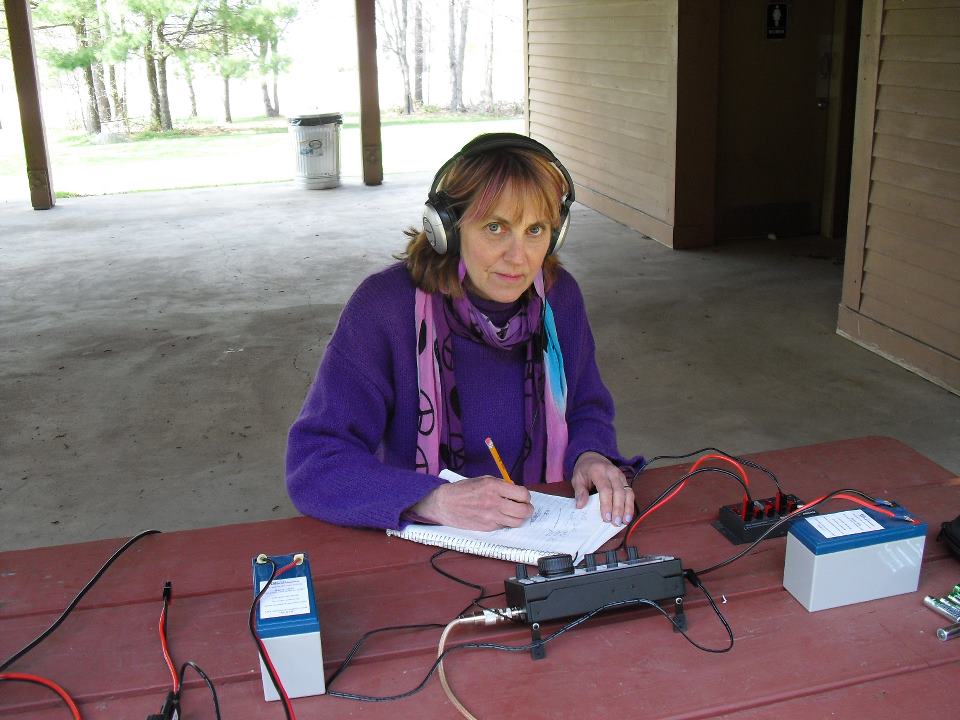
My first introduction to ham radio was at the home of a friend when I was in the fifth grade, her dad was a ham. I thought radio was magic. He had a tower on the side of their house in Haverhill, Massachusetts. The idea of being able to communicate to another station so far away made a huge impression on me. We moved away and I lost contact with my friend but I knew ham radio was something I would try at some point during my life. I drooled over the crystal radio kit that I saw in Radio Shack a year later, and asked for it as a Christmas gift but back then little girls were not encouraged to build radios...glad times have changed. Almost 4 decades later, after turning 50 years old, I had some extra time to dedicate as study time to get my ticket and start the road to learning code.
2) How long have you been licensed?
It's been over nine years!!!! I was licensed since late in February of 2004 as KB1KVU, then obtained the call AB1DR after passing my extra in April of 2004, In 2006 I applied for and was issued K1QO.
3) What drew you to QRP?
I've always been impressed with what low power, CW, and simple wire antennas can do. I get a major thrill out of 5 watts to New Zealand or participating in the last NAQCC mW contest and logging over a dozen contacts in an hour running 900 mW...it just doesn't get any better than that in radio. I've never wanted to own an amp, for what I do in the hobby I don't want to use a megaphone to talk to someone across the table from me when I can be heard using a quiet voice.

4) Who has been your biggest QRP influence?
Besides my patient and wonderful Elmer, N1IX, I have to say the QRP Foxhunt Group and a lot of the folks from New England QRP Seacoast Chapter have been major forces in keeping me alive in the hobby...it's been a much steeper learning curve than I ever expected but I've had help and support every time I hit snags and that's thanks to the QRP community. The QRP Fox Hunt group has some of the best and most supportive op's in the hobby!!!! I had been licensed for about a year when I started in the QRP fox hunts during the 2004-2005 winter season. It's impossible to name just one person who has had a major QRP influence on me because being new in the hobby I still have so much to learn; N1IX is a wonderful Elmer. K4BAI a CW Olympiad who supports the hobby 1000% and who I admire as the ultimate team player has been a constant source of inspiration and awe. I must also include: N9NE, (exceptional op, has given me loads of tips, suggestions and has been a great source of mobile advice/experience), W2LJ a great friend, FB op, and his blog is a constant flow of what is happening and what can be done in the hobby, WC7S, incredible motivator, antenna guru, K9CW, another great team player and exceptional op who will go the extra mile for new folks, K9JWV, always great moral support and has given me lots of super advice, N0UR, the MN QRP contesting phenom who put up with a mW Facebook Fest, as he did fox duty, a true showing on how great an op can be and how effective QRPp can be, that gave me guts to try QRPp. N9AW is probably a major game changer for a very large group with his creation of the Facebook QRP FoxHunt group...it's created a new dimension and sense of camaraderie that I truly enjoy. K3WWP is also someone I admire and has been a very positive influence...NAQCC has a huge membership and wonderful contests. K7QO has been a continued source of help with the books he's "translated" to CW...his IPad app is great tool and can be used to set for just about any speed. At the top of the table locally W1FMR, the founder of New England QRP Club, W1PID for inspirational outdoor operating adventures and K0ZK for his incredible spirit and technical know how, Arn is a treasure. KD1JV for his wonderful, portable kits, light weight and his vision of the ultimate in a trail rig...it just makes you want to go on a hike and operate!!! There are many others who have influenced me in the hobby as well.
5) What is your favorite QRP activity?
I enjoy the QRP Foxhunts, low level contesting and chasing DX, they are all fun and it's a good way for me to keep trying to improve my CW skills. Operating outdoors has always been a blast I hope to do more in the future.
6) What's your favorite piece of QRP gear (past or present)?
ATS-3 (KD1JV design) it's a gem...it's so cool, four bands and puts out 5W w/ 12 volts and weighs a few ounces.
7) Describe your current QRP station.
Right now I'm using a KX3 to an OCF dipole at about 30'.
8) What is your fondest QRP memory.
There are a few, probably the best memory I have is my first two-fur in the QRP Fox Hunt, the foxii were K4BAI and N9NE...it was in early December, 2005 and I was having a tough time, I had breast cancer surgery and was going through radiation...after getting the two-fur I did a dance around the living room!!!!! The other memory I have is a funny one. Early in my start as a ham N1IX was trying to teach me to work split on the K2 I had just built. By accident I transmitted on the transmitting stations frequency, he was working up one...I messed up setting up split I was so embarrassed I wanted to shut the radio off and quit trying. N1IX told me, "don't worry, that's the great thing about QRP, no one can hear you". He was joking but I believed him, I didn't know so I stayed on the air...wow I would learn very quickly how funny that comment was. I won't fall for that joke again, but I still accidently transmit on the transmitting stations frequency, so does everyone...hopefully I won't do it often and hopefully either someone will let me know I'm accidently doing it or I'll realize quickly that I'm making a mistake.

9) What other hobbies/interests do you enjoy when your not on the radio?
I love my dog, a Border Terrier named Kally, enjoy hiking, play golf, swim, solar energy and have a small flock of chickens for fresh eggs...they are all named so they will never be on the dinner table.
Thanks, Ann!
72 de Larry W2LJ
QRP - When you care to send the very least!
Wednesday, February 03, 2016
Smartphones
I was prompted to write this because of the latest poll on eHam. It's about smart phones and Amateur Radio apps. Of course, it devolved from being anything useful into a bunch of curmudgeons blasting the topic to smithereens.
"What do you need a smart phone for anyway? I detest them, they are the mark of the Beast - the Devil's plaything, they are everything that is wrong with society! I use a real radio that has knobs ...... remember what those are?" I am paraphrasing, of course. ;-)
And so on, and so on, and so on. Sigh - heavy sigh.
It's a tool, guys ...... just another tool in the Ham radio arsenal, get it?
I have a pre-owned (sound so much better than "used") Samsung Galaxy S3, which I recently picked up on eBay. It's my first personal 4G cell phone. (I know, forever behind the times.) Even though it's an older model, it's in excellent shape and I'm familiar with the S3, as my work-issued cell phone used to be an S3. For work, they recently upgraded me to an iPhone 5s, which I don't like (or use) - but this post is not about that.
My Galaxy S3 is a great companion for portable QRP ops. It's works much better than the Motorola Droid 2 that I previously used. It has more system memory, so it doesn't lock up or lag on me, like the Droid 2 used to. I have the following Amateur Radio apps on it:
HamLog
SOTAwatch
Morse Trainer by Wolphi
QRZDroid
DX Cluster

HamLog is great! It's easy to use and has a lot of features. If I'm not in a pileup situation (ragchew mode, or even causal sprint operation), it's easy enough for me to type in my contacts. In a hectic pileup situation (think activating NPOTA or the Skeeter Hunt), where things are happening fast and furious, I get flustered a bit. I can start out logging on the cell phone, but inevitably, I end up getting fumble-fingered and have to resort to old school - paper and pencil. If I'm near a wi-fi source (I have a very limited monthly data allowance, so my data connection is always off), it will even look up the names and QTHs of the operators that I am currently working. I can easily export the log to an ADIF file, so that I can add my portable ops contacts to my main log on Log4OM.
SOTAwatch - turn it on and it shows you the current activations. Call signs, peak, frequency and mode. It has other features which I haven't even explored yet.
Morse Trainer - This is one of the best Morse Code trainers out there IMHO. It will allow Morse to be sent as fast as 60 WPM. I keep mine set to a speed of about 40 WPM and have it send regular words. I try to listen to some code practice several times a week in my never ending goal to become an even more competent CW op. Boy, 25 WPM sure sounds easy-peasy after listening to 40 WPM for a while!
QRZDroid - QRZ.com in an app. Easy call sign look up.
DX Cluster - Very helpful in tracking NPOTA stations. The only drawback with DX Cluster is that you can filter it for either all HF bands or mono-bands. It would be nice if I could filter say, 20 and 17 Meters in one shot. But, hey, if wishes were nickels, I'd be a rich man. Wish I was smart enough to write apps like these, then maybe I would be a rich man!
The bottom line is that a smart phone can be a useful tool to compliment and enhance your overall Amateur Radio experience. It's not a replacement or any other kind of bogeyman. It is what you make of it.
72 de Larry W2LJ
QRP - When you care to send the very least!
Subscribe to:
Posts (Atom)