You may be like me. I've been at this hobby for a while now. I've built a ton of kits, made a bunch of antennas, passed all my exams with no problem. I was in the electronics repair biz for over 20 years, trouble shooting and repairing circuit boards down to the component level. But yet, to this day, I can open up a "QRP Quarterly" or a "QST" and look at the technical articles and feel like they are "WHOOSH" - about a mile over my head.
For those of you in the same boat, I would highly recommend the contents of the You Tube channel provided and maintained by Alan Wolke W2AEW. Alan is a fellow member of the Raritan Valley Radio Club. As a VE, I've attended a couple of Ham Crams where Alan was the lead instructor - I can readily testify that Alan knows his stuff, inside and out, upside down and backwards.
Alan has "The Knack" in more ways than one. Not only is he technically gifted, but the also has the ability to take the Greek out of electronics (no offense to my friends from Greece or of Greek decent), and make difficult concepts understandable, in plain English. And that's a pretty good talent to have when you're a Technical Specialist for Tektronics.
In addition to Alan's You Tube channel, to which I think just about every Amateur Radio op should be subscribed to, Alan gave an excellent interview to Eric on "QSO Today". You can listen to it here - http://www.qsotoday.com/podcasts/w2aew
Now, I'm not saying that if you watch all of Alan's videos that you'll be able to instantly comprehend every technical article you read in any Amateur Radio publication. But I can tell you that more and more of the content will be understandable and that you won't be totally clueless - like I used to feel. I'm getting better, but still have a long way to go.
72 de Larry W2LJ
QRP - When you care to send the very least!

Monday, February 29, 2016


Saturday, February 27, 2016
Red Letter Day
Today was a very, very good day at the W2LJ Shack. I worked a bunch of NPOTA entities, as well as some friends and a notable station. It was my best day as an NPOTA Chaser so far.
The day kicked off to about as good a start as possible when I saw my QRP buddy Marc W4MPS spotted on the DX Cluster. He was activating NM29 in North Carolina on 40 Meters.

It was good to hear Marc (it was an SSB QSO), and things continued to roll on from there. I worked:
K5CM at MP04 on 40 Meter CW.
N2CX at WR39 on 40 Meter CW. For those of you who don't know, Joe N2CX is one half of the brain trust of the NJQRP Club.
KC3RW at NS33 on 40 Meters SSB.
KB3WAV and KC3RW at NS33 on 40 Meter SSB.
N2APB at TR21 on 40 Meter CW. George N2APB is the other half of the NJQRP brain trust!
NC4PC at BF07 on 40 Meter SSB.
KM4KFB at TR16 on 20 Meter SSB.
W4UAL at TR12 and PV12 on 20 Meter SB.
Then, taking a break from NPOTA Stations, I worked Marc WA2FON on 40 Meter SSB. Marc was SOTAing on the top W2/GC-010, Bearpen Mountain in the Catskills in New York.

Back to NPOTA, I worked W5RE at NP18 on 20 Meter CW. From there, I took a hop over to 17 Meters and busted the pileup to work KG4EU, the other Amateur Radio op at Guantanamo Bay, in Cuba. So now I can say I worked them both.
Back to NPOTA again, I worked KA4CDN at DZ11 on 40 Meter CW.
KB3WAV again, but this time at DZ01 on 40 Meters SSB.
Then I worked K6KPH, the famous Maritime Radio Historical Society Station, who was at NPOTA SS10. That was a pretty good pileup. Every CW Op worth their salt is familiar with the famous K6KPH call sign. I ended my NPOTA day by working KV4T and TR02 on 17 Meters CW.
It was good to hear so many NPOTA stations on CW (for a change) and I worked each one with 5 Watts, even K6KPH. I also worked K4M, which is a Special Event station honoring Samuel Morse, being operated by the Radio Operadores del Sur de Puerto Rico.
So it was a good day, a good day, indeed!
72 de Larry W2LJ
QRP - When you care to send the very least!
The day kicked off to about as good a start as possible when I saw my QRP buddy Marc W4MPS spotted on the DX Cluster. He was activating NM29 in North Carolina on 40 Meters.

From Field Day 2015, when W4MPS joined in the SPARC Field Day effort.
It was good to hear Marc (it was an SSB QSO), and things continued to roll on from there. I worked:
K5CM at MP04 on 40 Meter CW.
N2CX at WR39 on 40 Meter CW. For those of you who don't know, Joe N2CX is one half of the brain trust of the NJQRP Club.
KC3RW at NS33 on 40 Meters SSB.
KB3WAV and KC3RW at NS33 on 40 Meter SSB.
N2APB at TR21 on 40 Meter CW. George N2APB is the other half of the NJQRP brain trust!
NC4PC at BF07 on 40 Meter SSB.
KM4KFB at TR16 on 20 Meter SSB.
W4UAL at TR12 and PV12 on 20 Meter SB.
Then, taking a break from NPOTA Stations, I worked Marc WA2FON on 40 Meter SSB. Marc was SOTAing on the top W2/GC-010, Bearpen Mountain in the Catskills in New York.

Back to NPOTA, I worked W5RE at NP18 on 20 Meter CW. From there, I took a hop over to 17 Meters and busted the pileup to work KG4EU, the other Amateur Radio op at Guantanamo Bay, in Cuba. So now I can say I worked them both.
Back to NPOTA again, I worked KA4CDN at DZ11 on 40 Meter CW.
KB3WAV again, but this time at DZ01 on 40 Meters SSB.
Then I worked K6KPH, the famous Maritime Radio Historical Society Station, who was at NPOTA SS10. That was a pretty good pileup. Every CW Op worth their salt is familiar with the famous K6KPH call sign. I ended my NPOTA day by working KV4T and TR02 on 17 Meters CW.
It was good to hear so many NPOTA stations on CW (for a change) and I worked each one with 5 Watts, even K6KPH. I also worked K4M, which is a Special Event station honoring Samuel Morse, being operated by the Radio Operadores del Sur de Puerto Rico.
So it was a good day, a good day, indeed!
72 de Larry W2LJ
QRP - When you care to send the very least!
Thursday, February 25, 2016
QRP SSB
Going out for a QRP break at lunch time can have its surprises. Sometimes, it's juicy DX, sometimes the bands are hopping, sometimes it's a good ol' fashioned rag chew.
Today brought two nice contacts. The first was with Mike KE5AKL who was atop SOTA peak W5N/SE-048, which is the Otowi Benchmark in New Mexico. Mike and I were both 449 to each other. I always like working the SOTA peaks. I never registered as a chaser, I just do it for the fun and challenge.
The second QSO was even more satisfying. I turned on my smart phone and brought up the DX Cluster. It told me that NI5DX was on 14.255 MHz and was activating NPOTA TR20, the El Camino de los Tejas National Historic Trail. I have to admit that all the QSOs that I've had operating portable QRP - they've all been CW. I've never even tried SSB from the Jeep before.
But because of NPOTA, I have been packing the microphone in my day pack, so I decided to give it a shot. Within a dozen or so calls, I got into Bill's log! Granted, while there was a bit of a pileup, it wasn't ferocious. There were breaks in the action which allowed me to get my foot in the door, so to speak. Because of that, I was able to make myself heard and now have another new NPOTA entity in my "list of entities worked".
On another subject, I see where the FCC will be listening to comments about making Amateur Radio Operator licenses in the United States a lifetime "deal". Once licensed, you never have to worry about renewing or having your ticket expire - until you do, that is.
I was wondering if this is a follow up step after eliminating the Vanity Call Sign fees. It seems to me, anyway, that if licenses are good for a lifetime, that there will be a lot fewer vanity call signs to choose from in the long run. Less calls to choose from, less applications to process, which means lower costs to the FCC. Just a thought.
So if you were thinking of requesting a vanity call sign - now might be the time to do it. If anyone out there was lusting after W2LJ - sorry, I plan on keeping it for a VERY long time!
72 de Larry W2LJ
QRP - When you care to send the very least!
Wednesday, February 24, 2016
This look interesting!
North American CW Weekend
3-5 June 2016
Fairview Park Marriott
Falls Church, Virginia
The 2016 CW Weekend will take place June 3-5 at the Fairview Park Marriott in Falls Church, Virginia. This is open to all hams or others with an interest in CW or Morse code communication - FOC, CWOPS, SKCC, the Morse Operators Society, and FISTS. It is predominantly a social event and provides a great opportunity to connect with old friends, make new ones, and enjoy those eyeball QSOs with folks you have worked on the bands for years.
As in years past, we'll kick off with an informal pizza dinner on Friday evening, followed by a brunch on Saturday morning hosted by Jim N3JT and Nina KE4PSV at their home in McLean. Dinner will follow that evening at Clyde's in Tyson's Corners. There will be a hospitality suite with refreshments at the hotel on Friday and Saturday evenings. Sunday morning, many attendees meet informally at the hotel restaurant for breakfast before heading home or on to other activities. It is likely that Frank, W3LPL, will make a tour of his world class contest station available Sunday afternoon if there is interest.
Early June is a nice time of year to visit the Washington, DC area, and the schedule allows plenty of time for sightseeing, shopping, and socializing, or visiting with family and friends.
A block of rooms has been set aside at the Fairview Park Marriott at a special rate of $ 99. You may reserve by calling the hotel at 800-228-9290 FREE (be certain to mention you are with the "North American CW Weekend party). Reservations may also be made online at marriott.com/wasfp. The special booking code for our group is "NACNACA." The special rate is available from June 3d through June 6th.
There will be a modest registration fee of $ 15 per person or $ 25 per couple to cover refreshments and the hospitality suite, payable by check to Don W4ZYT [1517 W. Little Neck Rd, Virginia Beach, VA 23452-4717]. Further information is available from Don, W4ZYT (w4zyt.don@gmail.com) and will be posted on the FOC and CWOPS web sites..
We really do look forward to seeing lots of CW folks at this gathering. Talk it up, mark it down, and come!
They sent this announcement to me as an e-mail and I thought it looks interesting, so I thought I'd post it.
72 de Larry W2LJ
QRP - When you care to send the least!
Tuesday, February 23, 2016
A word of advice
This past Saturday, I served as a Volunteer Examiner at the finish line of a "Ham Cram". The Middlesex County Office of Emergency Management offered the day long session in order to allow CERT members from various municipalities throughout the county the chance to earn their Technician licenses. There were twelve participants, and at the end of the day, half of them had earned their licenses.
All of these people were all enthusiastic and determined to become Amateur Radio operators. So what went wrong? Why wasn't there a higher success rate? What went wrong was a lack of lead time and mis-communication. Some had learned of the Ham Cram session only three days beforehand. The information about the session was directed to the participants through their local municipal OEM directors. Middlesex County OEM did their due diligence by sending out the information in plenty of time, but we all know that information that goes through the chain-of-command can travel particularly slowly, especially if the "powers that be" aren't all that familiar with the information they are passing on. Not realizing that this information was time sensitive proved to be a major handicap.
For those of you who are not familiar with the term, or the concept, a Ham Cram is defined as a six or more hour long session where prospective Hams are crammed with the info they need to earn their license. Think of the all-nighters you may have endured before a particularly tough exam in college. The concept is the same.
The problem with the Ham Cram concept is that many people think they can walk into one as a blank page, and will then walk away as a book filled with all the knowledge they need to pass the license exam.
For the Ham Cram concept to work (and it works remarkably well if implemented correctly), the students need to get their hands on a license manual and read and study for six to eight weeks prior to the Cram session. The Ham Cram session educator needs something to work with. It's highly improbable that someone can walk "cold" off the street and earn their ticket after only six hours of cursory study - unless of course, you have a photographic memory.
Again, going back to the "all-nighter" session in college. That exam prep marathon came after an entire semester of classes. You were, in essence, reviewing what you had hopefully learned throughout the proceeding months. We all know that if you waited until that evening to crack open a book, then you were toast.
Or if you want to think of it another way, the Ham Cram instructor is like a diamond cutter. With a raw diamond he can produce a work of art. Give him a piece of coal and he'll be out of his element. So if you know of a prospective Ham and he or she is talking about participating in a Ham Cram, then the sagest advice you can impart upon them is that they should begin the studying process WAY in advance (weeks/months). Then they'll arrive at the Ham Cram as a rough diamond ready to be polished into a prized jewel.
72 de Larry W2LJ
QRP - When you care to send the very least!
Monday, February 22, 2016
A rant about working pileups - from both ends.
I was trying to work one of the NPOTA guys yesterday and wasn't having much success, which is OK. Sometimes that's just how it goes, a lesson learned the hard way from the QRP Fox hunts. I'll not name names or call signs or the location of this particular activation, as I would like to keep with the old "Dragnet" thing of "changing the names to protect the innocent."
The pile up was pretty hot and heavy - it's amazing, in a way, how popular this NPOTA program has become! I guess most Hams are kind of competitive by nature, and I suppose there's a little "pile up breaker" in a lot of us.
To get on with the story (and my rant), the Amateur Radio op decided to make sense of the pile up by resorting to working call sign areas, which is a good strategy. It thins out the herd a bit, albeit making for littler herds, but it DOES calm things down a bit.
The op worked about four stations from call area 1, then only a couple from call area 2, then about three from call area 3 - and then commenced to work about 30 or 40 from call area 4. And no, the NPOTA entity was not in call area 4 - so it wasn't a case of favoritism there.
My point is, if you're going to work by call areas, which is a recognized method of culling down the herd of a pile up - then be FAIR about it. It's definitely NOT fair, if you're going to spend five minutes on some call areas and then a half hour on others. Yes, propagation may determine that it works that way, but it's still not the right thing to do. If you're going to work call areas, then give everyone a fair chance. Work a set number (maybe 10 or less) and then move on to the next area. If an area seems to be in the skip zone, at least give those guys a decent chance. Heck, you can even say (for instance), "I'm not hearing anyone from call area 8. Last chance, anyone from 8 land before I move on?"
And guys, it's a nice practice to call for DX and QRPers between working call area 0 and then going back to call area 1.
By the same token ...... chasers - clean the wax out of your ears!
If the NPOTA activator is calling for call area 4 - we should NOT hear call signs with 2s, 5s, or 7s in them. If he's working call area 4 and you live in Tennessee, but your call sign is W7ABC, then you wait until he gets to the 7s. Either that, or apply for a call sign with a 4 in it.
More importantly, if you can't even hear the NPOTA station clearly enough to tell that he's working by call areas in the first place, then what are you doing throwing out your call sign? Throwing out your call sign on a frequency just because the DX Cluster that you use is telling you there's an NPOTA station on frequency is NOT the thing to do. What if by some wild chance he hears you and answers you and you can't hear him well enough to know that he just answered you? I'll tell you what's going to happen - everyone else on frequency is going to make note of your call sign and associate it with the word "Lid" - and I don't think you want that to happen.
Others in the pileup - when you hear a Lid being a Lid - don't comment. We all know he/she's a Lid by their actions. Your emphasizing the point just makes it worse.
Bottom line - Activators ...... use Common Sense.
Chasers ..... mind your manners and adhere to the DX Code of Conduct.
As Stan Lee would say, "'Nuff said!"
72 de Larry W2LJ
QRP - When you care to send the very least!
Friday, February 19, 2016
I got to be the Flea on the Hound last night
Last evening's QRP Fox hunt was of the 80 Meter flavor. Our esteemed Foxes were Brian K0DTJ in California and Dave N1IX in New Hampshire. "Conventional Wisdom" told me that I'd probably have a good shot at working Dave in NH, but probably not so much for Brian in CA.
This time, Conventional Wisdom did not disappoint.
I worked Dave pretty quickly. According to my log, I nabbed him at 0203 UTC. And as I suspected, Brian was nowhere to be heard. Actually, Brian and his pack of Hounds were nowhere to be heard, except for an occasional "Woof" and "Arf" from a Hound here and there.
I ended up spending the evening listening to Dave handle his pileup. It was a treat as N1IX is an accomplished Amateur Radio Op, to say the least. He handled all calls rapidly and without error. He also QRS'ed (slowed his code speed for those of you not familiar with the Q Code) from time to time when it was warranted. Dave is a member of the A-1 Operators Club, which is no surprise, and his inclusion is well deserved.
Towards the end of the hunt, Dave had fewer and fewer Hounds baying at him, and as a result, he was calling "CQ FOX" quite a lot. QUITE a lot. And, at the same time, his signal strength to me was actually increasing.
So at 0311 UTC, I decided to do something that I've never done before. I dialed the KX3's power output down to the flea power neighborhood - 100 milliWatts (that's 1/10th of 1 Watt for those of you, who like me, sometimes scratch your head when it comes to scientific notation), and gave Dave another call. In the past, I've only called a Fox a second time if I wasn't positive about being in the log, and I've certainly have never done it QRPp.
Thanks to Dave's excellent ears and superb station, I made it into "Official" log at 0311 at 100 milliWatts of power. According to QRZ, Dave lives 233 miles from me as the proverbial crow flies. So that means the QSO was accomplished last night as a rate of 2330 Miles per Watt.
Not too shabby, and you just GOTTA love this QRP stuff!
72 de Larry W2LJ
QRP - When you care to send the very least!
Thursday, February 18, 2016
Doctor and patient are doing fine
A few days ago, I went out to the car as I usually do, for some lunchtime QRP. In my haste to get everything put away after I was done, I inadvertently knocked the external battery off the car seat onto the floor. The KX3 started to move, as it was still attached, but a quick hand stopped it, and all was well. Or so I thought.

Yesterday, I went out again, and this time the KX3 wouldn't turn on. No problem, I thought to myself, the battery was probably on its way out, as it has been a while since I have given it its last drink. So last evening, while I was attending a CERT class on animal handling during declared emergencies, I had the battery plugged in at home, charging.
When I got home, around 10:00 PM, I tried reconnecting the battery to the KX3 to see if everything was OK. Still no sign of life - my KX3 was still flat lining.. Hmmmmmm ........ could the battery have gone totally bad?
I carried the radio down to the shack 13.8V power supply. Viola! It turned on!
And then immediately turned off.

My brain went into over drive. What the %(#@*#$ was going on ?!?
I dread sending stuff out for repair. Don't know why, I just do. I was in the professional photographic electronics repair biz for over 20 years. I have fixed studio strobes costing well over $12,000.00. I have taken apart digital camera backs that cost more than a Mercedes Benz. I have stared down banks of charged capacitors storing up enough electrons to supply 6,400 Joules of energy in one pop - certainly I should be able to figure out a relatively minor KX3 repair? Right?
I rolled up my sleeves and got down to it. Obviously, this was a power problem. But why was the rig shutting down so quickly? Internal short? Bad connection somewhere? Then I noticed that if I wiggled the power plug a certain way, the radio would stay on. My mind immediately flashed back to the battery falling incident from the other day. I must have done something to the power socket.

The advantage of building the KX3 (if that's what you want to call it) is that you know how it goes together, so you're not frightened at the prospect of taking it apart. You've seen it in all its naked glory and you lovingly put it together at least once, right? So what's the big deal in taking it apart?
Well, when you built it roughly five years ago, some of the finer details of how it went together get muddled up in the old memory banks. That's why it's good to never toss the build manual! Within about 5 -7 minutes I had it apart and had the display circuit in my hand. A little extra light and a lot of extra magnification from a magnifying glass confirmed my suspicion.
The power socket is a surface mount device, just about like everything else on that display/control circuit board. The weight of the battery tugged the socket enough to unmoor it from its assigned, tinned pads. When I would wiggle the connector "down" towards the circuit board, everything worked. As soon as I let downward pressure go, the connector would break contact from the circuit board again and the radio would appear dead.
I ran upstairs for a pair of scrubs and to wash my hands to prep for surgery. NO! Just kidding!

I changed my soldering station tip to the skinniest one that I have for when I work on SMD devices and I re-soldered that connector onto its pads. I took great care to add just a little "extra" solder just to make sure the connection is good, solid and won't come apart so easily in the future.
I hastily (I'll get back to that in a minute) put everything together and fired the radio up. Fixed! Problem solved! High fives and happy dances all around!
I will have to go back sometime over the weekend to remove the front plexiglass display window, though. In my haste, I wasn't so careful about finger prints. I'll have to go back and clean that up. Yes, I know ...... call me anal. I can't help it!
But as this blog post says - the patient (and more importantly, the doctor) are doing just fine! And even more importantly - no return trip to Aptos!
PROGNOSIS: Excellent! Today's lunchtime QRP session netted the following:
N0TA - SOTA peak W0C/PR-082 (Squaw Mountain) in CO on 20 Meters.
VP5/AC0W - Turks and Caicos Islands on 20 Meters
CT9/OM3RM - Madeira Island on 20 Meters.
PJ2/NF9V - Curacao on 15 Meters.
I chased KH7Y in Hawaii who was absolutely booming into NJ on 15 Meters, but could not make myself heard. Just goes to show, you can't win them all!
72 de Larry W2LJ
QRP - When you care to send the very least!

Gear on the backseat of the Jeep.
Yesterday, I went out again, and this time the KX3 wouldn't turn on. No problem, I thought to myself, the battery was probably on its way out, as it has been a while since I have given it its last drink. So last evening, while I was attending a CERT class on animal handling during declared emergencies, I had the battery plugged in at home, charging.
When I got home, around 10:00 PM, I tried reconnecting the battery to the KX3 to see if everything was OK. Still no sign of life - my KX3 was still flat lining.. Hmmmmmm ........ could the battery have gone totally bad?
I carried the radio down to the shack 13.8V power supply. Viola! It turned on!
And then immediately turned off.

My brain went into over drive. What the %(#@*#$ was going on ?!?
I dread sending stuff out for repair. Don't know why, I just do. I was in the professional photographic electronics repair biz for over 20 years. I have fixed studio strobes costing well over $12,000.00. I have taken apart digital camera backs that cost more than a Mercedes Benz. I have stared down banks of charged capacitors storing up enough electrons to supply 6,400 Joules of energy in one pop - certainly I should be able to figure out a relatively minor KX3 repair? Right?
I rolled up my sleeves and got down to it. Obviously, this was a power problem. But why was the rig shutting down so quickly? Internal short? Bad connection somewhere? Then I noticed that if I wiggled the power plug a certain way, the radio would stay on. My mind immediately flashed back to the battery falling incident from the other day. I must have done something to the power socket.

The power socket is the black, boxy thing to the right.
The advantage of building the KX3 (if that's what you want to call it) is that you know how it goes together, so you're not frightened at the prospect of taking it apart. You've seen it in all its naked glory and you lovingly put it together at least once, right? So what's the big deal in taking it apart?
Well, when you built it roughly five years ago, some of the finer details of how it went together get muddled up in the old memory banks. That's why it's good to never toss the build manual! Within about 5 -7 minutes I had it apart and had the display circuit in my hand. A little extra light and a lot of extra magnification from a magnifying glass confirmed my suspicion.
The power socket is a surface mount device, just about like everything else on that display/control circuit board. The weight of the battery tugged the socket enough to unmoor it from its assigned, tinned pads. When I would wiggle the connector "down" towards the circuit board, everything worked. As soon as I let downward pressure go, the connector would break contact from the circuit board again and the radio would appear dead.
I ran upstairs for a pair of scrubs and to wash my hands to prep for surgery. NO! Just kidding!

I changed my soldering station tip to the skinniest one that I have for when I work on SMD devices and I re-soldered that connector onto its pads. I took great care to add just a little "extra" solder just to make sure the connection is good, solid and won't come apart so easily in the future.
I hastily (I'll get back to that in a minute) put everything together and fired the radio up. Fixed! Problem solved! High fives and happy dances all around!
I will have to go back sometime over the weekend to remove the front plexiglass display window, though. In my haste, I wasn't so careful about finger prints. I'll have to go back and clean that up. Yes, I know ...... call me anal. I can't help it!
But as this blog post says - the patient (and more importantly, the doctor) are doing just fine! And even more importantly - no return trip to Aptos!
PROGNOSIS: Excellent! Today's lunchtime QRP session netted the following:
N0TA - SOTA peak W0C/PR-082 (Squaw Mountain) in CO on 20 Meters.
VP5/AC0W - Turks and Caicos Islands on 20 Meters
CT9/OM3RM - Madeira Island on 20 Meters.
PJ2/NF9V - Curacao on 15 Meters.
I chased KH7Y in Hawaii who was absolutely booming into NJ on 15 Meters, but could not make myself heard. Just goes to show, you can't win them all!
72 de Larry W2LJ
QRP - When you care to send the very least!
Thursday, February 11, 2016
These QRP Fox hunts are humbling
Just when you think you have it figured out, you realize you don't.
The 80 Meter QRP Fox hunt, featured two fine Foxes, Tom Jennings KV2X in upstate NY and Tim Groat KR0U in Colorado.
OK, so say you're me. You're on 80 Meters alternately using a wire and a vertical. You find Tim KR0U and he's about 559 with heavy QSB. The you twiddle the dial and you find Tom KV2X who's 20 over 9 with a strong, steady signal.
Who do you think you'd work quickest?
KV2X - right? After all, he's the next state over, it's 80 Meters, it's winter, and he's louder than all get out. You have to be decently loud to him in return ........ right? Anybody who's been on HF for more than five minutes knows this ... right?
It took me exactly 45 minutes to work Tom. And I have to tell you, there were many times that I was tempted to throw my Oak Hills Research Wattmeter in line. I thought something had broken, or something was wrong with my coax or the antennas themselves. It shouldn't take 45 minutes to work a signal THAT loud ..... should it? Conventional wisdom would seem to dictate otherwise.
Well it did. At this point, I figured the snow ball had a better chance surviving Hell than I had working Tim. But what the heck, in for a penny - in for a pound. I figured out the split and started putting out my call.
Knock W2LJ over with a feather, folks. The KR0U pelt was secured within 5 minutes of trying! I'm still kind of shocked and puzzled as to how that went. It took 3/4 of an hour to work a guy that I should have been able to work with two tin cans and wire, while the "tough one" ended up being a veritable piece o' cake. It makes no sense to me at all, but it is what it is, I guess.
Amateur Radio surpasses my feeble understanding and leaves me slack jawed, mouth agape and humbled once again!
72 de Larry W2LJ
QRP - When you care to send the very least!
Tuesday, February 09, 2016
Hey, Mister! Wanna see some sexy pictures?
Who said the fine art of home brewing is dead?


My friend, Bob W3BBO is at it again. First it was the regen receivers, now it's 6L6 transmitters. Bob is reliving the fun and excitement of his old Novice days. You know, when every single QSO was exciting because it was accomplished with gear you built yourself.
The thing is that Bob doesn't have what you would consider a lot of fancy tools or a all decked out machine shop. He's doing this excellent work with common tools that you and I probably already have.
So how come my projects don't come out looking half this good - heck, a quarter this good? Bob has "The Knack" - I don't.
72 de Larry W2LJ
QRP - When you care to send the very least!
Thursday, February 04, 2016
Profiles in QRP - Resurrected!
This was something I tried back in 2013. "Interviewing" accomplished QRPers and posting their thoughts here. I stopped it for a while due to a lack of response from some people that I had asked to be interviewed. I am going to give this another shot, as I feel it's an interesting and worthwhile project. I originally intended a different spotlight each month, but I am going to try and shoot for one each quarter of the year.
I'm a firm believer that we all can learn from each other and that is one of the main purposes of this blog - not only to let me gab on and on and on until you get sick of me - but I also hope I am imparting some knowledge or at least a few good tidbits along the way.
This interview was done back in 2013, but was never published. Our guest this month is Ann Byers, K1QO. I met Ann several years ago through the QRP Fox hunts. Not only is Ann a superb human being, she is also an accomplished CW operator and a QRPer. Since this interview, Ann has gone on to become a licensed pilot. She has a wicked fist and not only have I heard Ann in the QRP Fox hunt pileups, I've also heard her in contests. I guarantee that she can go toe-to-toe with any of the best!
So without further ado - our guest, Ann Byers K1QO.

1) How did you first become interested in Amateur Radio?
My first introduction to ham radio was at the home of a friend when I was in the fifth grade, her dad was a ham. I thought radio was magic. He had a tower on the side of their house in Haverhill, Massachusetts. The idea of being able to communicate to another station so far away made a huge impression on me. We moved away and I lost contact with my friend but I knew ham radio was something I would try at some point during my life. I drooled over the crystal radio kit that I saw in Radio Shack a year later, and asked for it as a Christmas gift but back then little girls were not encouraged to build radios...glad times have changed. Almost 4 decades later, after turning 50 years old, I had some extra time to dedicate as study time to get my ticket and start the road to learning code.
2) How long have you been licensed?
It's been over nine years!!!! I was licensed since late in February of 2004 as KB1KVU, then obtained the call AB1DR after passing my extra in April of 2004, In 2006 I applied for and was issued K1QO.
3) What drew you to QRP?
I've always been impressed with what low power, CW, and simple wire antennas can do. I get a major thrill out of 5 watts to New Zealand or participating in the last NAQCC mW contest and logging over a dozen contacts in an hour running 900 mW...it just doesn't get any better than that in radio. I've never wanted to own an amp, for what I do in the hobby I don't want to use a megaphone to talk to someone across the table from me when I can be heard using a quiet voice.

4) Who has been your biggest QRP influence?
Besides my patient and wonderful Elmer, N1IX, I have to say the QRP Foxhunt Group and a lot of the folks from New England QRP Seacoast Chapter have been major forces in keeping me alive in the hobby...it's been a much steeper learning curve than I ever expected but I've had help and support every time I hit snags and that's thanks to the QRP community. The QRP Fox Hunt group has some of the best and most supportive op's in the hobby!!!! I had been licensed for about a year when I started in the QRP fox hunts during the 2004-2005 winter season. It's impossible to name just one person who has had a major QRP influence on me because being new in the hobby I still have so much to learn; N1IX is a wonderful Elmer. K4BAI a CW Olympiad who supports the hobby 1000% and who I admire as the ultimate team player has been a constant source of inspiration and awe. I must also include: N9NE, (exceptional op, has given me loads of tips, suggestions and has been a great source of mobile advice/experience), W2LJ a great friend, FB op, and his blog is a constant flow of what is happening and what can be done in the hobby, WC7S, incredible motivator, antenna guru, K9CW, another great team player and exceptional op who will go the extra mile for new folks, K9JWV, always great moral support and has given me lots of super advice, N0UR, the MN QRP contesting phenom who put up with a mW Facebook Fest, as he did fox duty, a true showing on how great an op can be and how effective QRPp can be, that gave me guts to try QRPp. N9AW is probably a major game changer for a very large group with his creation of the Facebook QRP FoxHunt group...it's created a new dimension and sense of camaraderie that I truly enjoy. K3WWP is also someone I admire and has been a very positive influence...NAQCC has a huge membership and wonderful contests. K7QO has been a continued source of help with the books he's "translated" to CW...his IPad app is great tool and can be used to set for just about any speed. At the top of the table locally W1FMR, the founder of New England QRP Club, W1PID for inspirational outdoor operating adventures and K0ZK for his incredible spirit and technical know how, Arn is a treasure. KD1JV for his wonderful, portable kits, light weight and his vision of the ultimate in a trail rig...it just makes you want to go on a hike and operate!!! There are many others who have influenced me in the hobby as well.
5) What is your favorite QRP activity?
I enjoy the QRP Foxhunts, low level contesting and chasing DX, they are all fun and it's a good way for me to keep trying to improve my CW skills. Operating outdoors has always been a blast I hope to do more in the future.
6) What's your favorite piece of QRP gear (past or present)?
ATS-3 (KD1JV design) it's a gem...it's so cool, four bands and puts out 5W w/ 12 volts and weighs a few ounces.
7) Describe your current QRP station.
Right now I'm using a KX3 to an OCF dipole at about 30'.
8) What is your fondest QRP memory.
There are a few, probably the best memory I have is my first two-fur in the QRP Fox Hunt, the foxii were K4BAI and N9NE...it was in early December, 2005 and I was having a tough time, I had breast cancer surgery and was going through radiation...after getting the two-fur I did a dance around the living room!!!!! The other memory I have is a funny one. Early in my start as a ham N1IX was trying to teach me to work split on the K2 I had just built. By accident I transmitted on the transmitting stations frequency, he was working up one...I messed up setting up split I was so embarrassed I wanted to shut the radio off and quit trying. N1IX told me, "don't worry, that's the great thing about QRP, no one can hear you". He was joking but I believed him, I didn't know so I stayed on the air...wow I would learn very quickly how funny that comment was. I won't fall for that joke again, but I still accidently transmit on the transmitting stations frequency, so does everyone...hopefully I won't do it often and hopefully either someone will let me know I'm accidently doing it or I'll realize quickly that I'm making a mistake.

9) What other hobbies/interests do you enjoy when your not on the radio?
I love my dog, a Border Terrier named Kally, enjoy hiking, play golf, swim, solar energy and have a small flock of chickens for fresh eggs...they are all named so they will never be on the dinner table.
Thanks, Ann!
72 de Larry W2LJ
QRP - When you care to send the very least!
I'm a firm believer that we all can learn from each other and that is one of the main purposes of this blog - not only to let me gab on and on and on until you get sick of me - but I also hope I am imparting some knowledge or at least a few good tidbits along the way.
This interview was done back in 2013, but was never published. Our guest this month is Ann Byers, K1QO. I met Ann several years ago through the QRP Fox hunts. Not only is Ann a superb human being, she is also an accomplished CW operator and a QRPer. Since this interview, Ann has gone on to become a licensed pilot. She has a wicked fist and not only have I heard Ann in the QRP Fox hunt pileups, I've also heard her in contests. I guarantee that she can go toe-to-toe with any of the best!
So without further ado - our guest, Ann Byers K1QO.
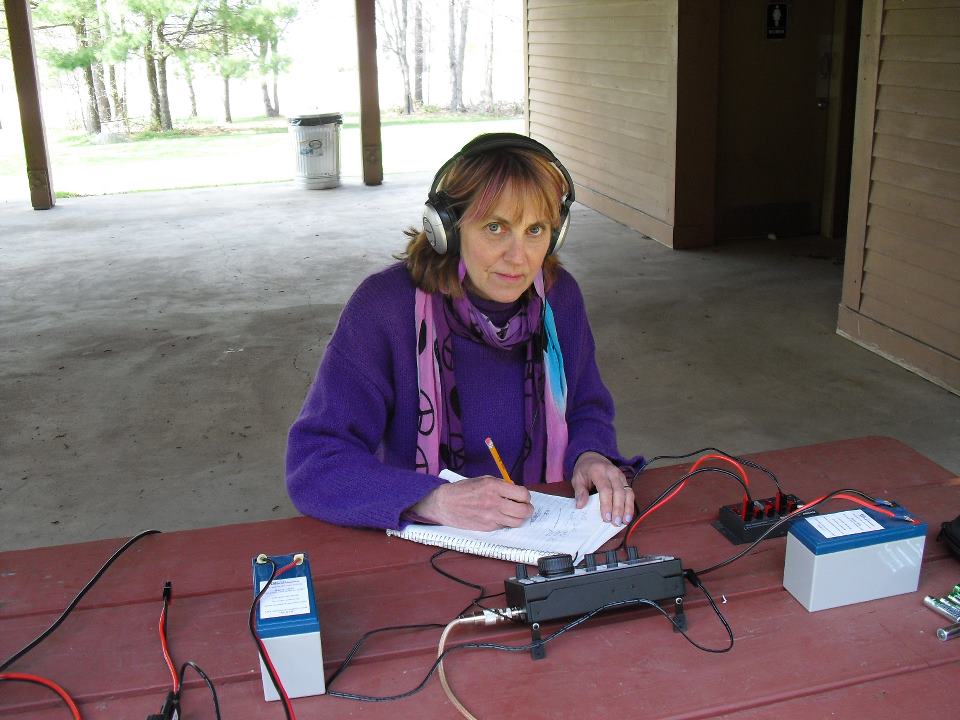
My first introduction to ham radio was at the home of a friend when I was in the fifth grade, her dad was a ham. I thought radio was magic. He had a tower on the side of their house in Haverhill, Massachusetts. The idea of being able to communicate to another station so far away made a huge impression on me. We moved away and I lost contact with my friend but I knew ham radio was something I would try at some point during my life. I drooled over the crystal radio kit that I saw in Radio Shack a year later, and asked for it as a Christmas gift but back then little girls were not encouraged to build radios...glad times have changed. Almost 4 decades later, after turning 50 years old, I had some extra time to dedicate as study time to get my ticket and start the road to learning code.
2) How long have you been licensed?
It's been over nine years!!!! I was licensed since late in February of 2004 as KB1KVU, then obtained the call AB1DR after passing my extra in April of 2004, In 2006 I applied for and was issued K1QO.
3) What drew you to QRP?
I've always been impressed with what low power, CW, and simple wire antennas can do. I get a major thrill out of 5 watts to New Zealand or participating in the last NAQCC mW contest and logging over a dozen contacts in an hour running 900 mW...it just doesn't get any better than that in radio. I've never wanted to own an amp, for what I do in the hobby I don't want to use a megaphone to talk to someone across the table from me when I can be heard using a quiet voice.

4) Who has been your biggest QRP influence?
Besides my patient and wonderful Elmer, N1IX, I have to say the QRP Foxhunt Group and a lot of the folks from New England QRP Seacoast Chapter have been major forces in keeping me alive in the hobby...it's been a much steeper learning curve than I ever expected but I've had help and support every time I hit snags and that's thanks to the QRP community. The QRP Fox Hunt group has some of the best and most supportive op's in the hobby!!!! I had been licensed for about a year when I started in the QRP fox hunts during the 2004-2005 winter season. It's impossible to name just one person who has had a major QRP influence on me because being new in the hobby I still have so much to learn; N1IX is a wonderful Elmer. K4BAI a CW Olympiad who supports the hobby 1000% and who I admire as the ultimate team player has been a constant source of inspiration and awe. I must also include: N9NE, (exceptional op, has given me loads of tips, suggestions and has been a great source of mobile advice/experience), W2LJ a great friend, FB op, and his blog is a constant flow of what is happening and what can be done in the hobby, WC7S, incredible motivator, antenna guru, K9CW, another great team player and exceptional op who will go the extra mile for new folks, K9JWV, always great moral support and has given me lots of super advice, N0UR, the MN QRP contesting phenom who put up with a mW Facebook Fest, as he did fox duty, a true showing on how great an op can be and how effective QRPp can be, that gave me guts to try QRPp. N9AW is probably a major game changer for a very large group with his creation of the Facebook QRP FoxHunt group...it's created a new dimension and sense of camaraderie that I truly enjoy. K3WWP is also someone I admire and has been a very positive influence...NAQCC has a huge membership and wonderful contests. K7QO has been a continued source of help with the books he's "translated" to CW...his IPad app is great tool and can be used to set for just about any speed. At the top of the table locally W1FMR, the founder of New England QRP Club, W1PID for inspirational outdoor operating adventures and K0ZK for his incredible spirit and technical know how, Arn is a treasure. KD1JV for his wonderful, portable kits, light weight and his vision of the ultimate in a trail rig...it just makes you want to go on a hike and operate!!! There are many others who have influenced me in the hobby as well.
5) What is your favorite QRP activity?
I enjoy the QRP Foxhunts, low level contesting and chasing DX, they are all fun and it's a good way for me to keep trying to improve my CW skills. Operating outdoors has always been a blast I hope to do more in the future.
6) What's your favorite piece of QRP gear (past or present)?
ATS-3 (KD1JV design) it's a gem...it's so cool, four bands and puts out 5W w/ 12 volts and weighs a few ounces.
7) Describe your current QRP station.
Right now I'm using a KX3 to an OCF dipole at about 30'.
8) What is your fondest QRP memory.
There are a few, probably the best memory I have is my first two-fur in the QRP Fox Hunt, the foxii were K4BAI and N9NE...it was in early December, 2005 and I was having a tough time, I had breast cancer surgery and was going through radiation...after getting the two-fur I did a dance around the living room!!!!! The other memory I have is a funny one. Early in my start as a ham N1IX was trying to teach me to work split on the K2 I had just built. By accident I transmitted on the transmitting stations frequency, he was working up one...I messed up setting up split I was so embarrassed I wanted to shut the radio off and quit trying. N1IX told me, "don't worry, that's the great thing about QRP, no one can hear you". He was joking but I believed him, I didn't know so I stayed on the air...wow I would learn very quickly how funny that comment was. I won't fall for that joke again, but I still accidently transmit on the transmitting stations frequency, so does everyone...hopefully I won't do it often and hopefully either someone will let me know I'm accidently doing it or I'll realize quickly that I'm making a mistake.

9) What other hobbies/interests do you enjoy when your not on the radio?
I love my dog, a Border Terrier named Kally, enjoy hiking, play golf, swim, solar energy and have a small flock of chickens for fresh eggs...they are all named so they will never be on the dinner table.
Thanks, Ann!
72 de Larry W2LJ
QRP - When you care to send the very least!
Wednesday, February 03, 2016
Smartphones
I was prompted to write this because of the latest poll on eHam. It's about smart phones and Amateur Radio apps. Of course, it devolved from being anything useful into a bunch of curmudgeons blasting the topic to smithereens.
"What do you need a smart phone for anyway? I detest them, they are the mark of the Beast - the Devil's plaything, they are everything that is wrong with society! I use a real radio that has knobs ...... remember what those are?" I am paraphrasing, of course. ;-)
And so on, and so on, and so on. Sigh - heavy sigh.
It's a tool, guys ...... just another tool in the Ham radio arsenal, get it?
I have a pre-owned (sound so much better than "used") Samsung Galaxy S3, which I recently picked up on eBay. It's my first personal 4G cell phone. (I know, forever behind the times.) Even though it's an older model, it's in excellent shape and I'm familiar with the S3, as my work-issued cell phone used to be an S3. For work, they recently upgraded me to an iPhone 5s, which I don't like (or use) - but this post is not about that.
My Galaxy S3 is a great companion for portable QRP ops. It's works much better than the Motorola Droid 2 that I previously used. It has more system memory, so it doesn't lock up or lag on me, like the Droid 2 used to. I have the following Amateur Radio apps on it:
HamLog
SOTAwatch
Morse Trainer by Wolphi
QRZDroid
DX Cluster

HamLog is great! It's easy to use and has a lot of features. If I'm not in a pileup situation (ragchew mode, or even causal sprint operation), it's easy enough for me to type in my contacts. In a hectic pileup situation (think activating NPOTA or the Skeeter Hunt), where things are happening fast and furious, I get flustered a bit. I can start out logging on the cell phone, but inevitably, I end up getting fumble-fingered and have to resort to old school - paper and pencil. If I'm near a wi-fi source (I have a very limited monthly data allowance, so my data connection is always off), it will even look up the names and QTHs of the operators that I am currently working. I can easily export the log to an ADIF file, so that I can add my portable ops contacts to my main log on Log4OM.
SOTAwatch - turn it on and it shows you the current activations. Call signs, peak, frequency and mode. It has other features which I haven't even explored yet.
Morse Trainer - This is one of the best Morse Code trainers out there IMHO. It will allow Morse to be sent as fast as 60 WPM. I keep mine set to a speed of about 40 WPM and have it send regular words. I try to listen to some code practice several times a week in my never ending goal to become an even more competent CW op. Boy, 25 WPM sure sounds easy-peasy after listening to 40 WPM for a while!
QRZDroid - QRZ.com in an app. Easy call sign look up.
DX Cluster - Very helpful in tracking NPOTA stations. The only drawback with DX Cluster is that you can filter it for either all HF bands or mono-bands. It would be nice if I could filter say, 20 and 17 Meters in one shot. But, hey, if wishes were nickels, I'd be a rich man. Wish I was smart enough to write apps like these, then maybe I would be a rich man!
The bottom line is that a smart phone can be a useful tool to compliment and enhance your overall Amateur Radio experience. It's not a replacement or any other kind of bogeyman. It is what you make of it.
72 de Larry W2LJ
QRP - When you care to send the very least!
Wednesday, January 27, 2016
Delightful lunchtime QSO
The bands seemed to be in decent shape this lunchtime, with low background noise levels. According to SOTA Watch, there were a few activations that I wasn't able to hear, and Ed WA3WSJ was out and about, but he was on 20 Meters. A pathway on 20 Meters from NJ to PA is a very rare occurrence.
While twiddling the dial, I heard Bob K9OSC calling CQ in the 20 Meter QRP neighborhood. Bob lives in Fridley, MN and had an excellent signal in NJ. QSB varied his RST between 599 and 559, but even so, with the low background noise, Bob was "Q5" copy the whole time.

Bob was using his K3 to a homebrewed rotary dipole. His aerial enabled us to have a very enjoyable 20 minute 2X QRP QSO. If you get the chance, look up K9OSC on QRZ.com. I think you'll be blown away like I was. A very good operator, a very good station, a very good rag chew.
Thanks, Bob and I sure hope I hook up with you again!
72 de Larry W2LJ
QRP - When you care to send the very least!
Tuesday, January 26, 2016
You can't work 'em if you can't hear 'em.
The snow plows came through to clear our street. Even so, they never really plow the entire street. They clean it up for sure, so that you can travel safely down the road, but there's always that snow plow residue on the sides of the street. So, until the snow melts substantially, I can't park on the street, as I usually do, there's just not enough room to park and still have space for other cars to get by. That means I have park in the driveway. Since I generally get home last, I have to get up and move my Jeep when my wife Marianne has to leave for work at 5:00 AM (I've mentioned - she's a nurse).
So this morning, after moving my car for her, I made some coffee and headed down into the shack. I had about a half hour before I had to shower, shave and get dressed for work. I figured that maybe, just maybe, I'd hear K5P, as this is their last day on the island, I believe. And sure enough, there they were on 80 Meters, calling CQ! And from the rate they were answering stations, you could tell they were listening for ATNOs - stations they had never worked before (which would have been me!).
They were decently loud - about 559 with QSB on 3.530 MHz with QSB. Even so, this was the best I've heard them throughout the entire DXpedition. I put the KX3 into "Dual Watch" mode, so I could figure out where they were listening, and then I fired up the KXPA100 to 90 Watts and jumped into the fray.
Then some idiot proceeded to come onto their QRG (the frequency they were transmitting on) and began to send an non-ending string of S9 dits, totally obliterating them.
"You can't work 'em if you can't hear 'em."
Sigh.
72 de Larry W2LJ
QRP - When you care to send the very least!
Monday, January 25, 2016
How fast it can go downhill.
I went out to the Jeep today during lunch. The parking lots are clear, but there is snow, snow everywhere! Big heaping mounds of it.
Anyway, I had my cell phone on, and lo and behold, both K5P and VP8STI were spotted all over the place. A lot of good it did me. I couldn't hear either DXpedition well, on ANY band they were spotted. And sadly, that's the way it's been for me for the entirety of the K5P DXpedition. Today on 15 Meters - the reports were "Booming In!" and "Loud", and I got all stoked - only to hear them at about 0.5,0.5,9. They were so weak as to be unworkable. VP8STI? I heard them decently well for the first time on 20 Meters yesterday afternoon at home. They were all of about 559 to me. With the pileup wide, wild and wacky, I didn't even see the point of throwing my hat in the ring. I was too tired after all the snow shoveling anyway, so if that removes me from the ranks of avid DXers, so be it.
I decided to go to 20 Meters and call CQ near the QRP watering hole. I was answered by Will K9FO who was a solid 599. I got the same report in return. Just as I was ready to settle in for a nice lunchtime QSO, the Propagation Princess threw a hissy fit and destroyed what could have been a really nice 2X QRP conversation. On the next go round, I had QSB'ed so badly that Will had flipped on the afterburners (all the way to 100 Watts) so that I could hear him come back to me. And I did, but just barely. I had gone nil to him. And thus ended another potentially nice QSO.
Stupid Propagation Princess. What do I have to do, ply her with flowers and chocolates?
72 de Larry W2LJ
QRP - When you care to send the very least!
Sunday, January 24, 2016
Not much radio this weekend.
Worked one NPOTA station yesterday. Another three or four today. The preferred tool this weekend was the snow shovel.


We got a total of about 20 inches, or 50 cm. Glad it's over. The antennas are still up, even through some pretty fierce winds, so I can't complain.
72 de Larry W2LJ
QRP - When you care to send the very least!
Thursday, January 21, 2016
Some friendly NPOTA (and portable ops, in general) advice
If you've never done any type of portable operating and you're intrigued by NPOTA, and are thinking of activating a park or entity, there are several things that you need to do. To a lot of QRPers, this will all be "Elementary, my dear Watson", as so may of us are used to taking our radios to all kinds of off-the-beaten-path locations. But if you've never left the friendly confines of your Home shack before, here are some things to consider:
1) Scope out the entity or park before "Game Day". Know where you're going to operate from. Is there an out of the way place where you can set up, or will you be right in the thick of things? Are there any prohibitions/releases/permissions needed? You want to know about these things and get them out of the way and taken care of before Activation Day. There's nothing as disheartening as showing up and having a Park Ranger come up to you and say, "You can't do this, because (insert any number of reasons) .........". And, while we're on the subject of Park Rangers ......... I know this is so basic as to almost be insulting, but I'm going to mention it anyway. No matter what else happens during your activation, PLEASE ..... at all times be cooperative, courteous and respectful to NPS employees. They're just there doing their job. It's important that we present Amateur Radio operators and Amateur Radio operations through the best lens possible. Don't ruin things for your future brother and sister Hams by being rude, pushy, or by having an attitude.
2) Know your equipment, know your antennas. Know what works, what doesn't. Take what you need (with backups), but leave the fluff at home. If you've never done a portable operations gig outside of Field Day, then you need some practice. Portable operations are not quite the same as Field Day. Close, but not quite the same. First off, your activation more than likely won't be for 24 hours, so you're going to have to consider power. Power is the most important thing. 4, 5 or 6 hours at the 100 Watt level? You're going to need to bring heavy, fully charged deep cycle batteries with you. 4, 5 or 6 hours at QRP levels? Life gets much easier. Smaller, lighter SLAs or better yet, feather-weight lithium ion batteries will serve you well.
Second, you may very well be "it". Solo ... a party of one. So that means all the work will be performed by you. Make sure your setup will be manageable by you, alone without any outside help. Don't be overly ambitious. There's nothing wrong with just tossing a wire into a tree and going "au natural". If you can manage elaborate that's all well and good, but this is supposed to be enjoyable for you, too. The KISS* principle is a good one to remember and it applies to NPOTA and portable ops in general, very, very well.
Antennas. Unfortunately, there is no "one size fits all" solution, but the idea is to make a lot of contacts. You don't want to spend all your precious time setting up aerials to get on the air, so go with antennas that are relatively easy to set up quickly. Operating stationary mobile from the car? Hamsticks, Buddisticks, Buddipoles, screwdriver antennas are all good choices. Operating away from the car? End fed wires, Buddipoles, Buddisticks, dipole antennas, and the Alex Loop are all good choices, but again, your environment (presence of trees or not?) and/or park rules will be a big factor in deciding what you can or cannot use.
Logging. Logging is one of the most important aspects of NPOTA, and you really can't be casual about it. So far, in the early moments of NPOTA, it appears as though this program is quite the huge hit. It's not unusual to tune across the HF bands and hear pileups taking place. All these NPOTA chasers want credit for their time and effort. It's your duty as an Activator, to do your best to record the QSOs as reasonably accurately as you can. Bring an accurate watch with you, preferably one that can be set up to display UTC time. For the actual task of logging, whether you bring along your laptop, or log on your cellphone (Hamlog is excellent for this!), or even log using plain ol' paper and pencil, you need to perform this task efficiently and well. Keep in mind that you will need to upload your logs to the ARRL's Logbook of the World. This is how Activators and Chasers get credit. If you're not already on LotW, then you need to send in for a password and set up an account. If you're already an LotW user, you will need to download and install the latest version of Trusted QSL. This will allow you to set up locations for your account other than "Home" using the NPOTA entity designators as location names. THIS IS IMPORTANT! If you do not upload your log using the NPOTA entity designator as your location, neither you or your chasers will get credit for all your effort. Believe me, you do not want hundreds of e-mails from angry NPOTA chasers asking you why they didn't get credit for working you. Not that that would ever, ever happen! ;-)
If your NPOTA activation will be your first solo portable experience, go to a local park away from home and try your setup there. Some people would recommend setting up in the backyard, but it's way too convenient to just walk back into the house if you've forgotten something. When you're away from home, even if it's a short distance, and you discover you have forgotten something vital, you are way more than likely to never, ever forget it again. Don't feel bad about making a checklist for yourself. Checklists are very, very good things.
3) Know yourself. Know your limits. Everyone would like to go hiking and activate that trail, or activate that park in the middle of the beauty and solitude of Nature .....but if you can't walk to the corner mailbox without getting winded - you're not going to activate a SOTA peak or a mountain trail. If you need to, find a place with a parking lot (gives you the option to operate from the car if you're not the outdoors type or if the weather is bad), picnic tables (if you're only somewhat the outdoors type) and "facilities" so your activation can be an enjoyable, exhilarating experience that you will want to repeat, and not look back upon with dread. You're most likely to enjoy your outing if you're comfortable, so dress appropriately, bring along water (and snacks if you need to), bring along some type of folding chair if you think it will be required.
4) Bring your cell phone and one of whatever VHF. UHF, VHF/UHF handheld(s) you may own. God forbid you sprain an ankle and need help, it just a call way, via telephone call or a repeater contact. The cell phone has an added benefit. If you are lucky enough to have cell service at your chosen location, you can log onto DX Summit or DX Heat and you can self spot your activation. You can quite literally go from calling CQ to pile up conditions within seconds. If you do self spot, please make sure to put "NPOTA" and your entity designator in the comments portion of the spot.
I really hope the above doesn't scare you off or deter you. It wasn't meant to, it was meant to bring some common sense ideas to be considered by new, or less experienced portable operators. Once you've left the shack and have gotten into the Great Outdoors, with your radio providing you with fun and companionship, I guarantee that you will be smitten and will want to go out and do it again, and again, and again, and again.
One last caveat. I am by no means an expert on portable ops. I'm not a SOTA Mountain Goat, nor a W1PID nor a WG0AT nor a N7UN, nor a K0JQZ for that matter. I'm just offering basic advice based upon my own limited experience. The comment box is always open, so please feel free to add to what I have written here; or correct me on anything I may have gotten wrong. We all learn when we share.
I've posted this video before, but to see how simple, easy and fun and successful this can be, here's the YouTube video that Sean Kutzko KX9X posted about his activation of Pigeon Key in Florida.
72 de Larry W2LJ
QRP - When you care to send the very least!
*KISS = Keep It Simple, Stupid!
Monday, January 18, 2016
NPOTA - Brrrrrrrrr!
Of course, W2LJ picks one of the coldest, windiest days of the Winter season (so far) to do an NPOTA activation. Of course! But it was a blast (of cold air) nonetheless - even if I still haven't warmed up some hours later.
We got a light dusting of snow yesterday, which was a prelude to today. It was sunny and clear, but the winds were blustery and our high temperature for the day was reached last night at Midnight. Ever since then, the temperatures have been dropping. As I type this, it's currently 16F (-9C) outside. While I activated NPOTA, it was 24F (-4C).

I headed out at 11:40 AM to the Washington-Rochambeau National Historical Trail TR23, which we know as Old Raritan Road in Scotch Plains, NJ. I wanted to set up at the historic Frazee House, but that part of Old Raritan Road is currently blocked off for repaving. I settled for operating at the entrance to the Ashbrook Country Club golf course in steady. It's right on the trail, as you can see from the photo above. At the entrance to the golf course is the remnants of a cannon that was used in the Battle of Short Hills in June 1777, as seen in the photo below.

Set up was easy, I've done it so many times at lunchtime at work that I could do it in my sleep. The cold made things a tad more difficult, though; but I was ready to get on the air at Noon (1700 UTC), just as I had planned.
I started out on 20 Meters, using the Buddistick. It really helps to bring a cell phone along on these kind of outings. Having a smart phone enabled me to go onto the DX Summit Website and self spot. Within a few seconds of sending the spot, I was busy handling QSOs. There was never a really deep pileup, but there weren't many lulls either. When a lull hit, I used the opportunity to either change bands, or turn on the car to warm it up a bit. As an experienced QRPer, and being used to working weak signals, you get into the mindset to avoid as much background noise as possible. While I was operating, the engine was off. I would rather be a bit cold than miss another QRPer because of engine noise.
After 20 Meters, I operated on 17 Meters for a while. I had wanted to use 18.086 MHz, but I could tell that was pileup territory for one of the DXpeditions. So I "QRL"ed on 18.072 MHz, and not hearing any answer, I camped out there for a while.
When the Jeep interior cooled down as to start becoming uncomfortable (I'm ALL about comfort!), I took the opportunity to warm the interior up, and to switch from the Buddistick to the 40 Meter Hamstick. I get a better match with the Hamstick, only 1.3:1, which is lower that the 1.8:1 that I get with the Buddistick. I still have to work on finding the ideal combination of arms and whip length for 40 Meters on the Buddistick. 40 Meters was as productive as 20 Meters. Most of the QSOs were made on those two bands, although 17 Meters was not a slouch by any means.

I called it a day at 3:00 PM (2000 UTC) just as I had planned. In the end, I made 88 QSOs, which is actually way better that any Bumblebee or Skeeter outing that I have had, and is not bad for 5 Watts to less than full sized antennas. My best DX was California, Arizona, Puerto Rico and two stations from Belgium. I worked a few of you readers that I know from here, and I thank you heartily for those Qs. I also worked my best friend and Ham Radio mentor, Bob W3BBO. I worked QRP notables Steve WG0AT, Guy N7UN, fellow QRP Fox hunter Chris KQ2RP, and I also worked Kay Craigie N3KN, outgoing President of the ARRL.
But the best QSO of the day was when I worked Dave KD2FSI, who I logged for at Jockey Hollow on Saturday. This was perhaps Dave's second or third CW QSO, maybe? It was a blast to be there and to hear his fist on the air!
All the QSOs have been uploaded to LoTW. I can't wait to activate another NPOTA entity. The bug has really bit now. As the seasons change, and the weather gets warmer, the strategy will change from antennas mounted on the Jeep, to perhaps wires tossed in the trees. The best is definitely yet to come! Thank you Sean KX9X and the ARRL for sponsoring this great program!
72 de Larry W2LJ
QRP - When you care to send the very least!
Sunday, January 17, 2016
Another good NPOTA day!
But today's activity was as a chaser. I worked the following today:
KM1CC - 40M CW - SS03 - Cape Cod National Seashore
K2JB - 40M SSB - BF03, TR10 - Cowpens National Battlefield, Overmountian Victory National Historic Trail
N1IMW - 40M SSB - WR23 - Lamprey Wild & Scenic River
WA3LAB - 20M SSB - NM05 - DeSoto National Memorial
NJ1F - 40M CW - AA15 - Kate Mullany National Historic Affiliated Area
AB2AH/P - 40M SSB - MP03 - Gettysburg National Military Park
AD0DX - 20M CW - TR07, TR11, TR14 - Oregon National Historic Trail, Santa Fe National Historic Trail, California National Historic Trail - a 3-fer!
KM1CC - 40M SSB - Just to say "Thank You" for the earlier contact.
N0TA - 20M CW - MN28 - Florissant Fossil Beds National Monument
I was going to activate TR23 - the Washington - Rochambeau Revolutionary Route National Historical Trail next Saturday. However. looking at the long range weather forecast on Weather Underground, they are currently calling for 1 - 2 feet of snow from next Friday into Saturday. I'm sure that will probably change, but in any case, I have decided to activate the trail tomorrow.

W2LJ will put TR23 on the air tomorrow from 1700 - 2000 UTC. I will be operating QRP CW, in and around the QRP Watering Holes, mainly on 20, 17 and 15 Meters. (14.060 MHz, 18.086 MHz, 21.060 MHz) I will try 40 Meters if I can get a wire up in a tree, depending on where I set up. I may end up working from the Ashbrook Gof Course parking lot which is right on the trail, so it might just be the Buddistick and the 40 Meter Hamstick on the Jeep roof. I will try to spot myself on the major DX Clusters as well as QRPSPOTS.
72 de Larry W2LJ
QRP - When you care to send the very least!
KM1CC - 40M CW - SS03 - Cape Cod National Seashore
K2JB - 40M SSB - BF03, TR10 - Cowpens National Battlefield, Overmountian Victory National Historic Trail
N1IMW - 40M SSB - WR23 - Lamprey Wild & Scenic River
WA3LAB - 20M SSB - NM05 - DeSoto National Memorial
NJ1F - 40M CW - AA15 - Kate Mullany National Historic Affiliated Area
AB2AH/P - 40M SSB - MP03 - Gettysburg National Military Park
AD0DX - 20M CW - TR07, TR11, TR14 - Oregon National Historic Trail, Santa Fe National Historic Trail, California National Historic Trail - a 3-fer!
KM1CC - 40M SSB - Just to say "Thank You" for the earlier contact.
N0TA - 20M CW - MN28 - Florissant Fossil Beds National Monument
I was going to activate TR23 - the Washington - Rochambeau Revolutionary Route National Historical Trail next Saturday. However. looking at the long range weather forecast on Weather Underground, they are currently calling for 1 - 2 feet of snow from next Friday into Saturday. I'm sure that will probably change, but in any case, I have decided to activate the trail tomorrow.
W2LJ will put TR23 on the air tomorrow from 1700 - 2000 UTC. I will be operating QRP CW, in and around the QRP Watering Holes, mainly on 20, 17 and 15 Meters. (14.060 MHz, 18.086 MHz, 21.060 MHz) I will try 40 Meters if I can get a wire up in a tree, depending on where I set up. I may end up working from the Ashbrook Gof Course parking lot which is right on the trail, so it might just be the Buddistick and the 40 Meter Hamstick on the Jeep roof. I will try to spot myself on the major DX Clusters as well as QRPSPOTS.
72 de Larry W2LJ
QRP - When you care to send the very least!
Saturday, January 16, 2016
Had a wonderful time today
My good friend Dave Hackett KD2FSI, fellow South Plainfield Amateur Radio Club member, decided to conduct an NPOTA activation. Yesterday, Dave posted on Facebook that he was going to travel up to Morristown, NJ to activate Morrsitown National Historical Park, HP28. I asked (tongue-in-cheek) if visitors would be welcome, and Dave answered in the affirmative, so I knew I had to get up there today.

If you saw Dave's setup, you would swear that you died and went to Ham Radio heaven. Dave recently purchased a minivan, which has become a custom outfitted portable communications center. Dave has hand crafted a wooden bed frame, with storage underneath that allows him to cart along everything he needs for portable Amateur Radio operations. If the need arises, Dave can operate quite comfortably from either inside or outside the van. He is equipped for just about any eventuality that you can think of, and if need be, he can "camp out" in semi-luxury as needed. I should have taken pictures for this post, but I was so excited about helping to activate an entity for NPOTA that I plumb forgot! (See my update below)
I got to the park shortly after Noon. It's been years since I've been up to Jockey Hollow and I took a few wrong turns. I ended up driving through Harding, NJ. Wow! Talk about seeing where the "1%" lives. What estates! But I digress.
I got to the Jockey Hollow parking lot and Dave was already good to go. He had his hybrid homebrew/commercial Buddipole on a painters pole at about the 15 foot level. He had just finished conducting a run when I drove up, so he was ready to take a break and stretch his legs for a bit when I arrived. We chatted for a bit while I admired his set up. Dave was using a Yaesu at 100 Watts off a deep cycle marine battery, and it was doing him in good stead.
Shortly after, we got back down to business. Dave folded down the seat, so I could set next to him (very comfortably) on his padded bed frame/bench seat/storage cabinet. I offered to log for him while he took the microphone. Dave called "CQ NPOTA" for a bit and we had a few bites. Then I decided to whip out my cell phone, bring up DX Summit and spot him on the cluster.
Quite literally, all Hell broke loose! It was like standing next to a dam when it decided to burst. We were at the business end of a pileup and were having the time of our lives. A little over an hour later, Dave decided to take another break, so I operated station KD2FSI for a few more QSOs, while he stretched his legs. When things quieted down, we both took a break to discover that we had made over 100 QSOs in that short amount of time. We worked all up and down the East coast and as far West as Arizona and New Mexico.
While Dave was operating solo, he also worked into Canada, the Netherlands and Belgium, I believe. It was a great time and I'm very grateful to Dave that he let me be his wingman for the day. As far as Amateur Radio goes, Dave is still considered a "rookie" as he is licensed for less than three years. Let me tell you, Dave is no rookie! Dave has taken to HF operating like a bird to the air or a fish to the water. He is completely at home behind the microphone for phone operations and behind the keyboard for digital operations.
And, oh yeah, he's also learning to get comfortable behind the key for CW operations. I'm hoping that he'll really be comfortable by Field Day!
UPDATE:
Dave posted some photos to the SPARC Facebook page, so I am going to do a little cross posting here, so you can see his wonderful set up.

Dave's minivan parked on his homebrew mast holder. The mast is an extendable painter's pole. I'm guesstimating about 15 feet high. His Buddipole is a hybrid of homebrew and commercial W3FF parts. By his outing yesterday, it was obvious that Dave's concoction is a huge success!

From the back of the minivan looking forward. Dave's laptop is sitting on his handcrafted bedframe/storage unit. As you can see, it also serves as a desk. He had only a thin cushion on it, as he was not spending an overnight at the park. For sleeping purposes, Dave has a much thicker and comfortable memory foam pad that his son gave him for Christmas. This thin pad was just the thing for using his bedframe as a bench when Dave was running stations while I logged for him.
72 de Larry W2LJ
QRP - When you care to send the very least!
Subscribe to:
Posts (Atom)