Monday, May 01, 2006

Neat Bug!

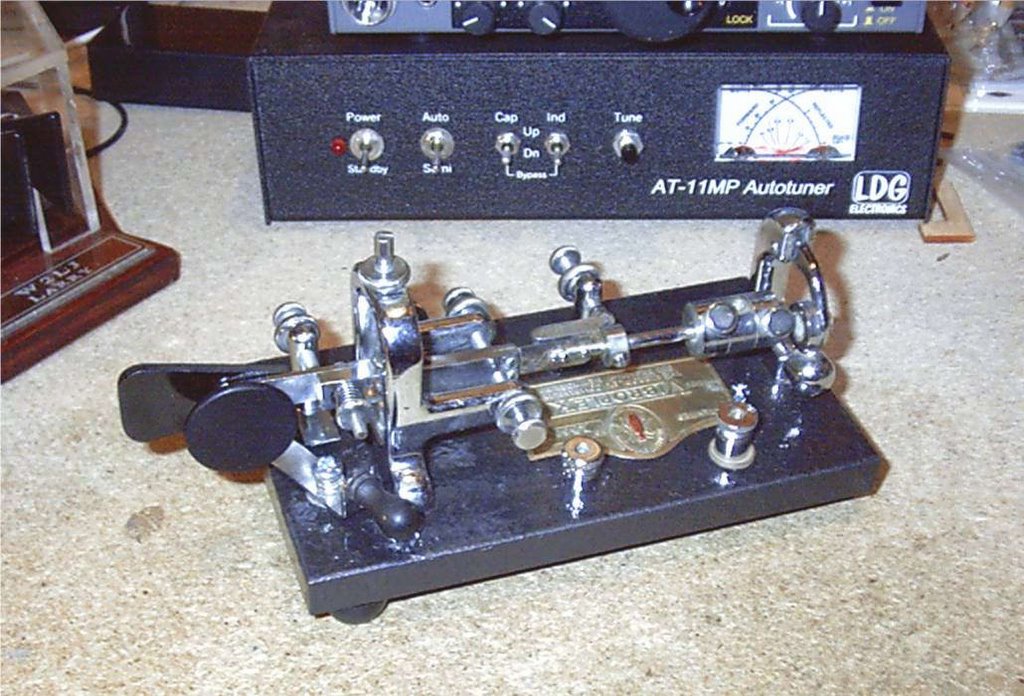
John Sielke w2AGN, a QRP and CW friend from South New Jersey announced on the Brasspounders e-mail reflector that he had acquired this vertical bug from Tom, K4VIZ.

I have one of Tom's mini paddles that I got last summer. It's well made and light enough for portable use, while at the same time is very sturdy.

Both John and I are very satisfied with Tom's products. His workmanship is very, very good and his products hold up very well.

I am definitely a satisfied customer! I would love to get my paws on one of these vertical bugs. As a recent convert to semi-automatic CW keys; this one looks like it would be a real treat to own. Of course, the only thing that prevents me from getting one is a small tiny detail .......... money!

Looks like it's going to be time to put a few items on eBay. If you want more details on this beauty, then go to:

http://www.vizkey.com/order.html#vertical

From there you can go to see details on the mini CW paddle and Tom's really neat 90 degree bug. That one looks like a keeper, too!

73 de Larry W2LJ

All Work & No Play

makes W2LJ not happy! It was a nice day today; sunny and in the high 60s. I would have liked to fire up the K1 at lunchtime. Unfortunately, I had to go to the local nursery/landscape shop and order 2 yards of topsoil. There is much needed yardwork to do this weekend, filling in trenches in the backyard that my dog has been digging all winter long, as well as planting new grass seed in bare spots and covering the seed with topsoil.

But I am excited about tonight. It's the first Monday of the month; so tonight is the monthly Spartan Sprint; sponsored by the Adventure Radio Society. This evening marks their 10th anniversary; so in honor of this, some of us were invited to apply for special event callsigns to be used in the Sprint tonight. I applied for and received W2S. So for just tonight, I will be signing as W2S instead of W2LJ. In fact Tom, K3TW the assistant contest manager managed to find applicants for all KXS, NXS and WXS callsigns for all 10 callsign districts! There will be 30 ARS members working the Sprint tonight with special 1X1 callsigns.

So how long will it be until I botch things and sign W2LJ? :)

73 de Larry W2LJ (W2S for tonight!)

Saturday, April 29, 2006

When Disaster Strikes!

What an idiot I am! Today while mowing the lawn, I saw a clump of weeds along the chain link fence that I just had to trim. So I ran the mower over them; and in the process, chewed up the feedlines to both my G5RV and the Butternut vertical! Talk about wanting to kick yourself in the behind!

Fortunately, all was not lost. I took the coax to my 2 Meter antenna, which I never use and hooked it up to the feedline leading to the Butternut. I cut the Butternut feedline above the mower damage and installed a PL-259. Then I used a barrel connector to attach it to the 2 Meter line. Done! I switched the coax from the VHF radio to the HF radio and it worked just fine.

For the G5RV, I used the piece of coax that was feeding the Butternut last year. I was having trouble with that coax and found the problem area. I cut away the bad part and the balance was just sitting, coiled up and tied to the fence. I put a PL-259 on that and pressed it into service. Voila! It works! It's mini RG-8X and will serve until I can afford some RG9913 or LM283 or something like that.

For safety, I took the coax and tie-wrapped it along the top of the chain link fence. Now it's no longer at ground level and this unfortunate incident should never happen again! I knew I was going to have a busy day with mowing the lawn and repairing the grill. The day got much busier than I had intended!

73 de Larry W2LJ

Friday, April 28, 2006

Makes a body feel good!

I had an excellent QSO last night with Dave KK4PQ from down in Albany, GA. 20 Meters was open nicely last night; and Dave answered a CQ that I put out. Dave was using a Yaesu FT-817ND at 5 Watts to a Vee beam. He had a killer signal into New Jersey; of course, until the band changed and killed us both. But it gets better than that! This was Dave's first CW QSO in about 10 years; and I was to have the honor of being the lucky op to work him!

He apologized for his fist, complaining that he was rusty. There was nothing to apologize for! And if Dave was rusty last night, I'd hate to have to work him when he's at top form. I'd probably get blown away! His fist was truly excellent and a joy to copy. If you ever hear KK4PQ calling CQ on the bands- rush right on over to work him. You're in for a treat!

73 de Larry W2LJ

Thursday, April 27, 2006

It Don't Get Any Better

Sunny and 72 degrees during lunchtime. Set up the K1 and the 20 Meter Hamstick on the Explorer. Had a really nice QSO with Jim W9KRH down in Weeki Wachee, FL while munching on a ham & cheese sandwich. What a way to spend lunch .... warm weather, sunny skies, good food and a good conversation.

I remember being in Weeki Wachee about 37 or so years ago, on vacation with my family. I remember going to see the mermaid show at the Spring. Jim says it's still going on, although he hasn't gone in years. He lives about three miles from the Spring. A quick Google search showed that the attraction is bigger than when I was a kid!

http://www.weekiwachee.com/

Jim was a solid 589 and he gave me a 579. Not bad considering there was an M Class solar flare earlier this morning. The effects must have passed; as I heard a decent number of signals on 20 Meters.

73 de Larry W2LJ

Jumping bands!

I was able to get on the air for just a lil' bit last night. The Mets game went into extra innings and I had to see the end. Yes, my number one outside-of-Ham-radio preoccupation is baseball in general; and the New York Mets in particular. In fact, this summer marks the 39th anniversary since I went to my first ball game at Shea Stadium. I remember it like it was yesterday! My dad took me on his day off and we saw a weekday double header against the Houston Astros. Rookie phenom, Tom Seaver, pitched one of the two games. I was hooked for life!

Anyway, I digress. When I finally did get the K2 fired up, I was treated to the sounds of many European and other DX stations on 30 and 40 Meters. With much difficulty, I worked IK2DOT on 30 Meters. I was pretty tough to hear with my 5 Watts signal. Originally, Carlo gave me a 119 report and was ready to QRT with me. That's when I realized I was on the G5RV. For whatever reason that is beyond my puny amount of antenna knowledge, the G5RV just does not play well on 30 Meters. I quickly switched on over to the Butternut HF9V vertical; and my signal must have literally jumped up! Carlo related to me that he had a good copy on me after that. We exchanged the standard pleasantries and then we signed.

As nice as it was to get that one in the log; I wish that DX stations would ragchew more. When my QRP signal makes it overseas with some decent strength; it would be nice to learn a little bit more about the op I'm working other than "UR 599 TNX QSO DR OM". Frustrating!

73 de Larry W2LJ

Wednesday, April 26, 2006

Founder of FISTS becomes an SK

This appeared on the FISTS e-mail reflector yesterday. It was posted by Nancy WZ8C, the head of FISTS North America.

It is so difficult type "G3ZQS" and "Silent Key" in the same sentence. But I just heard from Geo's son that Geo became a Silent Key at 7, UK time. As I had written to you yesterday, Geo had a heart attack last Saturday and had been in and out of consciousness all week.

Geo's passing leaves a big hole in the Morse world, but he left us with the wonderful legacy of FISTS. He created FISTS to keep friendship, good operating practices and encouragement of newcomers foremost in people's minds "whilst" they are on the air. I know you join me in
re-committing to this FISTS philosophy and making FISTS even stronger, in remembrance of Geo's vision.

73 88
Nancy WZ8C


For those not familiar with the parlance, a Silent Key is a Ham who passes away. He cannot send code anymore, thus his key becomes silent. I never met George; or even had a QSO with him. But I have been a member of FISTS, his brain child, since 1993 or there abouts. I'm not really sure whether it was 1993 or 1994 when I joined. Nevertheless, I have enjoyed my time as a FISTS member; and that is a direct result of George's efforts. His influence will be missed; but the mission continues - to preserve, protect and defend the use of Morse Code in Amateur Radio worldwide.

73 de Larry W2LJ

CW Geek

I was just reading my e-mail; and I saw a post to the SolidCopyCW group by my friend, Dan Romanchik KB6NU. In the signature line of his e-mails, he labels himself a "CW Geek". Cool, Dan! I think I'm going to have to start paying you a royalty fee for that!

Here's a link to Dan's blog; entitled appropriately enough - KB6NU's Ham Radio Blog . One of THE best Amateur Radio blogs on the Web, IMHO!

http://kb6nu.com/

73 de Larry W2LJ

Friday, April 21, 2006

The state of mind that is QRP

I guess that most QRP operators (myself inlcuded, tend to forget that not everyone has the QRP "mindset". What is the QRP mindset, you may ask? Let me take a few minutes to try and explain why it is that we do what we do.

1) QRP operators love to use low power, that is 5 Watts or less when using CW or the digital modes and 10 Watts or less when using SSB. Some of us use it out of necessity. Some QRPers live in places where Amateur Radio antennas are not allowed. These folks use "stealth antennas' and use low power so they cannot be detected. The rest of us? We just love using low power for whatever reason! The challenge is to maintain RELIABLE and QUALITY communications with low power. Efficiency is our passion. Others of us love the idea of establishing radio communications using minimalist equipment; and then there is an entire branch of us that lives to take small radios and light, efficient antennas out to the great outdoors to operate while hiking, camping or just anywhere outdoors!

2) Please do not mistake QRP operating with weak signal operating! QRPers do their utmost to maintain and produce a clean, readable and reasonably loud signal. We understand in many cases that our signals may not be 599; but in the same vein, we're not sadists who live to torture the unsuspecting Ham with sub-par signals! However, in the event our signals ARE weak, you won't offend us if you choose not to work us. We realize that while our QRP sigs might not be loud to QTH "A"; they might very well knock the headphones off of Joe Ham at QTH "B"!

3) Which brings me to the next point. QRPers, outside of hardcore DXers, are probably the most familiar with ins and outs of RF propagation and the effect that the sun has on the ionosphere. We know our signals might not be the loudest; so we tend to learn as much about RF propagation conditions as we can so our signals "work smarter and not harder". If you'd like a real treat, I urge you to go to:

http://www.qrparci.org/content/view/57/55/
This is an article about the ionosphere and how the sun affects it and radio communications. It is the best article in easy-to-understand-everyday-English that I have ever read on the subject.

4) QRPers do the best they can to learn the characteristics of their stations and antennas. QRPers take great pains to make sure that they squeeze every electron out of their antennas. If you spend any time on the various QRP e-mail reflectors, you will see more posts about antennas and receivers than just about anywhere else. And the experts abound! You can learn so much from these guys; and the giants of QRP are more than happy to share whatever they have learned over the years.

5) By their nature, QRPers tend to be builders, tinkerers, experimenters and tweakers. This is all done to maximize efficiency of equipment and antennas - to get, in essence, the biggest bang for the buck. The side benefit of this is that if you're having trouble with a piece of your station equipment or antenna; then go and find the nearest QRP enthusiast! If he or she can't help you themselves, they'll probably be able to point you in the right direction to clear up whatever problem you might be having.

6) Since QRPers are familiar with weak signal work, they tend to become first rate, top notch Amateur Radio operators. The best of the best can dig out signals from below the noise floor so well that you would swear they use ESP! In fact many QRPers tend to use just that term! Signals that are just barely audible are said to be at "ESP level"! Also, since the majority (but by no means all) of QRP operating tends to be using Morse Code, the best of these guys have the most outstanding fists! The Morse flies out of their fingers like music and their CW is an absolute joy to copy and listen to.

All the above being said, QRPers tend to be very enthusiastic about not only QRP; but about Amateur Radio in general. The majority have the "spirit of Amateur Radio' that was handed down to us by the great Hams that came before us. Our enthusiasm is infectious; and we hope we can relate that enthusiasm to the rest of the Ham population.

73 de Larry W2LJ

Still learning!

I've been using my reconditioned Vibroplex Original for about a month now. It's been a lot of fun to use and I've been enjoying the heck out of it; but something has been nagging me - something hasn't been quite "right".

I took the time out the other night, to look over things with a "fine toothed eye" as it were; and I found out what wasn't right. When you make a "dah" you push the paddle to the left. The "dah" contact is on a swing arm that should push away from the main part of the pendulum. There was such an amount of rust there; that the "dah" arm wasn't swinging away from the pendulum. I had to swing the entire pendulum to the left to make a "dah"; and that's not correct.

I took the pendulum off the base and squirted a ton of Liquid Wrench in there. It got it to the point where the "dah" contact arm did come loose; but it wasn't swinging freely like it should. It would swing out all right; but would "click" into place and required a lot of force to bring it back to normal. The "dah" tension spring should provide enough force on its own to do that under normal circumstances; and there was no way ANY spring would provide enough return force as things were.

I decided that I was going to order a new trunion pin from Vibroplex. I would take the old one out and seperate the "dah" arm from the main pendulum, clean it all up, and install a new trunion. In the process of beginning to tap the trunion out, I must have dislodged whatever rust or foreign matter was there. The "dah" arm was now flopping around freely; just as it should. I carefully tapped the trunion pin back to the correct location; but in the process of hammering, I flattened out the pivot points! Thank God for Dremel tools! I grinded the ends of the trunion pin to finer points and reinstalled everything where it belonged. The Bug is working 100% precent properly now. The code is coming off much smoother, less herky-jerky; and sounds much better now. I was always wondering why I couldn't transition from "dahs" to "dits" more smoothly - now I know!

The restoration is now complete; and I've learned a thing or two or three in the process. How cool is that?

73 de Larry W2LJ

Thursday, April 20, 2006

Success!

Today it reached about 75 degrees during luchtime; so I went outside and fired up the K1 at the back of my Ford Explorer. This time I had success!

I called CQ and was answered by John VE7CBU in Vancouver, British Columbia. Not bad for 5 Watts to a Hamstick mounted on top of an SUV!

I gave John a 589 and he gave me a 539. Then he proceeded to turn his power down to 5 Watts. Guess he wanted to give me a taste of my own medicine!

I had solid copy on him; which was rough on my part, but I managed. Unfortunately, I was not in the confines of my nice quiet shack located in my basement at home. I was in the parking lot at work, sans headphones while at the same time a freight train was blowing past me on the tracks which are located a couple hundred feet behind our building! It made it a tad rough for copying; but I guess that's what we portable QRPers live for! Next time, I'm going to have to remember to pack my headphones in the rig box.

73 de Larry W2LJ

Tuesday, April 18, 2006

Dead Bands

Today it is about 69 degrees during lunchtime. So I decided to go out to the Explorer during my break and fire up the K1. The weather was superb! Sunny and warm with a slight breeze. I could have easily chucked the light jacket I was wearing. Almost ideal.

The band, however, sucked. Turning the dial up and down throughout the 20 Meter band yielded nothing. Absolutley nothing. Well almost nothing. I heard quite a pileup down at the bottom of the band. I would assume that that was the VU4 DXpedition on the Andaman Islands. I didn't hear the fox; but I did hear the pack trying to get a nip of the quarry.

Maybe better luck tomorrow.

73 de Larry W2LJ

Wednesday, March 22, 2006

They all passed!

From a previous entries, I mentioned the Technician license class that Marv K2VHW and I were teaching this winter. The final session and exams were last night. We had an ARRL VEC accredited team present to administer exams.

I am happy to report that the entire class passed and are now Technician class licensees, awaiting callsign assignments from the FCC.

It would be an understatement to say that Marv and I were pleased with the results. We were more akin to proud parents; that might be the best way to put it.

The feedback we got from our students was extremely positive. We're hoping that we have the beginnings of a new Amateur Radio club in the embryonic stages. Possibly it will be centered around emergency and public service communications. Getting all of us together for Field Day would be real nice; but maybe too ambitious for this year.

We're also looking into the possibilities of doing this again next winter; with the added prospect of having some of our graduates pitch in and help with the teaching.

73 de Larry W2LJ

Sunday, March 19, 2006

Logging program shootout

So far, the incumbent is winning. I've customized the heck out of AC Log; but I keep going back to Win-EQF. Maybe it's just that habits are hard to break; but I like Tom's program better.

A final final decision hasn't been reached, however.

73 de Larry W2LJ

The Advocate

This appeared in the March 19th, 2006 edition of The Advocate, from Baton Rouge, Louisiana.

Attic Salt for March 19

Morse Code in danger of disappearing

By ED CULLEN
Advocate columnist
Published: Mar 19, 2006

An editor who was a Coast Guard radioman handed me a copy of a wire story about the Morse Code. Across the top, he’d written — “dit, dit, dah, dit — dah, dit, dah, dah — dit, dit.”

The editor’s coded message, written in a way discouraged by our instructors at Navy radio school, said “FYI.”

In the 1960s, radio telegraphy was still taught in military communication schools. It differed from the way Samuel F.B. Morse’s code sounded. Modern Morse Code, sent by radio transmitter, is a series of short and long tones. Early Morse Code relied on holes punched in paper or the spaces between clicks generated by electricity passing through an electromagnet.

In the Boy Scouts, we learned the code in written form first, a practice frowned upon by serious telegraphers because it slowed one’s deciphering the received code. Code, it was argued, should be regarded as another foreign language. The operator should be able to hear a series of dits and dahs and recognize a word. He shouldn’t have to first visualize the code. He should hear it and know the words as though someone were speaking to him in French.

When the U.S. military abandoned the Morse Code as outdated and slow, old radiomen wrote letters to the newspapers defending their art. It is true that the code can be “copied” when the radio bands make voice communication unworkable, but not enough people knew the code or could copy it at speed sufficient to make it practical.

There was the telephone, after all. And cell phones. And, of course, computers. All of which failed during Hurricane Katrina.

Ham radio operators didn’t use much code during Katrina, compared to the thousands of messages relayed by voice, but it was there if needed.

One of the great ironies of Katrina is that state-of-the-art communications systems, private and ones run by the government, failed. Ham radio operators using relatively inexpensive equipment carried the ball for weeks after the storm.

Now, even ham radio may be turning its back on the code or CW (continuous wave).

The FCC has been asked to drop the code requirement in ham radio licensing which makes sense. CW isn’t used by that many hams, and it keeps young people from applying for radio licenses. Without new blood, it’s feared the government will auction off parts of ham bands to commercial interests.

But hams fear that if the FCC makes it too easy to get an amateur license amateur radio will go the way of Citizens Band.

The code is what attracted me to ham radio. When I get on the air, it is code that I use. I haven’t anything urgent to communicate, so the speed of CW is just right.

I think there’s an argument for keeping the code. Why should everything be easy? Require learning the code, but lower the speed for licensing.

Morse Code is part of the romance of radio, a pastime once so accessible to its devotees that many operators built their own transmitters and receivers.

Old radios with their softly glowing tubes, homemade antennas and handsome brass telegraph keys are art practiced by ordinary Joes and Janes.

The Morse Code was something you could start to learn on a front porch on a rainy afternoon. Last week, when the story on Morse Code ran, men across the country took the occasion to use a language they learned in the service or the Scouts to communicate with kindred spirits. And not in e-mail but by making the sounds themselves or writing out the code.

So primitive. So neat.

___________________________________________________________________

73 de Larry W2LJ

Thursday, March 16, 2006

Progress

It's been a few weeks since I finished restoring the Vibroplex Original that I acquired on eBay. Now it's time to use it; as I have detailed in a previous post. Practice makes perfect; but there are also a few other resources that I am taking advantage of to help myself become a "veteran" bug user.

The first thing is to enlist the use of a "bug tamer". Even after installing all the weights I have on the pendulum of this thing, the speed is still way too high. By ear, I would estimate somewhere between 25 - 30 WPM. I can copy that; but I'm not comfortable sending that fast. My top reliable accurate sending speed poops out at about 23 WPM right now. So I have enlisted the use of a device to help mechanically slow down the vibrations of the pendulum.

It's nothing more than an aluminum tube which fits over the end of the pendulum, and extends outward. It has a weight at the end. With that installed, I can vary the speed of the bug depending on where I locate the "original" weights on the pendulum. I can slow the bug speed down to about as low as 13 WPM or so. I have it set right now, so that I am at about 18 WPM. I don't want to go too fast, even though I can normally send a little faster. I don't want to develop any sloppy tendencies.

The other thing that I have been using that is a tremendous help is a CW reading program on the computer in the shack. No ....... I'm not using it to decode CW coming off the radio. Sorry guys, but it my eyes, that's akin to blasphemy. But how I do use it, is as follows:

I get the computer program running, turn on the K2 and turn the AF gain all the way down. Then, I turn the VOX circuit off so I can key the rig without putting out any RF. The sidetone still sounds; because on the K2, the sidetone level is independent of the AF gain. So with the AF gain all the way down; and no RF coming out, I can use the K2 as a glorified code practice oscillator. At this point the CW reading program will decode whatever I send !!! I figure that if I can get to the point where I can send good enough so that the computer can reliably read it; then I must be sending out decent (at the very least) Morse Code.

So far so good. I'm still making mistakes, getting used to making those manual dahs is a pain. But what's coming out on the computer screen is starting to be, more often than not, legible copy. By the way, the CW decoding problem that I use is available for free from the AmQRP Website. You can click here, to get it.

73 de Larry W2LJ

Wednesday, March 15, 2006

An Editorial

The following appeared in today's Toledo Blade, in Toledo, Ohio. It pretty much sums up my feelings about this issue.

SOS for a fading skill


A PROPOSAL by the Federal Communications Commission to eliminate the Morse code requirement for gaining an amateur radio license is probably inevitable in the Internet age. Still, it marks another sad surrender to technological advance and a further step away from basic skills that stimulate the mind and improve the human condition.

The FCC is considering new rules that will no longer require applicants for a "ham" radio permit to send and receive messages with the electronic dots and dashes developed by Samuel F.B. Morse for his patented telegraph nearly 170 years ago.

The change, likely to be adopted next year, is mostly an issue for some 600,000 radio amateurs in the U.S., who now must demonstrate their code proficiency at five words per minute along with written examinations on technical matters and radio procedure for various levels of licensing. Dedicated hams believe the code requirement is among the factors that have separated them from the comparative frivolity of "citizens band" radio.

But it's more than that. Dropping the code requirement further distances the radio operator from the basics of the craft. While it is certainly easier to simply speak into a microphone than tap out a message on a telegraph key, the fact that less skill is required is not necessarily an advance.

Learning Morse code once was considered valuable not only for simple communication but also because it sharpened the mind. Generations of Boy Scouts may have been bedeviled by code tests needed to advance in rank and earn merit badges, but they were better, more responsible individuals for the effort and experience.

Likewise, amateur radio operators who know and use Morse code are, in a sense, more in tune with themselves and others. With their battery-powered equipment, hams continue to play an important role in modern communications, as they demonstrated during Hurricane Katrina, when land lines fell to the storm and the failure of electric plants made cell phones and the Internet useless in the face of disaster.

While it is almost certain that the FCC will drop the code requirement for amateur radio licenses, we would do well to use the occasion to ponder one of life's fading lessons:

Just because something is hard doesn't mean it's useless and, conversely, just because something is easy doesn't mean it's good.

Nearing the Finish Line

Last night was the next to last session of the Technician Class license course that I have been co-teaching since the beginning of January. It ended up being a 10 week course with six students. Next week is the exam session. An ARRL accredited VE team is coming in to administer the examinations; and we've opened up that session so anyone from the general public can come in for an exam.

The guys have all done a magnificent job! Last week we gave them a practice exam and they all passed. Last night, we gave them two more. One was given at the beginning of the session; and the second was given at the conclusion. In both instances, everyone "made the grade"! That was very satisfying to see.

One of our six students is the son of one of the other students. They came in as a father and son team. It was a kick to see son get fewer answers wrong on his exam than Dad! Willie, the son, is very interested in Ham Radio. I think he's going to go far with the hobby. More on that in a bit.

I am confident that in two weeks or so, five new callsigns will be issued. Five callsigns from six students? Yep, one of our students went to a Hamfest a couple of weeks ago and already passed his test. I am certain the other five will do just as well.

Next week will be out last session together; but in reality, it is just the beginning. The easy part was helping these folks to get their tickets. Now the work begins. The heavy lifting will be to make sure these guys at least get the chance to stay interested and active.

The Ham who co-taught this class with me is Marvin Bronstein, K2VHW. I cannot say enough about Marv! He is the greatest! He is a broadcast engineer by trade, who works for WABC TV in New York City. Marv has the distinct gift of taking difficult to understand concepts; and translate them into terms that make sense and are no longer mysterious. He came up with a couple of explanations for certain concepts that I've always understood; but now I understand them even better as a result of listening to him. Marv is definitely a "Ham's Ham" and quite an Elmer. His enthusiasm for Amateur Radio, for the students and for garnering new Hams is to be admired. I wish I knew a ton more guys like him.

Our group of South Plainfield Hams has to nurture these guys once they receive their callsigns. After all this work, I'd hate to see any of these guys go to the wayside because they failed to have good mentoring (for lack of a better term). To that end, we'll probably inaugurate some kind of South Plainfield Amateur Radio Club where we can gather and help them in their Amateur Radio endeavors. We've gotten their feet in the door. Now we need to get the rest of their bodies through.

73 de Larry W2LJ

Tuesday, March 14, 2006

A Tale of Two Logs

This comes from right out of the "Stupid Department"; but I am facing a dilemma. The dilemma involves which computer logging program to use. I know, I know, this is not "important, matter-of-life-and-death" stuff; but when you spend a lot of time on the air; you consequently end up spending a lot of time using a logging program.

Since 1992, I have been using Log-EQF and more recently, its Windows variant Win-EQF. It's a very nice program; and I have met the author, Tom Dandrea at the Dayton Hamvention. He's a super nice guy who has written a superb logging program. It's nice and easy to use. It does everything I want it to do; and it fits like a comfortable slipper or loafer. Most importantly, I can attach to each QSO a rather long comment field. I alos use my log as kind of an "Amateur Radio Journal". Not only do I detail what the QSOs were about; but I might also comment on new equipment, band conditions, out of the ordinary weather - all that kind of stuff.

Recently, I have heard rave reviews and have tried using Scott Davis, N3FJP's ACLog. This is also a superb, very nice logging program. Here's the rub. This program is "sexy". It looks and behaves like a Windows program. It looks like an Excel spreadsheet, actually. Win-EQF, on the other hand, looks like a Unix syle program that was made to work with Windows; not FOR Windows! And ACLog offers a degree of customization that Win-EQF doesn't. I can add fields for NAQCC and SKCC membership numbers, for example. I can order the tab number of the data fields; so I can enter data in the order that I want. It's truly a wonderful program with nothing but glowing reviews from it's users.

So what's the dilemma then? It sounds like ACLog is the runaway winner, right? Not so fast, Bunky! Win-EQF has some things going for it that make me want to stay with it anyway. There's the familiarity issue, for one. It's like an old friend that I really don't have to think about; I just "know" it. It displays all the information, I want for the most part (except for the extra fields). And the fact that there's a bit less customization means there are fewer decisions that I have to conciously make.

What to do ...... what to do. For now, they're both on my computer. I'll use them side by side for a while and see which one I gravitate to.

73 de Larry W2LJ

Thursday, March 02, 2006

Buggin' out!

Now that my Vibroplex Original Standard has gone through its restoration process, via yours truly, now comes the time to hook the lil' bugger (pun intended) up and use it.

Hooking it up is the easy part. Using it is another thing, entirely. In actuality, it's not difficult to use at all. In fact, it's very much like using a keyer and paddles.

That's the problem!

For the past 22 years, I have been using a keyer and paddles. I used to use a Bug many years ago; but it was MANY years ago! My brain is so used to touching a paddle lever and getting a series of dits and then touching the other paddle to get a series of dahs; that it has become ingrained.

Getting on the Bug the first time wasn't too bad. I pressed the lever in one direction and got a series of well formed and well designed dits. So far, so good. I pressed the lever in the other direction and got one well formed; but interminably long dah! Oh yes, that's right ... I AM THE ONE who has to manually make the dahs! Sorry, not used to that! The tendancy is to leave my finger on the lever way too long! Unfortunately, this is International Morse Code I'm dealing with and not American Morse. There are no extremely loooooong dahs in this system!

What to do? Practice, practice and practice some more! I have been sending imaginary exchanges to my keyer with its speaker turned on. This allows me to conveniently send "off the air". And after a few evenings, I judged that I didn't sound way too terribly. So I got on the air and called a CQ on 80 Meters. A guy came back to me and was actually able to decipher what I was sending! Wow!

In reality, while it's not terrible, I'm not comfortable with the way it sounds. My code with the Bug is still a little disjointed and stacatto. My fist is indeed, legible; but it doesn't "flow" at this point. It sounds more like the orchestra tuning up than playing the actual symphony. I pride myself on my Morse being "liquid" and being easy to listen to and decipher. Maybe I'm my own worst critic; but I am not happy ...... yet.

I need some more practice; but I do think I see the light at the end of the tunnel. Maybe in a few more weeks, I'll actually feel comfortable enough to get on the air and not make a fool of myself (again). I just hope that light I see at the end of the tunnel isn't a train!

73 de Larry W2LJ

Friday, February 24, 2006

Good PR !!!

While Amateur Radio might not make the headlines everyday, we got a mention in the White House report on Hurrican Katrina. The report was very self critical on the government's role in handling the aftermath of one of the worst natural disasters in our Nation's history. Amateur Radio was mentioned in a very positive light. At least we're getting noticed somewhere!

The following appeared courtesy of Rich Moseson W2VU, editor of CQ Magazine, on the CQ Magazine e-mail reflector. Thanks, Rich, for keeping us informed!

The following is from the CQ-News reflector:

From the CQ Newsroom…

The White House today released its review of the federal response to
Hurricane Katrina, which, according to a statement, "identifies the systemic
problems in Federal emergency preparedness and response revealed by
Hurricane Katrina - and the best solutions to address them." The report
included 17 lessons the Executive Branch learned after reviewing and
analyzing the response to Katrina; made 125 specific recommendations to the
President, and identified 11 critical actions to be completed before the
first day of the 2006 hurricane season.

The report also included a section titled, "What Went Right" in the Katrina
response, which singled out amateur radio operators for particular praise:

*"Other organizations worked tirelessly to assist emergency responders that,
due to the storm, did not have the equipment and means to effectively carry
out their duties. Amateur Radio Operators from both the Amateur Radio
Emergency Service and the American Radio Relay League, monitored distress
calls and rerouted emergency requests for assistance throughout the U.S.
until messages were received by emergency response personnel. A distress
call made from a cell phone on a rooftop in New Orleans to Baton Rouge was
relayed, via ham radio, from Louisiana to Oregon, then Utah, and finally
back to emergency personnel in Louisiana, who rescued the 15 stranded
victims. Ham radio operators voluntarily manned the amateur radio stations
at sites such as the National Hurricane Center, Hurricane Watch Net,
Waterway Net, Skywarn and the Salvation Army Team Emergency Radio Network."
*

Finally, the report identified three immediate priorities:
1) Implementing a comprehensive National Preparedness System "to make
certain that we have a fully national system that ensures unity of effort in
preparing for and responding to natural and man-made disasters;"
2) Creating a "Culture of Preparedness" that "emphasizes that the entire
Nation - at all levels of government, the private sector, communities, and
individual citizens - shares common goals and responsibilities for homeland
security;" and
3) Implement corrective actions "to ensure we do not repeat the problems
encountered during Hurricane Katrina."


A White House fact sheet summarizing the report is available online at
<http://www.whitehouse.gov/news/releases/2006/02/20060223.html>.

(Tnx CQ Public Service Editor Bob Josuweit, WA3PZO)

The full report is also available online at
<http://www.whitehouse.gov/reports/katrina-lessons-learned/>.


73 de Larry W2LJ

Wednesday, February 15, 2006

FCC noncommittal

SB QST @ ARL $ARLB003
ARLB003 FCC noncommittal on "Morse code" proceeding

ZCZC AG03
QST de W1AW
ARRL Bulletin 3 ARLB003
From ARRL Headquarters
Newington CT February 14, 2006
To all radio amateurs

SB QST ARL ARLB003
ARLB003 FCC noncommittal on ''Morse code'' proceeding

Just when the FCC will act on the ''Morse code'' proceeding, WT Docket
05-235, remains hazy. The Commission released a Notice of Proposed
Rule Making and Order (NPRM&O) last July proposing to eliminate the
Element 1 (5 WPM) Morse code requirement for all license classes.
The Amateur Radio community filed more than 3800 comments on the
proceeding, and additional comments continue to show up, even though
the formal comment deadline was last fall. The next--and
most-anticipated--step for the Commission is to formally adopt any
revisions to its rules and conclude the proceeding with a Report and
Order (R&O) that spells out the changes and specifies their
effective date.

''There really is no news,'' an FCC Wireless Telecommunications Bureau
(WTB) staffer told ARRL this week on background. ''We certainly hope
to release WT Docket 05-235 sometime this year, but we're not making
any predictions at this time.'' The WTB staffer indicated there would
be no ''big announcements'' at the Dayton Hamvention FCC Forum either.

Beyond eliminating the Morse requirement, the FCC declined in its
NPRM&O to go forward with any other suggested changes to Amateur
Service licensing rules or operating privileges.

The proceeding began with 18 petitions for rule making--many just
calling for the elimination of the Morse requirement but some asking
for more far-reaching changes in the Amateur Service rules. The
various petitions attracted a total of some 6200 comments. The FCC
subsequently consolidated the petitions--including one from the ARRL
asking the FCC to establish a new entry-level license class and to
retain the Morse requirement for Amateur Extra class
applicants--into a single proceeding designated WT 05-235.

Worth noting is that the FCC did not propose in WT 05-235 to extend
HF privileges to current Technician licensees who have not passed a
Morse code examination. In its NPRM&O the FCC suggested that in a
no-Morse-requirement regime, such ''codeless Techs'' would be able to
gain HF access by taking the Element 3 General class written
examination.

Before it releases an R&O on the Morse code proceeding, however, the
WTB wants to wrap up action in another Amateur Radio-related
docket--the ''Phone Band Expansion'' (or ''Omnibus'') NPRM in WT Docket
04-140, released last April 15. A dozen petitions for rulemaking,
some dating back to 2001, were consolidated in the Omnibus
proceeding. In that NPRM, the Commission proposed to go along with
the ARRL's Novice refarming plan aimed at reallocating the current
Novice/Tech Plus subbands to expand portions of the 80, 40 and 15
meter phone bands. The FCC also agreed with an ARRL proposal to
extend privileges in the current General CW-only HF subbands to
present Novice and Tech Plus licensees (or Technicians with Element
1 credit).

Any FCC decision to eliminate the 5 WPM Morse code requirement for
HF access would have no impact on either the current HF CW-only
subbands or on the CW privileges of Amateur Radio licensees. The
Morse code proceeding neither put forward nor recommended any
changes in CW allocations or privileges.
NNNN
/EX

Sunday, February 12, 2006

He's Got the Cooties!

No ..... not the Cooties; just a Cootie. And this Cootie has nothing to do with imaginary childhood pretend diseases.

When I joined the SKCC and started using the straight key on a continued basis, my elbow and arm let me know in no uncertain terms that it was objecting mightily! The prolonged up and down motion was creating a repetetive stress disorder.

So I sold a couple of military jet models on eBay. These were sitting around collecting dust; and in the process, I earned enough cash to purchase an LTA Cootie Key from Marshall Emm, N1FN at MorseXpress.

The Cootie Key, or sideswiper as it is also known, does just that. It allows you to send Morse Code by swinging the lever from side to side; instead of pumping it up and down. You make contact on each side of the swing; so it's more like using two straight keys back to back and then laying them on their sides.

I thought that it was going to take a real long time to get used to it; but fortunately, that hasn't been the case. I guess all those years of using a keyer and paddles has helped. The hardest thing to get used to is that you're making these dits and dahs manually. The temptation is always there to let your "keyer" make you either a string of dits and dahs. I have to constantly remnd myself that there is no keyer and that I have to break contact in order to make more dits and dahs.

After about a week's worth of practice off the air; I have ventured towards using this beautiful key on the air in realtime QSOs. I must be doing okay as no one has called me a "lousy fist" yet; and everyone seems to understand what it is that I'm trying to say.

In any event, practice makes perfect and I'm sure I'll get better and better the more I use it.

73 de Larry W2LJ

Saturday, February 11, 2006

Restoration project

I am embarking on a restoration project; which I don't believe is going to prove to be too difficult. To the left is a Vibroplex bug that I won in an auction on eBay. I got it at the great price of $31.00. Considering the fact that the average Vibrpolex bug goes for well over $100.00 on eBay, I think I got a real good deal.

This one is a Vibroplex Standard Original. The serial number dates its manufacture in 1957. That's cool; because this makes this bug as old as me! In any event, this bad boy has a few problems right from the get go. There are no weights on the pendulum; and there was only one finger piece on it when I got it. The picture above shows that I have taken that off. The hole that the finger piece screws into was cross-threaded so I am going to have to retap the hole.

A telephone call to Vibroplex was in order; so I placed an order for two new black finger pieces as well as one heavy and one medium weight. I think this bug was stored somewhere where the humidity is high. A look at the strap underneath shows some heavy oxidation; which can lead to intermittant operation. The strap will have to come off and get polished by the Dremel tool. While I'm at it, the rest of the metal pieces will receive a light buffing from the Dremel, too. The base will receive a gentle going over with a Mr. Clean Magic Eraser. That should get this beauty back in fine business shape! And once it's operational, I am looking forward to the challenge of matering the use of a "speed key".

73 de Larry W2LJ

Thursday, February 02, 2006

The ultimate in recycling!


It has been said that the history of Amateur Radio has time and time again displayed the resourcefulness of Amateur Radio operators.

In 2006 Hams are taking this reputation to the next level! Tomorrow, February 3rd is scheduled to be the launch date for SuitSat.

The Ham Radio ops who are currently assigned to and are living aboard the International Space Station will be making use of an old, worn out Russian space suit. They are filling it with various bits of Kenwood 2 Meter amateur radio gear; and they will be setting it free to float in orbit on its own. The EVA when this is supposed to happen is scheduled for tomorrow; and if all goes well, then SuitSat (as it has become to be known) will be born.

The suit will be under no kind of propelled orbit. It will just be free floating, orbiting around the earth under the influences of orbital and gravitational laws. The batteries that will be powering the equipment are expected to last about six weeks. The suit will be sending out a beacon message; and if the suit is orbiting over your area at a sufficient elevation above the horizon, you should be able to hear the message with an ordinary 2 Meter handheld tuned to 145.990 MHz.

For more information, check out the following links:

http://www.amsat.org/amsat-new/articles/SuitSat/

http://www.suitsat.org

Happy monitoring and good luck! Who knows, this might get you interested in working the various OSCAR satellites that we have up in space. I've done it; and it's a ton of fun!

73 de Larry W2LJ

Sunday, January 22, 2006

Too much fun!

A week ago, maybe two at most, I got wind of a new Yahoo Group that was forming. This one is called the Straight Key Century Club; and it is the brainchild of Tom Peterson KC9ECI. This group is dedicated not only to the CW lover; but to the CW lover who loves to use the original tool of the trade, the straight key. In order to accomodate those who have carpal tunnel problems, the use of bugs and Cootie keys is permissable. That the Morse has to be generated mechanically, is the "key". And no, I'm not sorry for the pun.

What is phenominal is how Tom's concept has caught on like wildfire. Over 500 Hams have joined just in the first few fledgling weeks of the club! Fortunately, that tells me that the prophets who have declared that, "CW and Morse Code are dead" clearly have their heads firmly planted up their nether regions.

The club's founders also had the vision to decide to locate the "watering hole" frequencies within the Novice/Tech CW allocations. So not only will entry level Hams get the chance to participate; but the rest of us will make those regions of spectrum sing once again with the delicious sounds of Morse Code.

So, if you love CW (and you probably do if you're even reading this) and you haven't joined the SKCC, then please hop on over to http://groups.yahoo.com/group/skcc/ and see what it's all about!

73 de Larry W2LJ

Thursday, January 12, 2006

Mr. Kotter! Mr. Kotter!

Tuesday evening, I embarked upon a journey that I haven't taken in about 9 or 10 years. Tuesday evening, I began teaching a Technician class license course.

In South Plainfield we have, according to QRZ and HamCall (as well as FCC records) about 50 or so licensed Amateur Radio operators. Maybe five have shown interest in becoming involved with public service communications for the town. A ten percent turnout is definitely disheartening.
So the group of five decided to do something about it. We advertised a Technician License course in the local town newspaper. At an introductory meeting in December, 11 folks showed up. At that time we took the opportunity to explain a bit more about what Amateur Radio is, what it can do; and why we were offering the class.

Six of those eleven people showed up for the class Monday night. I was happy to see so many people show up with so much enthusiasm for Amateur Radio. Over the next 9 -10 Tuesday evenings there will sessions covering every aspect of the hobby needed for these good people to pass their tests and get their licenses.

My hat gets tipped to the ARRL for offering "The Now You're Talkinig" text and associated study materials. Like I said before, the students are showing enthusiasm and a "wanting-to-be-there" attitude that tell sme that this is going to be a ton of fun.

73 de Larry W2LJ

Wednesday, January 11, 2006

Flabbergasted, surprised, shocked and humbled.


Checking my e-mail earlier today, I saw an e-mail from Jim Sheldon WØEB which was titled, "A1 Ops Club". I figured that Jim had been named an A1 Operator and was relating his excitement and joy. A few seconds later, I saw that Jim was congratulating ME on being nominated, seconded and inducted into the A1 Operators Club !!!!!

HooooooooooYaaaaaaaaahhhhhhhhhh !!!!!!!!!!!!

I have dreamed about this moment since my days as a Novice operator some 27 years ago. Then, that was a far away dream - a hope that someday I would be considered a top notch operator. I am elated, flabbergasted, shocked, overjoyed and humbled all at the same time! I have nothing to relate this to on the Amateur Radio Scale of Happiness! This is way better than earning DXCC; or joining the 1000 Miles per Watt Club. This is better than anything. Maybe, just maybe, the only thing that comes close was being named "Elmer of the Year" back in 1998 by my local chapter of the QCWA.

No, this is in a class all by itself. This is better than anything. This is extra special because the A1 Operators Club is a club you cannot join. You have to be nominated and seconded by two Hams who are already members - your peers. You have to be deemed fitting in the following criteria, as it appears on the ARRL Web site.

Membership comes after nomination by two Club members who find the nominee qualified to be a member of this elite group. Nominations should be based on the following:

  1. General considerations. Transmissions stable, well filtered, and occupying the minimum required bandwidth. On voice, clarity of speech, brevity, uses appropriate words and good grammar. On digital modes, clean tones and appropriate operating-frequency selection. On CW, proper character formation and spacing with appropriate speeds (high-speed ability is not a consideration).

  2. Procedure. Always listens before transmitting. Appropriately short CQs, avoidance of unnecessary repetition, use of proper procedures and abbreviations recommended by ARRL, avoidance of common inanities in making contacts. When operating a message forwarding system, make sure that traffic is routed to its destination.

  3. Judgment and courtesy. Courteous, and considerate of the other operator's point of view. Takes every opportunity to assist others, especially beginners. Patient and helpful at all times, and never knowingly operates in such a way as to lessen the pleasure of others.

  4. Copying ability. This applies to all modes, for there is a knack to passing information through such difficulties as interference from other stations (QRM), atmospheric noises (QRN), fading (QSB), etc.
The thought that two of my fellow Amateur Radio operators are of the opinion that I display such qualities is really, really humbling. I hope to ALWAYS operate in a manner so as to be worthy of my inclusion.

To the two Hams who nominated and seconded me ..... I thank you from the bottom of my heart. This is the pinnacle of my Ham radio career.

73 de Larry W2LJ


Friday, January 06, 2006

SKN 2006

Straight Key Night was a week ago; and as usual, it was fun! It was nice to hear 80 Meters filled with wall-to-wall CW signals. It reminded me as to how 80 Meters used to be most nights back during my Novice days in the late 1970s.

I only had about four QSOs on New Year's Eve; but they were fun, relaxing and enjoyable. I used two different straight keys and both were a pleasure to use. I started off with an old Western Union J-38 that I acquired from eBay a few years ago. I have it mounted on an extra heavy aluminum base - it goes NOWHERE! I have it adjusted so that the action is barely perceptable, yet positive. I could send all night on that baby.

The other key was the Christmas 2005 miniature key that my wife gave me for Christmas a week ago. It was surprisingly comfortable and easy to use. Even though it is small and light, it has three rubber feet on its base that keeps it where you put it.

24 hours later, on New Year's night it was amazing to see the "difference a day made". That night there were barely ANY signals on 80 Meters and it took me about an hour to drum up a QSO. That ended up being with a local guy who lives probably less than 10 miles or so away from me. It would be nice indeed to have that kind of activity on the bands every night of the year!

73 de Larry W2LJ

PS: We're into the sixth day of January and I've logged 38 QSOs so far this month! Hopefully, I will get a good start on breaking my total for 2005.

Saturday, December 31, 2005

A Done Deal!

2005 started on January 1st at 0141 UTC with a Straight Key Night QSO with Bob WB8QLA. 2005 wrapped up with a QSO with Jim W4QO on December 31st at 0217 UTC. 365 days of at least one QRP CW QSO a day. The year ended with a total of 1778 QSOs on all the HF bands, save for 12 and 10 Meters.

It's hard to believe that I reached my goal! Band conditions have been so crummy this year. There were times during Coronal Mass Ejections, when radio conditions were all but in a black out; that it seemed that I might have gotten farther using smoke signals instead of RF. But the Morse Code and CW just never let me down. CW and Morse Code did get through when nothing else could have!

There were several highlights to my Amateur Radio year; but three stand out in my mind:

1) The completion of "QSOa Day" for 2005. I had no real idea of the complexity of the task. Juggling family obligations, social schedules with propagation, band conditions and operating time seemed daunting at times.

2) Working SPØPAPA on April 9th. This was a special event station operating in Poland, celebrating the pontificate of Pope John Paul II the weekend of his funeral. All of my grandparents immigrated to this country from Poland. By birth I am an American, by ancestry I am a Pole. John Paul II and this QSO meant a very great deal to me.

3) The one that got away! In July I came THIS close to working Iraqi station YI6ZL. He heard my QRP signal through the pile-up and came back to me with "W2L?" looking for the rest of my suffix. Unfortunately, I was creamed by a W4 station who obviously couldn't understand what "W2L?" meant! Completing that QSO with Iraq on 5 Watts and beating out a humongous pile-up would have been sweet!

So now it's officially 2006 via Universal Coordinated Time. In a half an hour, I'm going to put the kids to bed; and then head down to the shack and Straight Key Night to get it all started, all over again. At times, life is good!

73 es a very Happy, Healthy, Joyous and Prosperous New Year to you all!
de Larry W2LJ

Thursday, December 29, 2005

Two nights to go!

Two more nights! Tonight and tomorrow night and I will have completed my goal for 2005 - at least one CW QRP QSO a day for the entire year! As of last night, I have made 1773 QSOs this year - all of them CW - all of them QRP - all of them on either my K1 or K2 or Rockmite 40.

Tonight is the 40 Meter Foxhunt and it is raining here in New Jersey. That may mean my neighborhood power line noise problem might have disappeared for the night. I am anxious for 9:00 PM to come by so I can join in on the hunt; and maybe even hear the Foxes this time!

What's the goal for 2006? Beat the QSO total for 2005. Maintain my "QSO a Day' pace for as long as I can. Finish unfinished projects. Operate portable from the great outdoors more.

Happy New Year to all!

73 de Larry W2LJ

Tuesday, December 27, 2005

Christmas 2005

Christmas Day 2005 has come and gone, even though the Season officially lasts until January 6th, Santa was very, very good this year to my wife and kids; and he was especially nice to me, Ham radio-wise, this year.

Through a hint from my wife, Santa brought the 2005 Christmas Key, a miniature ornament sized; but fully functional straight key. This lil' key is an object of beauty to a veteran CW op. It's perfectly sized for portable operations; but will probably end up never leaving the house! It is surprisingly stable and does not "walk" when being used upon my bench.

Through a hint from my Mom, Santa also brought a Hi-Mite for 15 Meters. This is a great little rig from Dave Benson K1SWL and Small Wonder Labs. It's based upon the famous RockMite series; but includes a VFO so as to be more flexible than the crystal controlled, single frequency RockMites. My Mom was fascinated that a radio kit could arrive in such a small envelope. I explained the situation to her and told her that I would show her one of my Rockmites so she could see just how small a radio can get. As I grew up she remembered the days of the big boat anchors with tubes that glowed. She came to recognize that radios were getting smaller through the various transceivers that I had owned throughout the years; but she wasn't quite ready to believe how small these Small Wonder Labs wonders really are.

Finally, through a hint from my sister, Santa brought a copy of the new ARRL book on basic radio concepts. It's a good book to have, even for a seasoned Ham like myself. I've never been a technical wizard of the likes of Dave Benson K1SWL or Steve Weber KD1JV. Maybe by reading this book and becoming even more comfortable with the basic principles, I can at least begin to understand more thoroughly the genius behind the masterpieces they offer.

All in all, it was an especially good Ham radio Christmas. I had not seen the likes of one of these in a few years. Mind you, I enjoy getting the customary shirts, PJs, and other more traditional "Dad type" of presents; but it was an extra special treat to find a few Ham radio items under the evergreen.

73 de Larry W2LJ

Thursday, December 22, 2005

Being the Fox

This past Tuesday evening, I was honored to have had the opportunity to be the Fox in the QRP-L 80 Meter Foxhunt. Fortunately for me, 80 Meters has been nice and quiet this Winter, relatively QRN free. The way 40 Meters has been this season, I have not had any success on that band let alone volunteer to be a Fox!

The anticipation was sweet; and I was awarded with a fabulously good time. Propagation was good; and I was able to work stations as far away as New Mexico. The discipline among QRP operators is outstanding! I announced I was working split, listening 1 kHz up, and I think I was pretty much able to work everyone I heard. I've been told that there were a ton of stations fighting to work me towards the end of the hunt. It was gratifying to find out that my 5 Watts gets out so well!

Once I established a nice rhythm, I was able to work stations at a very nice clip! Once I would announce the call of the station I has chosen to work; the other "hounds" ceased calling and allowed for uninterrupted exchanges. By the end of the 90 minutes (which absolutely flew by!) I had 48 stations in the log, with one dupe contact.

I deeply thank all the Amateur Radio Stations that worked me; as well as those I didn't work, but tried anyway. Also, I deeply thank those on the Foxhunt Committee who sponsor and organize this really super fun activity.

73 de Larry W2LJ

Friday, December 09, 2005

Back in business!


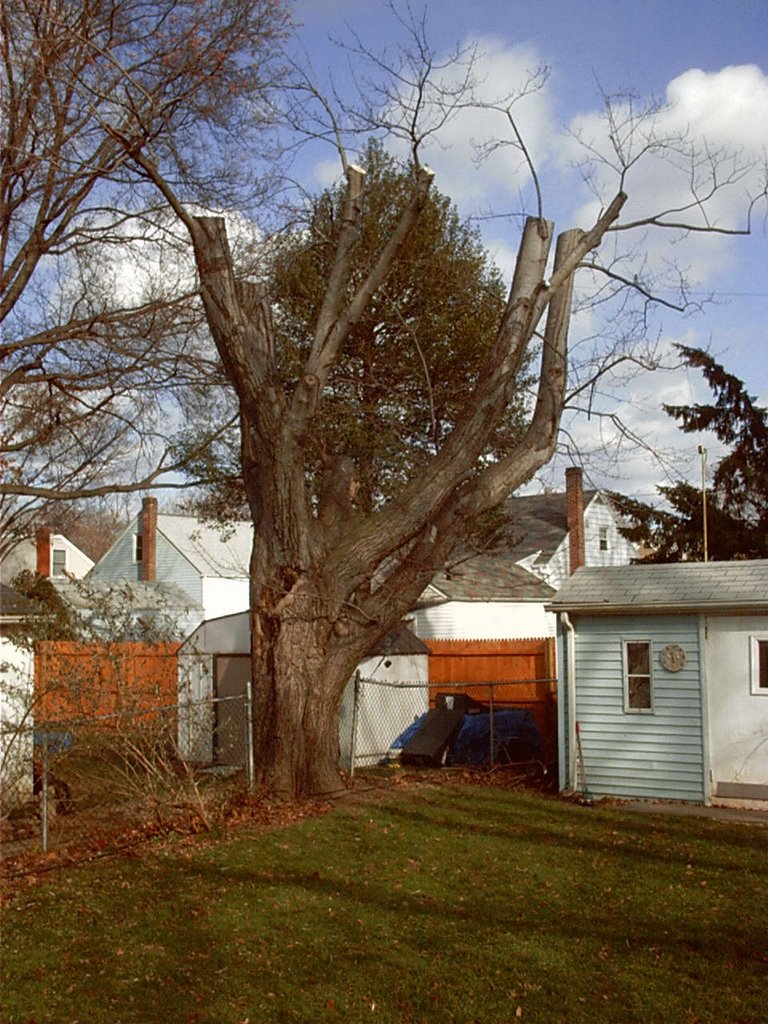
I am back in business - and have been for a week now. As you can see from the picture, my tree had a haircut. The top 20 feet were removed to provide less of a strain to the trunk. The tree is in pretty good health but has been weakened due to damage by squirrels and carpenter ants. The tree straddles my property and that of my neighbor. Neither of us wanted to get rid of the tree outright; we just want it to be safe. Neither of us needed branches falling on our kids; or even worse.

The center insulator for the G5RV is now at the very highest level this tree can now give me - 20 feet. It used to be at the 30 foot level and the tree itself used to be about 40 feet high.

It was hilarious getting the antenna rope back into the tree. I was using this thing called a "hyper dog" trainer which is basically a glorifed sling shot for tennis balls. The device was intended to allow you to chuck tennis balls for great distances; allowing your dog to chase and fetch the tennis balls, wearing itself out in the process.

I took a tennis ball and cut a slit into it. I took the antenna rope and tied it though a large ferrite bead. I inserted the bead and two, one ounce lead fishing weights inside the tennis ball. I then proceeded to attempt to shoot the tennis ball over the limb I wanted, taking the antenna rope with it. The tennis balls ended up flying well; but going in every direction except the one I wanted. Frustrated, I just took the tennis ball in my hand and just chucked it, bare handed.

It went where I wanted it to go on the first try.

In any event, my G5RV is back up. It's 10 feet lower than it used to be; but at least it's not lying on the ground anymore!

73 de Larry W2LJ

Thursday, December 01, 2005

A sad event

I had to come home from work during lunchtime today, to bring down my G5RV. Hopefully, it's only temporary. The maple tree that it is anchored to has become old and it's upper branches weak. It is a danger in a high wind situation. The tree will be topped, that is the top 15 feet or so worth of branches are going to be trimmed off and hauled away.

I won't have a good idea of what I'll be up against until I get home tomorrow night ...... maybe. To make matters worse, there is a wind advisory posted for the NorthEast for tomorrow. I was hoping to have this done tomorrow and then spend part of Saturday getting the antenna back up in the tree or maybe put some masting up if there's not enough of the tree left.

I hope it can be done soon. This leaves me with only the Butternut HF9V. Don't get me wrong - it's a fine antenna; but now I have no back up. I'm getting too close to finishing off "QSO a Day" for 2005 to have things loused up with less than a month to go just because of some tree surgery.

73 de Larry W2LJ

MOCADing - 11 months in.

As mentioned previously, at the beginning of this year, I made a resolution. Not something unrealistic, like losing 25 pounds (which I should do) or to give up smoking (which I don't do anyway). No, my resolution was to get on the radio every single blessed day of 2005, and make at least one QRP CW QSO. My motivation greatly enhanced by the fact the North American QRP CW Club offered it's "QSO a Day" award around the same time I began to contemplate undertaking this task. Talk about timing!

It's December now, and eleven months have passed with, so far, a QRP CW QSO being made each and every day. I have come to learn a few things:

First - This goal, while obtainable, seemed a lot easier to achieve than reality has borne out. I really didn't take into account the declining solar conditions at the bottom of the sunspot cycle. I didn't think that there would be nights when a QSO with someone within the state of NJ would seem like the greatest DX I have ever worked! There were evenings this past January and February, when the ionosphere was sooooooo screwed up from Coronal Mass Ejections, that a QSO with a guy some 30 miles away from me was as difficult as working the DXpedition on Kure Atoll this past fall. Luckily, I was able to work the guy 30 miles away - I never really even heard the guys on Kure all that well.

I didn't take into account things like school plays, recitals, civic meetings which eat up a huge chunk of evening "free time" (a term I use VERY loosely!). Getting home late some evenings and then running down to the basement shack got me operating when a lot of other guys were calling it quits for the night. I know we all need our sleep because we have to go to work tomorrow; but hey! I'm trying to accomplish something here! And I have found, quite remarkably, that is indeed possible to nod off during the middle of a CW QSO. There have been a number of times that my neck snapped and my head jerked as I caught myself dozing off!

I kind of thought that summer vacation was going to be a problem; but it turned out not to be. We rented a cabin at Lake George and I was able to take my K1 along with the PAC-12 antenna; and made the required QSOs. My family is very understanding (for which I love them dearly - especially my wife, Marianne); and fortunately, so was George - the owner of Stepping Stones Resort in Diamond Point, NY. (An unabashed plug for George and Stepping Stones, who were and continue to be very, very gracious).

My brother-in-law's wedding in late July was another concern. That was a hectic two days; but it turned out I had to come home the night of the rehearsal dinner as I had to be home to let our dog Jesse out to do his "business" for the night and again the next morning. This allowed me to squeeze in my QSO in for that Saturday.

Second - I didn't realize how rewarding this quest would become. Not just for making at least 365 consecutive QSOs; but also for a lot of "fringe benefits". My code speed has increased significantly. At the beginning of the year, I was comfortable at the 16 - 18 wpm range; and I could copy at up to 30 wpm for short bursts. Now, in December, I am quite comfortable in the 20 - 25 wpm range and have no problems copying in the 35 - 40 wpm range for short amounts of time until my brain cramps. And I can tell that this spiral upward will continue if I keep at this. The only downside is finding guys who can keep up a QSO at these speeds. Sadly, they seem to becoming fewer and fewer.

I am very fortunate to have a lot of friends that I have met through Amateur Radio. Some like Bob W3BBO, I have met locally. But MOCADing has allowed me to have made friends that I know only from QSOs on the air. These are genuine friends, who I have come to know and have had multiple QSOs with. It is so nice to hear a callsign and know who it is on the opposite end before making contact. There was one instance in particular, that I recall especially. I was in QSO with Jim Stafford W4QO, relatively late one evening in September. From the basement, I was able to hear my son crying in his bedroom. I immediately dropped everything to go and see what the matter was. My five year old had had a nightmare and needed some TLC, which he received. About twenty minutes later, after Joey was securely tucked back in bed, I went back to the shack to fine Jim - on frequency - patiently waiting! He was wondering what the matter was and was relieved with the explanation. He was actually on the verge of reaching out via the telephone to make sure there was no dire medical emergency. Other than the brotherhood of Ham Radio; where could you find that kind of concern and camaraderie?

And there are plenty of others like John AE5X and Gary K8KFJ, who I have come to know from working during QRP Sprints. It's always nice to run into them on the air, only to hear a "Hi Larry" come from the other side! Bob KB2FEL originally from NY and now from WV is also a good contesting "buddy". He always has a great signal and a friendly attitude. Then there are great guys like Geoff W1OH who took the time to send me information on great vacations destinations like Prince Edward Island. Then there are Tom KB3LFC and John K3WWP who I have come to know through the NAQCC and on the air. Also, there is Charles W2SH, who I found out, doesn't live very far from me. I have also come to know Lloyd K3ESE from the air and through a QRP club we both belong to, the Flying Pigs QRP Club International. Lloyd's political views and mine are like oil and vinegar - they DO NOT mix; but LL is a superb CW op. His fist is excellent and he is a joy to copy. His enthusiasm for QRP, CW, building and operating portable know no bounds. Did I mention Lloyd's sense of humor? - definitely quirky; but always amusing and funny.

Third - I have increased my knowledge of propagation. I have come to know what all these solar numbers and indexes actually mean; and I can know ahead of time whether or not it is going to be an easy go on a particular day. Directly responsible for my knowledge is Paul Harden NA5N. Reading his "plain language" articles and postings to the QRP e-mail reflectors has taken a complicated science; and has made it much more understandable.

I fully expect to make my goal; and make another 30 more QSOs to finish off December. The NAQCC is doing the award thing again in 2006; and I may actually try again. You may or may not be able to reach the goal; but I will guarantee you one thing. The attempt is truly an adventure and a learning experience; both at the same time.

See you on the air,
73 de Larry W2LJ

Wednesday, November 23, 2005

Things I am thankful for.

In keeping with Thanksgiving tradition, which is tomorrow, I am mindful and give thanks for all the wonderful gifts that God has given me. I am thankful for them all; but in particular, I am most thankful for these:

My lovely wife, Marianne.
Our two great children, Joey and Cara
My Mom and my sister; and my Dad who has since passed away
My extended family - by blood and by marriage.
My Catholic faith.
For my country, the United States.
Our dog Jesse and our cat Sadie
Our nice warm and dry house
Our jobs, that allow us to have necessary and good things.
Baseball, especially the New York Mets.
Amateur radio - the world's greatest hobby.

There are so many things to be thankful for - I can never think of them or list them all. Thank you, God, for blessing the lives of me and my family.

Friday, November 18, 2005

Giving Thanks.


It's less than a week to go until Thanksgiving. This is a day set aside, by the leaders of our country, in order to step back, take a breath and thank the Creator for the wonderful bounty He has bestowed upon the United States.

There are many out there who are uncomfortable with the abundance that has been bestowed upon us. I guess there are some out there who feel we have been given too much and that other nations have so little. There is some validity to that. The United States has been given much - but in turn, we give much in return. There has NEVER been a nation like ours, who gives and gives and gives, for the most part without asking for anything in return. Tsunami, earthquake, famine, flood, whatever ...... if it happens in another part of the world, Americans unhesitatingly open up their wallets or larders and donate whatever they can.

However, while the actions are all well and good; and very commendable, they are not enough in their own right. It is necessary for us to humble ourselves (I know .... what a concept!) and get down on our knees and thank God for the gifts He has given us. Because in the end, the wise ones know, that we can do nothing on our own. It is only by the grace and gifts from God that we are able to achieve what we achieve; and accomplish what we accomplish.

So this Thanksgiving, please put some time on the side - even if it's just a few seconds while you're shaving, dressing, taking the dog for a walk, or whatever; and from the bottom of your heart give thanks to the Almighty for the benevolence that He has deemed to bestow and continues to bestow upon us and our great country.

73 de Larry W2LJ

PS: To all the men and women in all the branches of the United States Armed Service - THANK YOU for defending our freedom and our way of life! Thank you for being there on the front lines so we can enjoy our bounty and give thanks without fear.

Friday, November 11, 2005

Whoa, Martha! Who turned off the ionosphere?

Wow! Tonight was a tough one! It was definitely like I was scraping the bottom of the QSO barrel in order to eke out a QSO to fulfill my "QSO a Day" obligation. Here it is, November 12th. I've made a QSO everyday since January and I'm getting down to the last 6 to 7 weeks of the year. I do not need the ionosphere to go haywire on me just now.

After puttng the kids to bed tonight, I went down to the shack for my nightly QSO. I got a late start because there was a new episode of SpongeBob Squarepants that the kids wanted to watch. As of 8:30 local time, I started calling CQ for an hour and a half with no takers! 40 Meters was wall to wall RTTY (yet another contest ... sigh!) and 30 Meters was pretty much dead. 80 Meters had some signals on it; but not all that many.

Around 10:30 I decided to come upstairs for a short break. When I headed down about 10 minutes later, I heard a very loud station calling CQ on 80 Meters. It was Mike Barrell WB9DLC. We've QSOed a few times before; so right then seemed as good a time as any to drop in my callsign and say "Hello". Mike and I chatted for about ten minutes, and then I let him go. He was hunting for new FISTS numbers as he is not far from achieving Century Gold, the award you earn for working 500 other FISTS members. Way to go, Mike!

73 de Larry W2LJ

Tally ho!

Last night was the third installment of the QRP-L 40 Meter Foxhunt. For those of you who are not familiar with the concept of a QRP Foxhunt, this is how it works.

We get these tiny, small clubs ........ No, No, NO !!!! No wild animals are bothered, injured or harassed. The way it goes is that two volunteer "Foxxi" get on an unnanounced frequency somewhere between 7.030 and 7.050 MHz. For the next 90 minutes, they call "CQ Fox" and then it's up for the rest of us "Hounds" to find the Fox; and have a successful exchange of RST, State, first name and output power. When the exchange has been successfully made, then and only then, can you consider yourself to have "bagged a pelt". If any of you out there have animal sensitivities and are bothered by the jargon; then I can only tell you to "Get a life". It's all in fun and there is no harm done to anything except for maybe knocking off a few charged particles up in the ionosphere.

At any rate, the current Foxunt season began three weeks ago and will continue to run every Thursday night until sometime in March 2006. Last night the Foxii were Doc KØEVZ and John W1RT, who are two very, very good QRPers. I didn't expect to hear John at all last night. He lives in Viriginia, which is too close for good communications on 40 Meters at that time of night at this time of year. I was not disappointed. I heard the pack of houds baying at him; but as expected, I heard nary a peep out of W1RT. I was disappointed, however, with Doc's signal. Doc lives in New Mexico and normally at this time of year, propagation to Texas and Louisiana and a lot of the great SouthWest is an easy hop for me.

I don't know if the ions decided to take the night off for Veteran's Day, or what. I heard absolutuely nothing of Doc or the pack of Hounds chasing him. Disappointed, I took a quick run down to 80 Meters and had a quick QSO with W9TO to at least fulfill my "QSO a Day" obligation.

With a half hour to go, I popped on back to 40 Meters and lo and behold, I was able to hear the faint whispers of Doc on the air. QSB was fast and deep, with Doc rising out of the ashes to be a solid 559; only to go to ESP levels within seconds. What made a bad situation worse was that I could hear Doc handing out exchanges to stations; but I couldn't hear any of those guys he was working! It was impossible for me to tell if Doc was working simplex (on his own frequency) or split (listiening on one frequency and transmitting on another). So I decided I was going to work split; but carefully. I started out almost simplex and then with each try I would move my transmit frequency just a touch higher and higher.

It didn't look good; but finally, with about 5 or 6 minutes left in the Hunt, Doc came back to "??LJ". I sent my call and heard it comeback, along with Doc's info. I sent mine only to hear "QRN agn pse". So I sent my information again, this time just about a WPM slower and sent each bit twice in an attempt to overcome the cruddy band conditions. I was awarded with a "Tnx Larry 72 de KØEVZ".

There's nothing like a fresh pelt hanging in the larder!

73 de Larry W2LJ

By the way, to all of you out there who have served; or are serving in the Armed Forces - "Happy Veteran's Day" !!!!! I thank you for your service to our country. These feelings of gratitude come from the heart and are not just "words" for me. I would like to especially thank a man from New Jersey who served as a Sergeant in the Signal Corps. during WWII in England, France and Germany. He was known as Master Sergeant Alexander Makoski. He is my Dad, who passed away in February 2001. I used to really enjoy his recounting of his experiences in Europe during the war.

Wednesday, November 09, 2005

Getting old .......

It is often said that as you get old the eyesight is the first to go. I have started building my ATS-3 transceiver kit ala' Steve Weber KD1JV. Working on this kit will put the above mentioned hypothesis to the test. This kit is 99% surface mount technology, or SMT as it is known.

SMT had to have been developed by masochists. The parts are so tiny that I'm pretty sure a grain of uncooked rice is bigger than some of these capacitors and resistors. All work is done with a tweezers and I have resorted to wearing one of those magnifying loupe headband thingies. My bifocals alone are not cutting muster.

The solder that Steve has supplied with the kit is so thin that it reminds me of a cat's whisker from the old crystal radio sets that I played with as a kid. Soldering is done carefully and methodically, all while trying to balance solder, soldering iron and a dental tool for holding parts down in two hands. After each component is soldered in, a visual inspecion is done with all the magnifiers flipped in place to make sure there are no solder bridges as well as no forgotten soldered joints. After the visual inspection is finished, I take an Ohmmeter and check for continuity from the component just soldered in to whatever pad or device that it is connected to.

Construction is definitely taking longer this way; but I want to make sure that if the radio doesn't hum on initial power-up, that it won't be due to some stupid soldering mistake that I may have unwittingly made.

If I can still see straight when I'm finished with this project; then I will consider myself to be a very fortunate Ham, indeed!

73 de Larry W2LJ

Tuesday, November 08, 2005

Arrrrrrrrrrgggggghhhhhh !!!!!!!!!!!

The people of this state (New Jersey) went and elected yet ANOTHER tax and spend Democrat to the Governor's office. I swear, a rattlesnake could run for office in this state, put a "D" by his name; and would be elected.

You know what the biggest "Jersey Joke" is? It's not the Turnpike, it's not the pollution, it's the people!

A Good Time

I had an extremely good time on the air last night! I flipped the K2 on and tuned in 40 Meters. Once again, I was greeted with a near silent hiss of a quiet backgound. Every time I turn to 40, I'm afraid that I'm going to be confronted with that buzzsaw of noise again. Breathing a gentle sigh of relief, I turned the K2 off and plugged in the Rockmite 40. After a few CQs, I was granted the opportunity for a QSO. The station I was working was a brand new QRPer who was trying out his new SW40 We were both 559 until the band changed a bit; and QSB took over the frequency. It was nice to see my 500 mWatts get out into the Midwest; and to see the radio still works.

About a half an hour later, I jumped into the fray of the Adventure Radio Society's monthly Spartan Sprint. That was good time as well. Twenty Meters wasn't the greatest, yielding only 3 QSOs. 40 and 80 Meters were great, though. I made 18 QSOs on each band. It was nice to hear the callsigns of fellow QRPers who have become friends; as well as new callsigns, perhaps those just being bitten by the bug?

At any rate, as a really "in it for the fun" kind of contester, I was pleased with my tally of 39 QSOs in two hours. The QRP Sprints are a lot of fun for me; and I look forward to them each and every month.

73 de Larry W2LJ

Monday, November 07, 2005

The Quiet That Was

The quiet that was ....... is back! Yay!

For the past week, the nice quiet background that I have come to know and love on 40 Meters is back. I have no idea as to why or wherefore; but the month of October saw an ambient noise level of S3 to S5 on 40 Meters. It made the band all but unusable. Only the strongest of signals were copyable; and this is not the "bread and butter" of a QRPer. Our strength is in our above average skill in copying signals that are "less than optimum".

There is a house across the street from us that is being renovated for resale. The folks who lived there left to go live with one of their children. It seems that workers have been in and out of there constantly, getting the place ready for resale. I have no proof; but I feel they must have been using something during their labors that was generating a ton of RFI. Now that the house is almost complete, the noise has seemed to have diminished.

Whether I am correct or not in my assumptions is immaterial. The noise is gone for now; and I hope it's for good!

Monday, October 31, 2005

My comments

My comments to the proposal by the FCC to eliminate the Morse Code requirement from Amateur Radio exams:

Gentlemen,

There have been may persuasive arguments put before the Commission as to whether or not the Morse Code requirement should be kept as part of the examination process. It appears the Commission deems that Morse Code requirement is an anachronism that no longer has any validity and should be eliminated. In my opinion, I believe the Commission is being shortsighted and that we should maintain the requirement.

Many amateurs and organizations point to the fact that the military and other professional communications services have abandoned Morse Code. To some extent, this is true. But those services have gone on to highly advanced satellite communications systems. Amateur radio operators, at least for the majority, have not. Our communications depend mostly on voice or radiotelegraphy in the High Frequency portion of the electromagnetic spectrum. Radiotelegraphy has proved itself to be the most reliable method of communications using those portions of the spectrum that we, for the most part are relegated to. During times of "radio blackout" due to increased sunpsot or other types of geomagnetic activity, often Morse Code communications using Continuous Wave transmission is the only permissible means of radio communications. It should also be noted that the most "cutting edge" frontiers of Amateur Radio - meteor scatter, spread spectrum, low power and microwave and weak signal communications all rely on Morse Code and CW as the "mode of choice" in completing communications.

The Commission has expressed a concern that the providing of Morse Code testing presses an "undue burden" on the part of the VE examining teams. I would like to say, that in over ten years personal experience as a Volunteer Examiner, my team and I never found administering the Morse Code exam to be a burden. In fact, we took extreme pleasure in administering the exam and watching untold numbers of candidates pass. Again, in my personal experience of over a decade as an examiner, I have never come across an individual who was unable to pass the exam given enough time to properly prepare.

The argument has been proposed that the Morse Code exam is a roadblock, preventing untold numbers of qualified individuals from entering the Amateur Radio service. I believe this claim to be unsubstantiated at best; and just another "urban myth" at worst. The Commission has indeed licensed children as young as the age of six or seven as Radio Amateurs. While this is the exception rather than the rule, I would suggest this points to the fact that anyone with a fair amount of ambition, desire and discipline can master a 5 word per minute Morse Code exam. For those who honestly and truly have a valid medical reason for being unable to complete the Morse portion of the test, the Commission had already provided recourse via the medical waiver. I would like the supporters of this argument substantiate their claims with some kind of documentation. It is not proper to make "wild claims" before the Commission without proper documentation. Furthermore, it would seem inappropriate for the Commission to accept these unproven claims as the rule; rather than the exception.

Were the Commission to delegate the Amateur Radio Service as some non-essential radio service such as CB, GMRS or the FRS then I would accept the hypothesis that the Morse Code exam is of little value and should be eliminated. But clearly, the Commission has repeatedly avowed the importance of the Amateur Radio Service and the need for it's continued health and well being. I would hope the Commission would agree with me that to maintain that health and vitality; that it is paramount to not lower standards; but on the other hand to maintain or increase them.

Respectfully submitted,

Saturday, October 15, 2005

My favorite band

I'm going to be upfront. I hate the Fall and Winter! There, I've said it. I hate the cold weather and I hate even the approach of cold weather. I hate the Winter and I despise Autumn because it means Winter is coming. I know, I've heard all the excuses - turning leaves, pumpkins, holidays, etc, etc, etc. Bah! I hate the cold and the lack of daylight. Fall and Winter are nothing but misery for me - with one exception .........

One of the only good things about this time of year is that 80 Meters comes back for the season. This is my favorite band; or at least it's in a tie with 40 Meters for that role. And fortunately 80 Meters comes into it's own at this time of year.

In Spring and Summer, along with the increased daylight and warmer weather also comes thunderstorms and aggravated atmospherics. When 80 Meters becomes noisey; I know warm weather it on the way. So, my favorite band disappears for just about 6 months except for a rare evening here and there.

But now, in October, the band pops up its' head again and becomes a joy to use. There is hardly any QRN and the signals pop out of nowhere all the way to 10 or even 20 over 9. Both my G5RV and Butternut HF9V vertical load quite readily on 80 Meters with no problems. I can ragchew to my heart's content and even work some DX here and there. All the "close in" states become more easy to work, once again.

This year, the QRP Foxhunt Committee had decided to run QRP Foxhunts on both 40 and 80 Meters this Winter season. I have signed up to be a Fox for an 80 Meter hunt or two. I hope they let me; it would be a blast!

73 de Larry W2LJ

Monday, October 10, 2005

It always amazes me ........

It never fails to amaze me .....

There are nights that I can be sitting behind the rig; and I seem to be calling "CQ" endlessly on or about the QRP watering holes with nary a nibble. Then I'll go down toward the bottom of the band edge and I'll hear some DX and will chase it down with not much trouble.

That was the way it was tonight. I was calling "CQ" for what seemed to be an eternity on 80 and 40 Meters. I thought I was going to nod off; I was getting so bored! I then spun the frequency knob towards the bottom of 40 Meters and heard SP3EPK calling "CQ" from Poland. I gave him a shot and he answered me on the third try!

I couldn't raise a stateside station; but yet somehow my 5 Watts made it to Poland and I got a 579 signal report to boot! Thanks, Les!

73 de Larry W2LJ

Wednesday, October 05, 2005

Code Practice

Are you tired of listening to the same old Morse Code practice tapes? Do you want to listen to some fun Morse Code and improve your speed - even if you're a grizzled old veteran? I have a solution for you; and best of all, it's all pretty much free!

The first thing you have to do is go to http://www/g4fon.com and download the program "Koch Trainer" for yourself. It's freeware that was developed and is maintained by Ray Goff G4FON.
This program will not only aid in teaching Morse Code to the neophyte; but it will also translate text files into audio files that the experienced operator can make use of.

I went to the Gutenburg Project and downloaded "The Legend of Sleepy Hollow" as a text file. I opened up "Koch Trainer" selected the speed I wanted and set the program to record the session as an audio (.wav) file. I then had the trainer play my text file and when it was finished, I converted the .wav file to mp3 format and then burned it to a CD.

Perfect for playing in the CD player in my car during the ride back and forth to work! This is the Amateur Radio version of "Books on Tape"!

73 de Larry W2LJ

Saturday, October 01, 2005

I can't hear you .......... !!!!

The current big DXpedition is to Kure Island which is at the Northwestern most end of the Hawaiian chain. The callsign they are using is K7C. They've been on that island for about 5 days now and I still haven't even heard them yet! I'm hearing the pile-ups; but not the DXpeditioners themselves. They've had thousands of QSOs according to the official Website - mostly with Japanese Hams, it seems.

Well, I've printed out some propagation forcasts using W6ELprop software. It looks like my best chance will be during the middle of the night; perhaps 3 or 4 in the morning! I'll set the alarm and we'll see. Is this sick, or what?

73 de Larry W2LJ